
Uncovering the Truth: The Hidden Lives of Neanderthals
Explore the history and myths of Neanderthals. Learn how modern science changed our view of these ancient human cousins in this B1 text.
Title
Uncovering the Truth: The Hidden Lives of NeanderthalsSeo_intro
Explore the history and myths of Neanderthals. Learn how modern science changed our view of these ancient human cousins in this B1 text.
References
Parts
- Part_number: 1Text:
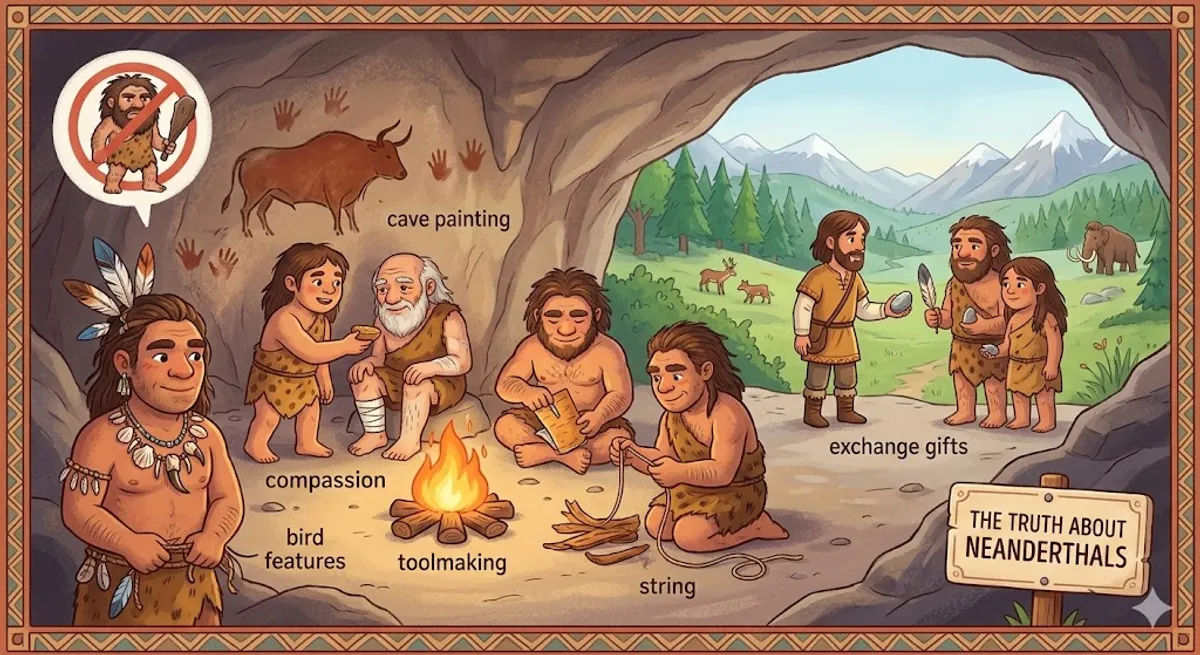
In 1856, workers in a German cave found strange fossils. These bones belonged to a species called Neanderthals, the first extinct humans known to science. At that time, many people believed the Earth was very young. However, scientists were starting to understand evolution. Unfortunately, early ideas about Neanderthals were very negative. They were called 'dim-witted oafs.' Popular drawings showed them as hairy creatures carrying clubs, walking with a stoop. People thought they were inferior to modern humans, or Homo sapiens. These misconceptions lasted for a long time, but they did not match the actual skeletal findings discovered later.
Vocabulary_explanations
Fossils: The remains or impression of a prehistoric organism preserved in petrified form.Extinct: No longer in existence; having no living representative.Evolution:The process by which different kinds of living organisms are thought to have developed from earlier forms.
Dim-witted: Not very intelligent; slow to understand things.Oafs: Stupid, uncultured, or clumsy people.Clubs: Heavy sticks with a thick end, used as a weapon.Stoop: A posture in which the head and shoulders are habitually bent forward.Inferior: Lower in rank, status, or quality.Misconceptions: Views or opinions that are incorrect because they are based on faulty thinking.Skeletal: Relating to or functioning as a skeleton.Questions:- Question: Neanderthals were discovered in Germany in 1856.Options:
- True
- False
Answer: True - Question: Early illustrations often showed Neanderthals carrying what?Options:
- A) Books
- B) Clubs
- C) Metal tools
Answer: B) Clubs - Question: Early scientists correctly identified Neanderthals as highly intelligent.Options:
- True
- False
Answer: False
- Part_number: 2Text:
Over the next century, archaeologists found the remains of over 300 Neanderthals. We now know they were quite different from us. Neanderthals were shorter and more muscular than modern humans. They had deeper-set eyes and larger bodies, which meant they needed more energy, or calories, every day. Surprisingly, their brains were actually slightly larger than ours. For over 350,000 years, they lived across Europe and Western Asia. For their final 10,000 years, they lived in the same areas as Homo sapiens. Recent finds show that their lives were much more complex than we initially suspected.
Vocabulary_explanations
Archaeologists: People who study human history and prehistory through the excavation of sites.Remains: The parts of a human or animal body that are left after it has died.Muscular: Having well-developed muscles; strong.Deeper-set: Positioned further back in the face (referring to eyes).Calories: Units of energy used to measure the energy value of food.Slightly: To a small degree; not much.Western Asia: The subregion of Asia that includes countries like Iraq, Iran, and Turkey.Areas: Regions or parts of a town, country, or the world.Complex: Consisting of many different and connected parts.Initially: At the beginning; first.Questions:- Question: Neanderthals had smaller brains than modern humans.Options:
- True
- False
Answer: False - Question: Compared to modern humans, Neanderthals were generally:Options:
- A) Taller
- B) Shorter and more muscular
- C) Thinner
Answer: B) Shorter and more muscular - Question: How long did Neanderthals live across Europe and Asia?Options:
- A) 10,000 years
- B) 6,000 years
- C) Over 350,000 years
Answer: C) Over 350,000 years
- Part_number: 3Text:
Neanderthals were not just strong; they were also compassionate. In the 1950s, scientists found a skeleton in Iraq of a man with a severed arm and leg injuries. He was also partially blind and deaf. Despite these disabilities, he lived for a long time. This suggests his community provided extensive support to help him survive. In a French cave, another old Neanderthal was found who had lost most of his teeth and probably needed help eating. Both sites showed signs of intentional burial. This proves that Neanderthals cared for their sick and honored their dead, moving beyond simple survival.
Vocabulary_explanations
Compassionate: Feeling or showing sympathy and concern for others.Skeleton: An internal or external framework of bone, cartilage, or other rigid material.Severed: Having been cut off or sliced away.Partially: Only in part; to a limited extent.Disabilities: Physical or mental conditions that limit a person's movements, senses, or activities.Extensive: Covering or affecting a large area; great in amount.Intentional: Done on purpose; deliberate.Burial: The act of placing a dead body in a grave or tomb.Honored: Regarded with great respect.Survival: The state or fact of continuing to live or exist, especially in spite of difficult conditions.Questions:- Question: Scientists found evidence of a Neanderthal who survived serious injuries.Options:
- True
- False
Answer: True - Question: What does the discovery of burials suggest about Neanderthals?Options:
- A) They were very violent
- B) They cared for their dead
- C) They lived alone
Answer: B) They cared for their dead - Question: Neanderthals were likely able to treat the sick or injured.Options:
- True
- False
Answer: True
- Part_number: 4Text:
Neanderthals were also very skilled hunters and toolmakers. For a long time, people thought they only used 'brute force' to hunt large animals. However, traces of fish scales and feathers on their tools suggest they also caught small game. They likely used snares and fast projectiles to hunt. They were clever enough to make glue by heating birch bark to attach handles to their tools. They also used fire to shape hard wooden sticks and created strong string from bark fibers. These advanced skills show that they were intelligent and capable of solving difficult problems in their environment.
Vocabulary_explanations
Brute force: Direct physical strength or violence.Traces: Very small amounts of something.Scales: Small, flat plates covering the skin of fish and reptiles.Game: Wild mammals or birds hunted for food or sport.Snares: Traps for catching birds or animals, typically having a noose of wire or cord.Projectiles: Objects propelled through the air, especially as a weapon.Birch bark: The outer layer of a birch tree.Attach: To join or fasten something to something else.Fibers: Thread-like pieces of a plant or animal tissue.Environment: The surroundings or conditions in which a person, animal, or plant lives.Questions:- Question: Neanderthals only hunted large animals like mammoths.Options:
- True
- False
Answer: False - Question: What did Neanderthals use to make glue?Options:
- A) Animal skin
- B) Heated birch bark
- C) Fruit juice
Answer: B) Heated birch bark - Question: Neanderthals used fire to help them make tools.Options:
- True
- False
Answer: True
- Part_number: 5Text:
The most surprising discovery is that Neanderthals likely had a sense of art. They decorated themselves with bird feathers and made jewelry from shells and eagle talons. Some evidence even suggests they created cave paintings in Spain. Perhaps most importantly, we now know that Neanderthals and Homo sapiens interbred. Most modern humans today carry up to 4% Neanderthal DNA. Instead of disappearing suddenly, they may have been absorbed into larger human populations. Today, scientists view human evolution not as a simple tree, but as a 'braided stream' where different groups met and joined together.
Vocabulary_explanations
Jewelry: Personal ornaments, such as necklaces or rings.Talons: The claws of a bird of prey.Interbred: To breed or produce offspring with another species or group.D N A: A molecule that carries genetic information in living things.Disappearing: Ceasing to be visible or to exist.Absorbed: Taken in or soaked up; made part of a larger whole.Populations: All the inhabitants of a particular area.Evolution: The gradual development of something, especially from a simple to a more complex form.Braided stream: A river system with many small channels that separate and rejoin.Joined: Connected or fastened together.Questions:- Question: Modern humans have no genetic connection to Neanderthals.Options:
- True
- False
Answer: False - Question: What evidence suggests Neanderthals liked art or decoration?Options:
- A) Eagle talons and shells
- B) Television sets
- C) Metal rings
Answer: A) Eagle talons and shells - Question: What is the 'braided stream' theory of evolution?Options:
- A) A way to catch fish
- B) Groups separating and rejoining over time
- C) A type of ancient clothing
Answer: B) Groups separating and rejoining over time
Recommended for You
Pickford, Michigan
Discover the amazing history of Pickford, Michigan! Read about brave pioneers, wild bears, massive school fires, and wor...
AI Hallucinations: Why Leading Questions Cause Trouble
Discover what AI hallucinations are and learn why asking leading questions can make artificial intelligence give you inc...
The Mystery of Pickford: An AI Hallucination
NOTE: THIS AN EXAMPLE OF AN AI HALLUCINATION IN RESPONSE TO LEADING QUESTIONS