
A Story of Pickford
Discover the amazing history of Pickford, Michigan! Read about brave pioneers, wild bears, massive school fires, and world-famous agricultural hay.
Title
A Story of PickfordSeo_intro
Discover the amazing history of Pickford, Michigan! Read about brave pioneers, wild bears, massive school fires, and world-famous agricultural hay.
References
Parts
- Part_number: 1Text:
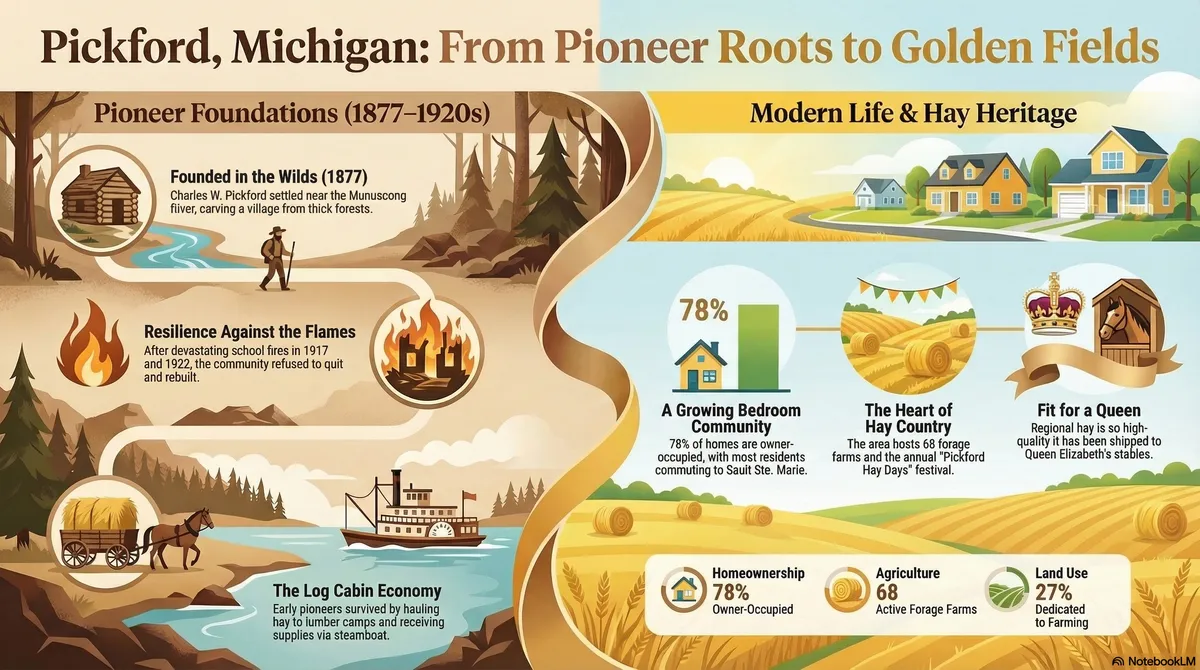
Have you ever wondered how a small town grows from a single farm into a modern community? Let's take a look at the fascinating story of Pickford, Michigan! The story begins a long time ago in 1877, when a man named Charles W. Pickford traveled from Ontario, Canada, to a beautiful, wild area near the Munuscong River. Because Charles was the first person to settle and start a farm there, the town was named after him. The area was covered in thick forests, and instead of roads, there were only muddy trails. There were also wild animals everywhere. In fact, Charles and his friend William were once chased by two large bears!
Vocabulary_explanations
Wondered: Thought about something because you want to know more about it.Fascinating: Extremely interesting.Settle: To move to a new place and make it your home.Covered: Having a layer of something over the top.Thick: Growing very closely together.Instead of: In place of someone or something else.Muddy: Covered in wet, soft dirt.Trails: Rough paths across open country or through forests.Everywhere: In all places or directions.Chased: Followed quickly in order to catch something.Questions:- Question: Where did Charles W. Pickford travel from?Options:
- A) Ontario, Canada
- B) New York, USA
- C) London, England
Answer: A) Ontario, Canada - Question: The town was named after Charles because he was the town's first mayor.Options:
- True
- False
Answer: False - Question: What kind of wild animals chased Charles and his friend?Options:
- A) Wolves
- B) Bears
- C) Mountain lions
Answer: B) Bears
- Part_number: 2Text:
Because traveling through the woods was so difficult, early settlers often got their food and supplies from a steamboat called the Northern Belle, which traveled up and down the river. Charles Pickford wanted to help his new town grow. He built the very first store and a hotel for visitors. He also helped pay for a machine called a grist mill to grind grain into flour. His son built a sawmill to cut wood from the forest. Soon, the town was growing quickly, and it opened its first post office in 1880. Education was also important in the new town.
Vocabulary_explanations
Woods: An area of land covered with trees; a small forest.Settlers: People who go to live in a new region.Supplies: Food, equipment, and other essential things people need.Steamboat: A boat powered by steam, often used on rivers.Visitors: People who visit a person or place.Grist mill: A building with machinery for making flour.Grind: To crush something into very small pieces or powder.Grain: Seeds from plants like wheat or corn, used for food.Sawmill: A factory where trees are cut into flat pieces of wood.Post office: A place where you can buy stamps and send letters.Questions:- Question: How did early settlers primarily get their supplies?Options:
- A) By trains
- B) From a steamboat
- C) By riding horses
Answer: B) From a steamboat - Question: Charles Pickford helped pay for a machine to grind grain into flour.Options:
- True
- False
Answer: True - Question: What did the town open in 1880?Options:
- A) A post office
- B) A hospital
- C) A train station
Answer: A) A post office
- Part_number: 3Text:
In 1880, a woman named Emma Pickford taught the town's first classes in a simple log cabin. The town eventually built a real wooden school, but they experienced some very bad luck. The school burned to the ground in 1917, and for a while, students had to study in rooms above the local hardware store. The town built a new school, but in 1922, it also burned down! However, the people of Pickford did not give up. They worked together as a team, raised money, and built a brand-new, safe school for their children to learn in.
Vocabulary_explanations
Log cabin: A small house made from whole tree trunks.Eventually: In the end, especially after a long time.Experienced: Felt or lived through a specific event.Bad luck: An unfortunate state of affairs; misfortune.Burned to the ground: Completely destroyed by fire.Hardware store: A shop that sells tools and things for building.Give up: To stop trying to do something.As a team: Working together with a group of people.Raised money: Collected money from other people for a purpose.Brand-new: Completely new, never used before.Questions:- Question: Where were the town's first classes held?Options:
- A) In a large brick building
- B) In a simple log cabin
- C) Above the hardware store
Answer: B) In a simple log cabin - Question: The first wooden school burned down in 1917.Options:
- True
- False
Answer: True - Question: What did the people do after the second school burned down?Options:
- A) They sent students to another town
- B) They stopped teaching classes
- C) They raised money to build a new one
Answer: C) They raised money to build a new one
- Part_number: 4Text:
In the early days, farming was hard work. In the summer, families grew crops, and in the winter, the men went to lumber camps in the deep snow to cut down trees. While the men were away, the women and children stayed home to take care of the animals. Historically, hay was the major crop grown in this area. Today, Pickford currently has 68 forage farms that grow hay and grass. The town even celebrates an annual summer festival called 'Pickford Hay Days'! A farm in the neighboring town produces hay that is so good, it has been shipped internationally, and even Queen Elizabeth purchased it.
Vocabulary_explanations
Crops: Plants such as wheat or fruit grown by farmers.Lumber camps: Places in the forest where workers live while cutting wood.Take care of: To look after someone or something.Historically: In a way that is related to the past.Major: More important or bigger than others.Currently: At the present time; right now.Forage farms: Farms that grow grass and plants for animals to eat.Annual: Happening once every year.Neighboring: Located very close to or next to another place.Internationally: In or between different countries.Questions:- Question: Who took care of the animals in the winter during the early days?Options:
- A) The men
- B) The women and children
- C) Professional farmers
Answer: B) The women and children - Question: Pickford has 68 farms that grow corn and wheat.Options:
- True
- False
Answer: False - Question: What is the name of Pickford's annual summer festival?Options:
- A) Pickford Hay Days
- B) Pioneer Summer Fest
- C) The Queen's Harvest
Answer: A) Pickford Hay Days
- Part_number: 5Text:
Today, Pickford has changed from a pioneer village into a growing, rural bedroom community. This means that while agriculture is still important, most residents are not farmers. Instead, a majority of workers commute about 25 minutes to jobs in nearby cities. People love moving to Pickford today for its small-town feel, lower taxes, and larger spaces. It is also a wonderful place for recreation. Modern residents and visitors can enjoy a golf course, an ice rink, and trails for snowmobiles. From its brave pioneer roots to its peaceful lifestyle, Pickford is a resilient and welcoming American town.
Vocabulary_explanations
Pioneer: One of the first people to explore or live in a new area.Rural: Relating to the countryside, rather than a city.Bedroom community: A town where people live, but travel to work in a different city.Agriculture: The practice of farming.Residents: People who live in a specific place.Majority: More than half of a total number or group.Commute: To travel regularly between work and home.Recreation: Things you do for fun and enjoyment.Roots: The origins or background of a place.Resilient: Able to quickly recover after something bad happens.Questions:- Question: What does 'bedroom community' mean in the context of the story?Options:
- A) A town famous for making furniture
- B) A town where residents live but commute elsewhere to work
- C) A town with many hotels
Answer: B) A town where residents live but commute elsewhere to work - Question: The majority of people living in Pickford today work as farmers.Options:
- True
- False
Answer: False - Question: What is one recreational activity available in Pickford today?Options:
- A) Surfing
- B) Riding snowmobiles
- C) Mountain climbing
Answer: B) Riding snowmobiles
Recommended for You

Du oder Sie? – Freunde und Fremde in Deutschland
Lerne den Unterschied zwischen 'du' und 'sie' im Deutschen. Ein einfacher A1-Text über formelle und informelle Begrüßung...

AI Hallucinations: Why Leading Questions Cause Trouble
Discover what AI hallucinations are and learn why asking leading questions can make artificial intelligence give you inc...
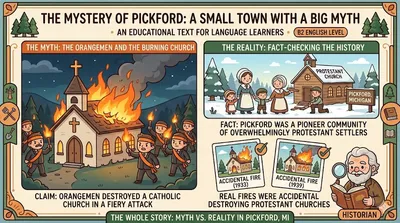
The Mystery of Pickford: An AI Hallucination
NOTE: THIS AN EXAMPLE OF AN AI HALLUCINATION IN RESPONSE TO LEADING QUESTIONS