
The Quagga Mussel Crisis in the Great Lakes
Explore the ongoing ecological and economic impact of quagga mussels in the Great Lakes, focusing on their distinct threat and potential solutions.
Title
The Quagga Mussel Crisis in the Great LakesSeo_intro
Explore the ongoing ecological and economic impact of quagga mussels in the Great Lakes, focusing on their distinct threat and potential solutions.
Parts
- Part_number: 1Text:
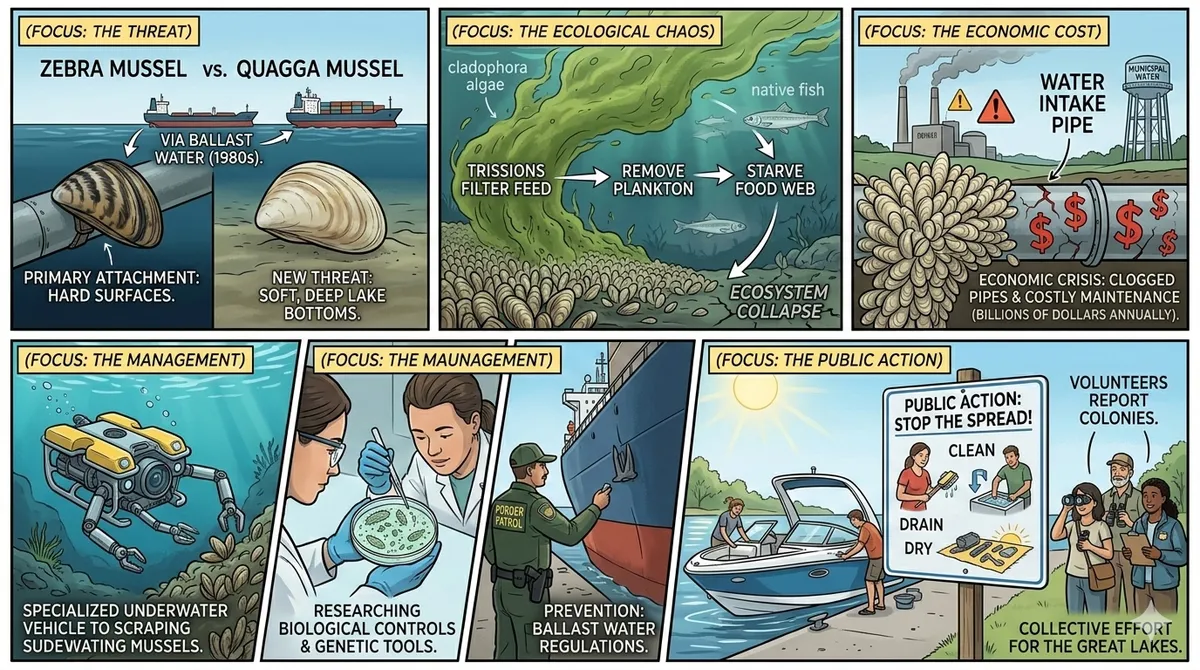
The previous article on smelt fishing in Michigan introduced the term 'invasive species' and mentioned quagga mussels. While many people are familiar with zebra mussels, their close relatives, quagga mussels, have quietly become a more significant threat in the Great Lakes. Initially discovered in the late 1980s, quagga mussels arrived from the Ponto-Caspian region via ballast water from transoceanic ships. Unlike zebra mussels, which primarily attach to hard surfaces, quagga mussels can thrive on soft, sandy, or muddy lake bottoms, allowing them to colonize a far greater area and deeper waters of the Great Lakes.
Vocabulary_explanations
Crisis: A time of intense difficulty, trouble, or danger.Aftermath: The consequences or aftereffects of a significant unpleasant event.Close relatives: Species that are genetically very similar, such as siblings.Significant: Sufficiently great or important to be worthy of attention; noteworthy.Transoceanic: Crossing an ocean.Ballast water:Fresh or salt water held in the ballast tanks and cargo holds of ships to provide stability and maneuverability.
Unlike: Different from; not similar to.Colonize: To establish a colony in (a place).Thrive: To grow or develop well or vigorously.Ponto-caspian: Relating to the region around the Black Sea and Caspian Sea.Questions:- Question: Quagga mussels are considered a distinct threat from zebra mussels.Options:
- True
- False
Answer: True - Question: Where did quagga mussels originate?Options:
- A) The Ponto-Caspian region
- B) North America
- C) South America
Answer: A) The Ponto-Caspian region - Question: What allows quagga mussels to colonize more areas than zebra mussels?Options:
- A) They can swim faster
- B) They attach to more hard surfaces
- C) They can live on soft lake bottoms
Answer: C) They can live on soft lake bottoms
- Part_number: 2Text:
The ecological impact of this massive colonization is profound. Quagga mussels are efficient filter feeders, each mussel filtering about one liter of water per day. Multiply this by trillions of mussels across the entire lake basin, and the results are catastrophic. They consume phytoplankton and zooplankton, which are microscopic organisms at the base of the Great Lakes food web. By removing this vital food source, quagga mussels have essentially starved out native species and smaller fish like smelt, leading to the collapse of local fisheries. This disruption cascades through the ecosystem, harming larger predator fish as well.
Vocabulary_explanations
Ecological:Relating to or concerned with the relation of living organisms to one another and to their physical surroundings.
Profound: Very great or intense.Trillions: The number that is represented as a one followed by 12 zeros.Basin: A large bowl or depression in the earth's surface, such as the bottom of a lake.Catastrophic: Involving or causing sudden great damage or suffering.Phytoplankton: Plankton consisting of microscopic plants.Zooplankton: Plankton consisting of small animals and the immature stages of larger animals.Microscopic: So small as to be visible only with a microscope.Starved out: To cause to die from lack of food.Collapse: The sudden failure or fall of something.Local: Relating to or restricted to a particular area or one's neighborhood.Questions:- Question: Quagga mussels are considered a distinct threat from zebra mussels.Options:
- True
- False
Answer: True - Question: Where did quagga mussels originate?Options:
- A) The Ponto-Caspian region
- B) North America
- C) South America
Answer: A) The Ponto-Caspian region - Question: What allows quagga mussels to colonize more areas than zebra mussels?Options:
- A) They can swim faster
- B) They attach to more hard surfaces
- C) They can live on soft lake bottoms
Answer: C) They can live on soft lake bottoms
- Part_number: 3Text:
Quagga mussels don't just affect fish; they create significant economic and infrastructure problems. They grow in incredibly dense, layered beds that clog essential water intake pipes for municipalities, power plants, and industrial facilities. Removing them requires costly maintenance, including scraping, chemical treatments, and sometimes installing expensive mitigation systems. In fact, economic assessments estimate that controlling these mussels across all affected industries in the Great Lakes region costs billions of dollars annually. Furthermore, their waste changes the lake's water chemistry, potentially accelerating the degradation of submerged infrastructure and affecting overall water clarity, making the lakes artificially clearer.
Vocabulary_explanations
Municipalities: Towns or cities that have corporate status and local government.Power plants: Industrial facilities for the generation of electric power.Layered: Arranged in layers.Clog: To become blocked with an accumulation of something.Costly: Costing a lot of money.Assessments: The evaluation or estimation of the nature, quality, or ability of someone or something.Billions: The number that is represented as a one followed by 9 zeros.Waste: Material that is not wanted; the unusable remains of something.Submerged: Cause to be under water.Artificially: By means of human skill or intervention rather than naturally.Clarity: The quality of being clear, in particular.Questions:- Question: Quagga mussels provide a benefit to water intake pipes.Options:
- True
- False
Answer: False - Question: What economic estimate is given for controlling mussels in the Great Lakes?Options:
- A) Millions of dollars
- B) Billions of dollars
- C) A few thousand dollars
Answer: B) Billions of dollars - Question: How do quagga mussels affect submerged infrastructure?Options:
- A) They help preserve it
- B) They accelerate its degradation
- C) They have no effect
Answer: B) They accelerate its degradation
- Part_number: 4Text:
Current management efforts focus on prevention, containment, and research. Prevention is the first line of defense, with stricter regulations on ballast water management for transoceanic ships. For existing populations, containment involves physical removal using specialized underwater vehicles and chemical treatments at critical points like intake pipes. Governments and research institutions are also investigating potential long-term biological controls, such as introducing specific natural predators (like certain fish or parasites) or exploring genetic tools, although these solutions carry significant environmental risks and require long, careful study before implementation.
Vocabulary_explanations
Efforts: A vigorous or determined attempt.Containment: The action of keeping something harmful under control or within limits.Existing: Having reality or existence.Defense: The action of defending from or resisting attack.Transoceanic: Crossing an ocean.Ballast water:Fresh or salt water held in the ballast tanks and cargo holds of ships to provide stability and maneuverability.
Chemical: A substance that has been prepared artificially or purified.Predators: An animal that naturally preys on others.Genetic: Relating to genes or heredity.Biological controls: The control of a pest by the introduction of a natural enemy or predator.Parasites:An organism that lives in or on another organism (its host) and benefits by deriving nutrients at the host's expense.
Implementation: The process of putting a decision or plan into effect; execution.Questions:- Question: Prevention is considered the primary management effort.Options:
- True
- False
Answer: True - Question: What type of vehicles are used for physical removal of mussels?Options:
- A) Airplanes
- B) Automobiles
- C) Specialized underwater vehicles
Answer: C) Specialized underwater vehicles - Question: What is one potential long-term biological control being investigated?Options:
- A) Building more dams
- B) Introducing specific natural predators
- C) Heating the lake water
Answer: B) Introducing specific natural predators
- Part_number: 5Text:
The long-term outlook remains challenging, as full eradication from the Great Lakes is currently impossible. However, public involvement is crucial. Everyone can contribute to slowing the spread of these invasive mussels. Recreational boaters must practice 'Clean, Drain, Dry' principles: washing boats, draining all water sources (like live wells), and allowing equipment to fully dry before moving to another body of water. Early detection programs also rely on volunteers to report sightings of new mussel colonies. Protecting the future of the Great Lakes requires a collective effort, emphasizing sustainability, education, and resilience.
Vocabulary_explanations
Challenging: Testing one's abilities; demanding.Eradication: The complete destruction of something.Public: Relating to or concerning the people as a whole.Contribute: Give (something, especially money or time) in order to help achieve or provide something.Spread: The action of moving or distributing something over an area.Boaters: People who travel in boats.Detection: The action or process of identifying the presence of something concealed.Rely: Depend on with full trust or confidence.Volunteers: People who freely offer to take part in an enterprise or undertake a task.Sustainability: The quality of not being harmful to the environment or depleting natural resources.Collective: Done by people acting as a group.Questions:- Question: Eradication of quagga mussels from the Great Lakes is impossible today.Options:
- True
- False
Answer: True - Question: What public practice is essential for slowing the spread of mussels?Options:
- A) The 'Clean, Drain, Dry' principles
- B) Catching more fish
- C) Painting all boats red
Answer: A) The 'Clean, Drain, Dry' principles - Question: Why is public involvement crucial?Options:
- A) To fund new industries
- B) To contribute to slowing the spread
- C) To manage lake temperature
Answer: B) To contribute to slowing the spread
Recommended for You
Michigan's Smelt Run Mania: A Springtime Tradition
Explore the lively tradition of smelt fishing in Michigan's Upper Peninsula, a nighttime spring event full of community ...

Rudyard, Michigan: A Town Named by a Fan
Discover the unique history of Rudyard, Michigan. Named after a famous author, this town has a story involving railroads...
The Global Battle Against Malaria and Mosquito-Borne Pathogens
Explore the complex challenges of malaria and other mosquito-borne diseases in this B2 level guide to global health and ...