
Michigan's Smelt Run Mania: A Springtime Tradition
Explore the lively tradition of smelt fishing in Michigan's Upper Peninsula, a nighttime spring event full of community spirit and cold water.
Title
Michigan's Smelt Run Mania: A Springtime TraditionSeo_intro
Explore the lively tradition of smelt fishing in Michigan's Upper Peninsula, a nighttime spring event full of community spirit and cold water.
Parts
- Part_number: 1Text:
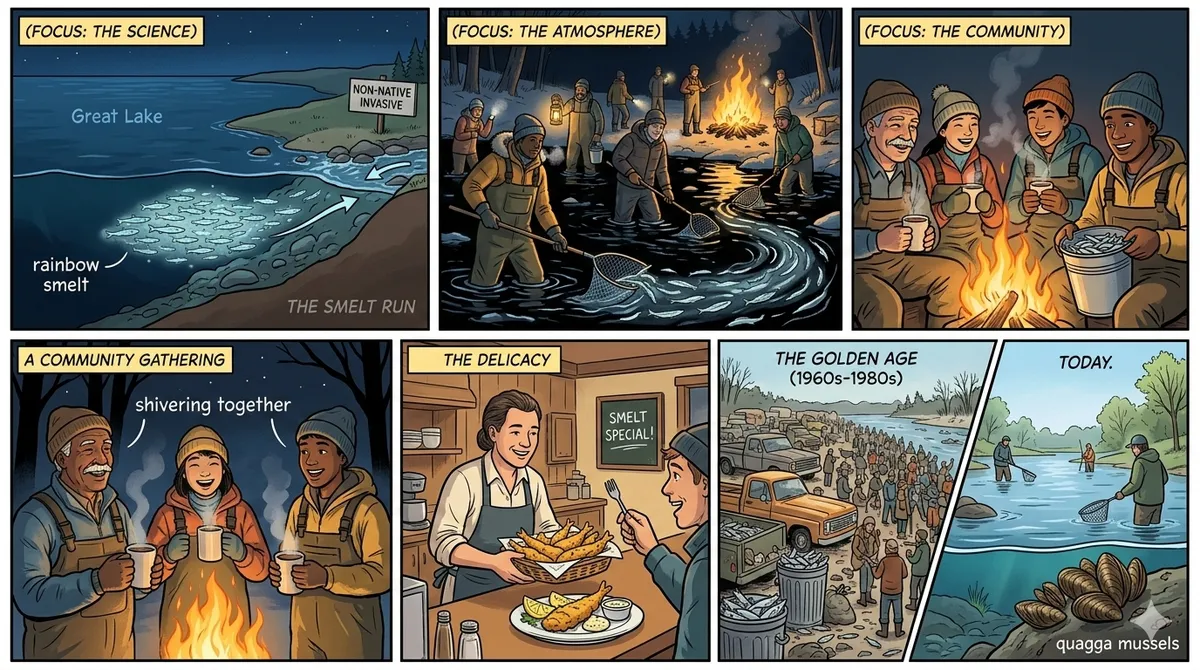
Every spring, as the ice melts from the rivers in Michigan's Upper Peninsula, a unique phenomenon occurs. Thousands of small, silvery fish called rainbow smelt begin their annual spawning run. These fish are not native to the Great Lakes; they were introduced in the early 20th century. Despite being an invasive species, they quickly became part of the local culture. When the water temperature is just right, usually in April, massive schools of smelt move from the deep lakes into the shallow streams at night. This movement triggers a frenzy among local residents and visitors who eagerly await their arrival.
Vocabulary_explanations
Phenomenon: A remarkable person, thing, or event.Silvery: Having the color or luster of silver.Annual: Occurring once every year.Spawning: The process of releasing eggs and sperm, usually into water, by aquatic animals.Native: Associated with the place or circumstances of a person's birth.Introduced: Brought something into a new place or environment for the first time.Invasive species:An organism that is not native to a specific location and has a tendency to spread, which can cause damage.
Culture: The ideas, customs, and social behavior of a particular people or society.Schools: Large groups of fish swimming together.Frenzy: A state or period of uncontrolled excitement or wild behavior.Questions:- Question: Smelt are native to the Great Lakes.Options:
- True
- False
Answer: False - Question: When does the smelt run usually happen?Options:
- A) Middle of winter
- B) Early autumn
- C) Spring, usually April
Answer: C) Spring, usually April - Question: Where do the smelt go to spawn?Options:
- A) Into deep lake water
- B) Into shallow streams
- C) Onto the river banks
Answer: B) Into shallow streams
- Part_number: 2Text:
The atmosphere during a smelt run is electric and unlike any other type of fishing. This activity requires very little expensive gear, making it accessible to almost everyone. The most common method is not using a hook and line, but rather large 'dip nets' or 'seine nets.' Because the fish run at night, the riverbanks come alive with the glow of lanterns, flashlights, and bonfires. People stand waist-deep in the icy cold water, wearing rubber waders to stay dry. It is a noisy, cold, and thrilling experience as participants scoop swarms of the small fish out of the dark water.
Vocabulary_explanations
Atmosphere: The pervading tone or mood of a place, situation, or work of art.Electric: Feeling full of excitement or emotion.Activity: A thing that a person or group does or has done.Gear: Equipment that is used for a particular activity.Accessible: Able to be reached or entered; easy to use or obtain.Dip nets: Nets attached to a long handle, used to scoop fish out of water.Seine nets:Large fishing nets that hang vertically in the water with weights at the bottom and floats at the top.
Glow: A steady radiance of light.Bonfires: Large open-air fires used for warmth or celebration.Waders: Waterproof boots or trousers extending to the chest, worn by fishermen.Questions:- Question: You need expensive equipment to fish for smelt.Options:
- True
- False
Answer: False - Question: What is the primary equipment used to catch smelt?Options:
- A) Fishing rods and hooks
- B) Dip nets and seine nets
- C) Underwater cameras
Answer: B) Dip nets and seine nets - Question: Why do people bring lanterns and bonfires?Options:
- A) Because the fish run at night
- B) To scare away predators
- C) To cook the fish immediately
Answer: A) Because the fish run at night
- Part_number: 3Text:
The social aspect of smelt dipping is perhaps more important than the fishing itself. It is a true community gathering. Friends, families, and even strangers gather around the fires to talk, laugh, and share stories while shivering together. For many locals, it is a rite of passage for young people to participate in their first cold smelt run. The reward for all this effort comes later. Smelt are considered a delicacy. Cleaning them can be tedious work, but the result—deep-fried, battered smelt—is a beloved springtime treat in many Michigan homes and restaurants.
Vocabulary_explanations
Aspect: A particular part or feature of something.Community: A group of people living in the same place or having a particular characteristic in common.Gathering: An assembly or meeting, especially one held for a specific purpose.Strangers: People whom one does not know or with whom one is not familiar.Shivering: Shaking slightly and uncontrollably as a result of being cold, frightened, or excited.Rite of passage: A ceremony or event marking an important stage in someone's life.Effort: A vigorous or determined attempt.Delicacy: A choice or expensive food item that is rare or requires special preparation.Tedious: Too long, slow, or dull; tiresome or monotonous.Beloved: Dearly loved.Questions:- Question: Smelt dipping is usually a solitary activity.Options:
- True
- False
Answer: False - Question: How are smelt typically prepared for eating?Options:
- A) Raw (sushi style)
- B) Deep-fried and battered
- C) Steamed with vegetables
Answer: B) Deep-fried and battered - Question: What phrase describes how many locals view participating in the smelt run?Options:
- A) A tedious chore
- B) A rite of passage
- C) A waste of time
Answer: B) A rite of passage
- Part_number: 4Text:
There was a 'golden age' of smelt fishing in Michigan between the 1960s and 1980s. During this era, the smelt runs were massive. Older residents recall times when the rivers were so thick with fish that they literally couldn't walk without stepping on them. Hundreds of cars and pickup trucks would line the roads near popular streams. People would fill entire pickup truck beds, five-gallon buckets, and garbage cans with their catch. Small towns heavily benefited from the tourism, as hotels and restaurants were packed with hopeful fishermen from all over the state.
Vocabulary_explanations
Era: A long and distinct period of history with a particular feature or characteristic.Massive: Large and heavy or solid; exceptionally large.Recall:Bring (a fact, event, or situation) back into one's mind, especially so as to recount it to others; remember.
Thick: Containing many things closely together.Literally: Used for emphasis or to express strong feeling while not being literally true.Benefit: Receive an advantage; profit.Tourism: The commercial organization and operation of vacations and visits to places of interest.Packed: Filled to capacity.Hopeful: Feeling or inspiring optimism about a future event.All over: Everywhere in.Questions:- Question: The smelt runs are larger today than they were in the 1970s.Options:
- True
- False
Answer: False - Question: In the 'golden age', how much smelt did some people catch?Options:
- A) Only a few fish per person
- B) Enough to fill pickup truck beds and garbage cans
- C) They were not allowed to keep any fish
Answer: B) Enough to fill pickup truck beds and garbage cans - Question: How did small towns react to the smelt runs in the past?Options:
- A) They closed their businesses
- B) They heavily benefited from increased tourism
- C) They banned fishing in their streams
Answer: B) They heavily benefited from increased tourism
- Part_number: 5Text:
However, the massive smelt runs of the past are now a memory. In recent decades, the smelt population has declined dramatically. Scientists point to several ecological factors for this change, including competition from other invasive species like quagga mussels and a decrease in the nutrients they rely on. Furthermore, larger fish predators that eat smelt have increased in numbers. While you can still catch smelt in Michigan's Upper Peninsula today, it is no longer the chaotic spectacle it once was. Nevertheless, the tradition remains a treasured part of spring, representing resilience, community, and the ever-changing nature of the Great Lakes ecosystem.
Vocabulary_explanations
Decades: Periods of ten years.Population: All the inhabitants of a particular town, area, or country (or in this case, species).Declined: Become smaller, fewer, or less; decreased.Factors: Circumstances, facts, or influences that contribute to a result or outcome.Competition: The activity or condition of competing.Nutrients: Substances that provide nourishment essential for growth and the maintenance of life.Predators: Animals that naturally prey on others.Chaotic: In a state of complete confusion and disorder.Spectacle: A visually striking performance or display.Resilience: The capacity to recover quickly from difficulties; toughness.Questions:- Question: What is the status of the smelt population today compared to the past?Options:
- A) It has stayed exactly the same.
- B) It has increased dramatically.
- C) It has declined significantly.
Answer: C) It has declined significantly. - Question: Quagga mussels have helped increase the smelt population.Options:
- True
- False
Answer: False - Question: Why is the tradition still valued today?Options:
- A) Because it is a treasured part of spring and community
- B) Because the fish are worth a lot of money
- C) Because it is required by law
Answer: A) Because it is a treasured part of spring and community
Recommended for You
The Quagga Mussel Crisis in the Great Lakes
Explore the ongoing ecological and economic impact of quagga mussels in the Great Lakes, focusing on their distinct thre...

Rudyard, Michigan: A Town Named by a Fan
Discover the unique history of Rudyard, Michigan. Named after a famous author, this town has a story involving railroads...

The Global Battle Against Malaria and Mosquito-Borne Pathogens
Explore the complex challenges of malaria and other mosquito-borne diseases in this B2 level guide to global health and ...