
The Global Battle Against Malaria and Mosquito-Borne Pathogens
Explore the complex challenges of malaria and other mosquito-borne diseases in this B2 level guide to global health and prevention.
Title
The Global Battle Against Malaria and Mosquito-Borne PathogensSeo_intro
Explore the complex challenges of malaria and other mosquito-borne diseases in this B2 level guide to global health and prevention.
Parts
- Part_number: 1Text:
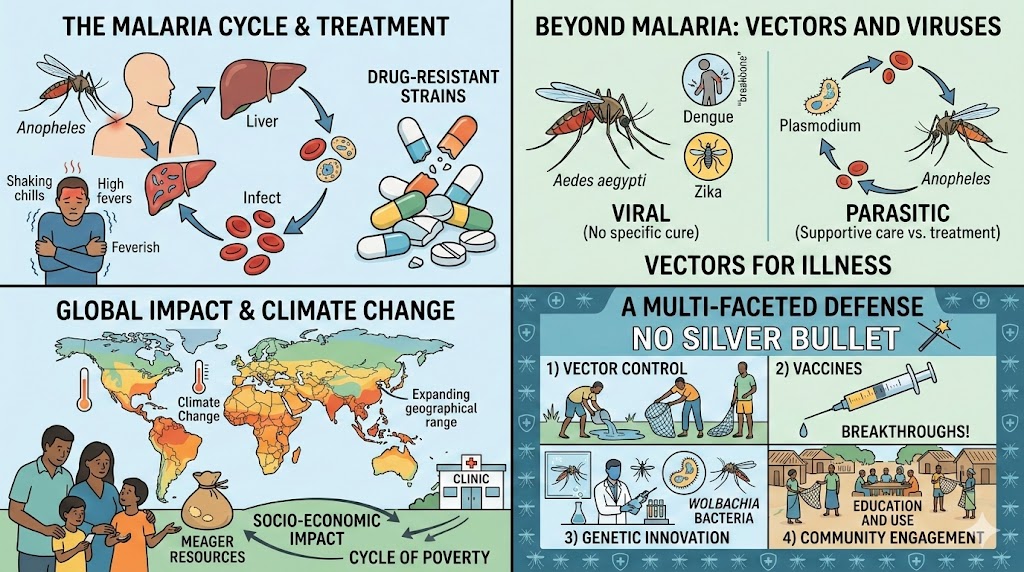
Malaria remains one of the most significant public health challenges globally, primarily transmitted through the bite of infected female Anopheles mosquitoes. Unlike many viral diseases, malaria is caused by Plasmodium parasites. When a mosquito bites a human, these parasites enter the bloodstream and travel to the liver, where they mature and multiply. Eventually, they re-enter the bloodstream to infect red blood cells. Common symptoms include high fevers, shaking chills, and flu-like illness. If left untreated, the infection can lead to severe complications or death. While progress has been made in reducing global cases, the emergence of drug-resistant strains complicates eradication efforts.
Vocabulary_explanations
Transmitted: Passed from one person, animal, or place to another.Parasites: Organisms that live on or in a host and get their food from or at the expense of their host.Bloodstream: The flow of blood around the body.Multiply: To increase greatly in number or amount.Shaking chills: A feeling of being cold that causes your body to shake, often accompanied by a fever.Complications: New problems that make an existing medical condition more difficult to treat.Emergence: The process of becoming visible or known.Drug-resistant: The ability of a microorganism to withstand the effects of a medication that used to treat it.Strains: Specific types or variants of a virus, bacteria, or parasite.Eradication: The complete destruction or elimination of something.Questions:- Question: Malaria is caused by a virus transmitted by male mosquitoes.Options:
- True
- False
Answer: False - Question: Where do malaria parasites go immediately after entering the human body?Options:
- A) The lungs
- B) The liver
- C) The brain
Answer: B) The liver - Question: What is the primary concern regarding 'drug-resistant strains'?Options:
- A) They are easier to catch
- B) They make mosquitoes live longer
- C) They are harder to treat with current medicine
Answer: C) They are harder to treat with current medicine
- Part_number: 2Text:
Beyond malaria, mosquitoes serve as vectors for various viral infections, including Dengue fever, Zika, and West Nile virus. Dengue is particularly prevalent in tropical and subtropical climates, often referred to as 'breakbone fever' due to the intense joint and muscle pain it causes. Unlike malaria, which is parasitic, these illnesses are viral and often lack specific cures, making supportive care the primary treatment. The Aedes aegypti mosquito is the notorious culprit for spreading Dengue and Zika. Public health initiatives focus on 'vector control,' which involves eliminating standing water where mosquitoes breed and distributing insecticide-treated bed nets to protect vulnerable populations at night.
Vocabulary_explanations
Vectors: Living organisms that can transmit infectious pathogens between humans, or from animals to humans.Prevalent: Widespread or common in a particular area or at a particular time.Subtropical: Relating to regions bordering on the tropics.Intense: Very strong, extreme, or serious.Parasitic: Relating to or caused by a parasite.Supportive care: Medical therapy given to prevent or treat symptoms rather than the disease itself.Notorious: Famous or well known, typically for some bad quality or deed.Culprit: The person or thing responsible for a crime or a misdeed.Initiatives: New plans or strategies intended to resolve a problem.Insecticide-treated: Covered with a substance used for killing insects.Questions:- Question: Dengue fever is nicknamed 'breakbone fever' because of the severe pain it causes.Options:
- True
- False
Answer: True - Question: What is the main difference between malaria and diseases like Zika or West Nile?Options:
- A) One is viral, the other is parasitic
- B) Only malaria is spread by mosquitoes
- C) Only Zika causes a fever
Answer: A) One is viral, the other is parasitic - Question: What does 'vector control' primarily involve?Options:
- A) Creating new vaccines
- B) Managing the environment to reduce mosquito populations
- C) Moving people to colder climates
Answer: B) Managing the environment to reduce mosquito populations
- Part_number: 3Text:
The socio-economic impact of mosquito-borne diseases is profound, trapping many regions in a cycle of poverty. Frequent illness leads to absenteeism in schools and workplaces, draining a family’s meager resources on healthcare costs. Furthermore, climate change is expanding the geographical range of mosquitoes. As temperatures rise, areas that were previously too cold for these insects are now seeing outbreaks. This shift requires global cooperation and increased funding for vaccine research. Recent breakthroughs in malaria vaccines offer a glimmer of hope, but broad implementation remains a logistical challenge. Consistent community engagement and education are essential to ensure that prevention methods are adopted and maintained over the long term.
Vocabulary_explanations
Socio-economic: Relating to or concerned with the interaction of social and economic factors.Profound: Very great or intense.Absenteeism: The practice of regularly staying away from work or school without good reason.Meager: Lacking in quantity or quality; very small.Geographical range: The total area in which a particular species is found.Outbreaks: Sudden occurrences of a disease in a particular time and place.Breakthroughs: Significant steps forward or discoveries, especially in science.Glimmer of hope: A small sign that something might improve or succeed.Logistical: Relating to the organization of a complex operation.Community engagement:The process of working collaboratively with groups of people to address issues affecting their well-being.
Questions:- Question: Climate change is helping to limit the areas where mosquitoes can live.Options:
- True
- False
Answer: False - Question: Why do these diseases contribute to a 'cycle of poverty'?Options:
- A) People stop wanting to work
- B) Healthcare costs and missed work drain family savings
- C) The mosquitoes only live in poor houses
Answer: B) Healthcare costs and missed work drain family savings - Question: What is one recent 'breakthrough' mentioned in the text?Options:
- A) The discovery of a new mosquito species
- B) The development of malaria vaccines
- C) A way to stop mosquitoes from biting entirely
Answer: B) The development of malaria vaccines
- Part_number: 4Text:
In addition to vaccines, innovative genetic technologies are being explored to combat mosquito populations. One method involves releasing genetically modified mosquitoes into the wild to reduce the number of offspring that reach adulthood. Another approach uses a bacteria called Wolbachia, which, when present in mosquitoes, can block their ability to transmit viruses like Dengue. These high-tech solutions, combined with traditional methods like spatial spraying and public awareness campaigns, form a multi-faceted defense strategy. While no single solution is a 'silver bullet,' the integration of science, policy, and local action provides a roadmap toward a future where these ancient diseases no longer threaten human life on a massive scale.
Vocabulary_explanations
Innovative: Featuring new methods; advanced and original.Genetic: Relating to genes or heredity.Offspring: The young of an animal or plant.Adulthood: The stage of being fully grown or developed.Spatial spraying: The process of spraying insecticide over a large area to kill adult mosquitoes.Awareness campaigns: Organized activities to increase knowledge about a specific issue.Multi-faceted: Having many different aspects or features.Silver bullet: A simple and seemingly magical solution to a complicated problem.Integration: The action or process of combining several things into a whole.Roadmap: A plan or strategy intended to achieve a particular goal.Questions:- Question: Wolbachia is a type of medicine humans take to prevent malaria.Options:
- True
- False
Answer: False - Question: What is the goal of releasing genetically modified mosquitoes?Options:
- A) To make them bite animals instead of humans
- B) To reduce the number of mosquitoes that survive to adulthood
- C) To make them larger and easier to see
Answer: B) To reduce the number of mosquitoes that survive to adulthood - Question: What does the author mean by saying there is no 'silver bullet'?Options:
- A) Traditional medicine is better than new technology
- B) There is no single, easy solution to the problem
- C) We should use actual silver to fight mosquitoes
Answer: B) There is no single, easy solution to the problem
- Part_number: 5Text:
Ultimately, the fight against mosquito-borne illnesses is a testament to human resilience and scientific ingenuity. Global health organizations continue to monitor emerging threats, such as the spread of the Asian tiger mosquito in Europe and North America. This ongoing surveillance is crucial for early detection and rapid response. While the path to total eradication is long and fraught with challenges—ranging from funding shortages to environmental concerns—the steady progress in medical research and global collaboration remains encouraging. By understanding the biology of the vector and the nature of the pathogens, humanity is better equipped than ever to mitigate the impact of these tiny yet deadly creatures on global health.
Vocabulary_explanations
Testament: Something that serves as a sign or evidence of a specified fact, event, or quality.Resilience: The capacity to recover quickly from difficulties; toughness.Ingenuity: The quality of being clever, original, and inventive.Surveillance: Close observation, especially of a developing situation.Early detection: Finding a disease or problem at its beginning stage.Fraught with: Filled with (something undesirable).Shortages: Situations in which there is not enough of something.Encouraging: Giving hope or promise.Biology: The life processes and physical characteristics of a particular organism.Mitigate: To make something less severe, serious, or painful.Questions:- Question: The Asian tiger mosquito is a new threat being monitored in Europe and North America.Options:
- True
- False
Answer: True - Question: What is 'surveillance' important for in this context?Options:
- A) Counting how many mosquitoes are in a room
- B) Early detection and rapid response to disease spreads
- C) Filming mosquitoes for television
Answer: B) Early detection and rapid response to disease spreads - Question: How does the author feel about the future of fighting these diseases?Options:
- A) Completely hopeless
- B) Encouraged by steady progress and collaboration
- C) Bored by the lack of new information
Answer: B) Encouraged by steady progress and collaboration
Recommended for You
America: A Nation of Immigrants
Explore the history of immigration in America! Learn about early arrivals, Ellis Island, cultural diversity, and modern ...
Homosassa Springs: A Natural Haven for Florida's Wildlife
Explore Homosassa Springs, Florida! Learn about manatees, unique animal ambassadors, and the famous Fish Bowl in this B1...
Understanding Body Shaming and How to Stop It
Learn about body shaming, its negative effects on mental health, and how we can build a kinder, more body-positive socie...