
17 - How an Electric Stove Works
Title
How an Electric Stove WorksReading Text
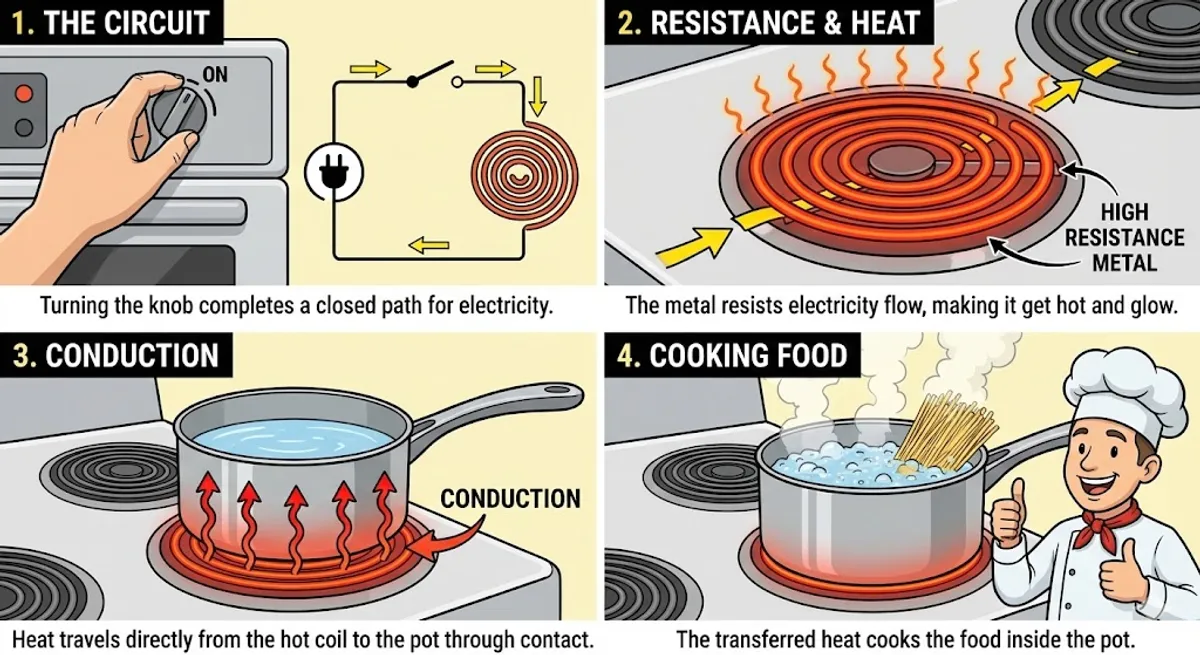
An electric stove uses science to cook food. When you turn the knob, electricity flows through a closed path called a circuit. The electricity travels into a metal heating coil on top of the stove. This metal has a quality called resistance. Resistance tries to stop the electricity from moving. This struggle makes the coil turn bright red and become very hot. Then, the heat travels from the hot coil directly to your cooking pot. This movement of heat is called conduction. Thanks to conduction, the food inside the pot cooks quickly.
Activities
Vocabulary
- Text: A complete path for electricity to flow.
- Text: A force that stops electricity and creates heat.
- Text: The movement of heat from one thing to another.
- Text: The round metal part of the stove that gets hot.
- Text: To move smoothly, like water or electricity.
- Label: CircuitAnswer: A
- Label: ResistanceAnswer: B
- Label: ConductionAnswer: C
- Label: CoilAnswer: D
- Label: FlowAnswer: E
- Before: Electricity needs a closedAfter: to work properly.Answer: circuit
- Before: HighAfter: makes the wire get very hot.Answer: resistance
- Before: The heat moves to the pan byAfter: .Answer: conduction
- Before: Don't touch the heatingAfter: when it is red.Answer: coil
- Before: Water and electricity canAfter: through lines.Answer: flow
- Text: path / circuit / is / a / A / closedAnswer: A circuit is a closed path.
- Text: heat / creates / Resistance / wire / the / inAnswer: Resistance creates heat in the wire.
- Text: moves / pot / Conduction / heat / the / toAnswer: Conduction moves heat to the pot.
- Text: red / turns / coil / The / hot / andAnswer: The coil turns red and hot.
- Text: knob / Turn / start / the / to / cookingAnswer: Turn the knob to start cooking.
Comprehension
- Text: A circuit is a path for water.Answer: false
- Text: Resistance makes the coil get cold.Answer: false
- Text: Conduction moves heat from the coil to the pot.Answer: true
- Text: The heating coil is made of plastic.Answer: false
- Text: You need to turn a knob to start the electricity.Answer: true
Written Expression
- Text: In your own words, how does the stove get hot?
- Text: Why must the bottom of a pot touch the stove coil?
Examples:
- The stove gets hot because the resistance in the metal coil stops the electricity and makes heat.
- The pot must touch the coil so conduction can move the heat into the food.
Recommended for You
Journey to Mars: The Porkchop Window
Learn about the time it takes to travel to Mars and the 'porkchop window' with this A2 English reading worksheet.

The Artemis II Launch to the Moon
Practice your English reading skills with this A2-level worksheet about the historic Artemis II mission to the moon.

Understanding the Word 'Kafkaesque'
Learn the meaning and origins of the word 'Kafkaesque' in this B2 English reading comprehension lesson.