Understanding the Word 'Kafkaesque'
Learn the meaning and origins of the word 'Kafkaesque' in this B2 English reading comprehension lesson.
Understanding the Word 'Kafkaesque'
Learn the meaning and origins of the word 'Kafkaesque' in this B2 English reading comprehension lesson.
Title
Understanding the Word 'Kafkaesque'Seo_intro
Learn the meaning and origins of the word 'Kafkaesque' in this B2 English reading comprehension lesson.
Reading Text
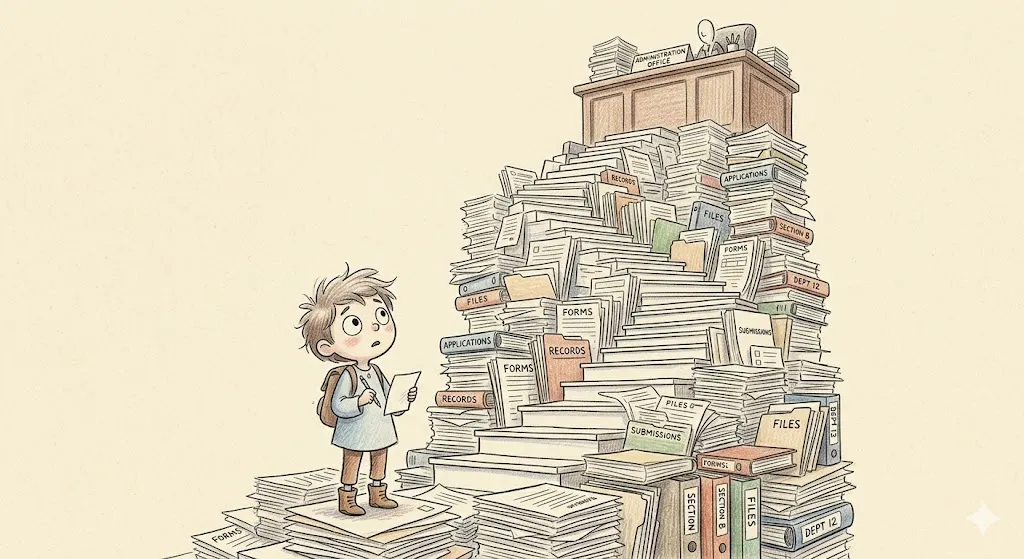
Have you ever been trapped in a seemingly endless cycle of paperwork, transferred from one department to another, only to find out that the form you need to submit can only be obtained by submitting the very same form? If you have, you have experienced a situation that many people would describe as "Kafkaesque." The term "Kafkaesque" originates from the name of the famous 20th-century Bohemian novelist and short-story writer, Franz Kafka. His works, most notably "The Trial" and "The Metamorphosis," frequently explore themes of alienation, existential anxiety, guilt, and absurdity. Today, the adjective is widely used in everyday language to describe situations that are unnecessarily complicated, frustratingly illogical, and profoundly bizarre. However, to truly understand what makes something Kafkaesque, we must look deeper than mere bureaucratic inefficiency. A genuinely Kafkaesque experience involves a surreal, nightmarish reality where individuals find themselves caught up in complex, incomprehensible systems. These systems operate with a cold, relentless logic that makes no sense to the people trapped within them. In Kafka’s "The Trial," for instance, the protagonist Josef K. is arrested and prosecuted by a remote, inaccessible authority. His crime is never revealed to him, nor to the reader. He spends the entire novel trying to navigate a bizarre judicial process, seeking help from advocates and officials who are just as confused or corrupt as the system itself. Josef K.'s struggle is utterly futile because the system is designed to be impenetrable and self-perpetuating. Therefore, a situation is not Kafkaesque simply because it is difficult or annoying. Missing a bus because it was raining and your alarm clock failed is unfortunate, but it is not Kafkaesque. Being forced to attend a series of mandatory meetings to discuss why productivity is decreasing because employees spend too much time in mandatory meetings is getting closer to the mark. A key element of the Kafkaesque is the complete powerlessness of the individual in the face of an omnipotent and invisible authority. People in these scenarios often experience a profound sense of disorientation. They try to apply rational thought and common sense to resolve their problems, but these tools are completely ineffective in a world that operates on dreamlike, contradictory rules. This often leads to a paralyzing sense of guilt or impending doom, even when the individual is entirely innocent. The characters in Kafka’s stories often accept their bizarre punishments or situations with a resigned, terrifying calmness, further highlighting the absurdity of their universe. In modern society, we frequently use the word to describe interactions with massive bureaucracies, such as government agencies, massive corporations, or legal systems. When you are put on hold for hours, forced to navigate a labyrinth of automated voice prompts, and eventually disconnected without ever speaking to a human being, you are experiencing a minor version of this phenomenon. The machinery of society has become so vast and complicated that it often seems to operate independently of human intention, crushing those who happen to get caught in its gears. Understanding this term helps us articulate the specific kind of dread that arises when logic fails, and we are left completely adrift in a sea of nonsensical rules.
Activities
Vocabulary
- Label: alienationAnswer: v1
- Label: bizarreAnswer: v2
- Label: impenetrableAnswer: v3
- Label: futileAnswer: v4
- Label: omnipotentAnswer: v5
- Label: disorientationAnswer: v6
- Text: A feeling of being isolated or disconnected from others.
- Text: Very strange or unusual, especially in a way that causes interest or amusement.
- Text: Impossible to understand or pass through.
- Text: Incapable of producing any useful result; pointless.
- Text: Having unlimited power; able to do anything.
- Text: A feeling of being confused and not knowing where you are or what is happening.
- Before: The dense legal jargon in the contract made it completelyAfter: to the average person.Answer: impenetrable
- Before: He felt a deep sense ofAfter: after moving to a new city where he didn't know anyone.Answer: alienation
- Before: Trying to argue with the automated phone system proved to be entirelyAfter: .Answer: futile
- Before: The king acted as anAfter: ruler whose commands could never be questioned.Answer: omnipotent
- Before: Waking up in a strange room in the dark caused her severeAfter: until she found the light switch.Answer: disorientation
Comprehension
- Text: The word 'Kafkaesque' simply means something is slightly annoying or inconvenient.Answer: false
- Text: Franz Kafka was a 20th-century Bohemian novelist.Answer: true
- Text: In 'The Trial,' Josef K. is fully aware of the crime he is accused of committing.Answer: false
- Text: A key element of a Kafkaesque situation is the powerlessness of the individual.Answer: true
- Text: Kafkaesque systems usually operate with clear, easily understandable rules.Answer: false
- Text: term / The / from / famous / originates / the / writer.Answer: The term originates from the famous writer.
- Text: is / entirely / with / arguing / system / the / futile.Answer: Arguing with the system is entirely futile.
- Text: bizarre / rules / The / illogical / completely / are / and.Answer: The rules are completely bizarre and illogical.
- Text: feels / individual / powerless / The / completely.Answer: The individual feels completely powerless.
- Text: bureaucracy / complex / be / extremely / can / Modern.Answer: Modern bureaucracy can be extremely complex.
Written Expression
- Text:
Describe a time when you experienced a situation that felt 'Kafkaesque.' What happened and how did it make you feel?
- Text:
Why do you think stories about individuals fighting against impossible, illogical systems resonate so much with modern readers?
Example Answer: I once had to renew a specific ID card. The government office told me I needed a document from the bank, but the bank told me they couldn't issue the document without the renewed ID card. I went back and forth for days feeling completely helpless, frustrated, and trapped in an impossible loop.
Critical Thinking
- Discuss whether completely eliminating bureaucracy is possible or desirable in modern society.
How can individuals protect their mental well-being when forced to interact with illogical and impenetrable systems?
Recommended for You

Are Organic Foods Really Healthier?
Explore the debate over organic food, comparing nutritional benefits, farming standards, and costs for intermediate Engl...
How Pigs and Ducks Stay Healthy on the Farm
Explore how pigs and ducks use unique body adaptations like mud, feathers, and webbed feet to survive and thrive in thei...

A Helping Hand at the Pond
Read a story about Pig and Duck working together to rescue a stuck toy truck by the pond. Includes vocabulary, reading c...