
Journey to Mars: The Porkchop Window
Learn about the time it takes to travel to Mars and the 'porkchop window' with this A2 English reading worksheet.
Title
Journey to Mars: The Porkchop WindowSeo_intro
Explore the science behind traveling to Mars and learn why scientists use a 'porkchop window' in this B1 English reading worksheet.
Reading Text
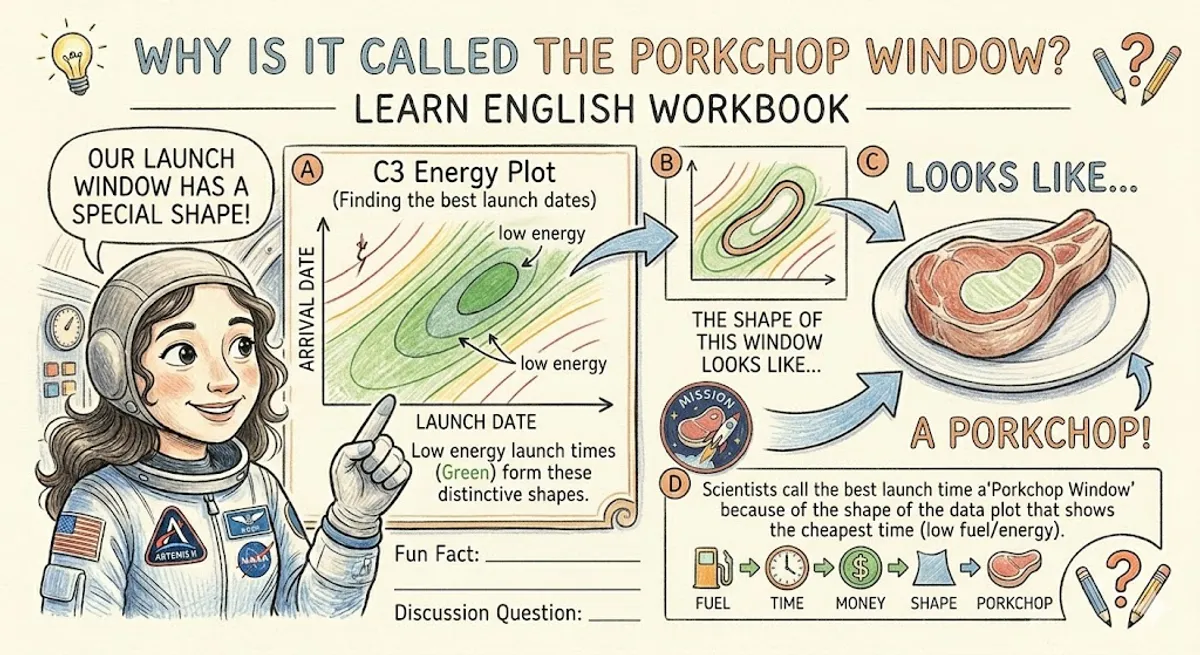
Traveling to Mars is one of the greatest challenges in space exploration. Unlike a trip to the Moon, which only takes a few days, a journey to the Red Planet takes several months. This is because the distance between Earth and Mars is constantly changing as both planets orbit the Sun at different speeds. To make the trip possible, scientists and engineers cannot just launch a rocket whenever they want. They have to wait for a specific time when Earth and Mars line up perfectly. This optimal time is called a "launch window," but scientists have a funny nickname for it: the "porkchop window." Why is it called a porkchop window? The name comes from the shape of the data charts that scientists use to plan the mission. When engineers calculate the amount of energy and fuel needed to launch a spacecraft to Mars on various dates, they plot the results on a graph. The areas on the graph that show the lowest energy requirements—meaning the cheapest and most efficient times to launch—form a series of curved lines. When looking at these lines on the paper, the shape looks exactly like a piece of meat called a porkchop! A porkchop window only opens once every 26 months. If a space agency like NASA misses this window, they have to wait more than two years for the next opportunity. Launching during this specific time is essential because it allows the spacecraft to use the least amount of fuel while arriving at Mars as quickly as possible. Even with this perfect timing, the journey still takes about seven months. During this long flight, astronauts would face many difficulties. They would have to live in a small space, deal with zero gravity, and protect themselves from dangerous space radiation. Despite these challenges, the idea of reaching Mars remains incredibly exciting.
References
Activities
Vocabulary
- Label: challengesAnswer: v1
- Label: optimalAnswer: v2
- Label: calculateAnswer: v3
- Label: efficientAnswer: v4
- Label: opportunityAnswer: v5
- Label: radiationAnswer: v6
- Text: Difficult tasks or problems that test a person's ability.
- Text: The best or most suitable.
- Text: To discover a number or amount using mathematics.
- Text: Working well without wasting time, money, or energy.
- Text: A chance to do something or a good time for it.
- Text: Energy in the form of waves or particles that can be dangerous.
- Before: Going to Mars is one of the greatestAfter: in space exploration.Answer: challenges
- Before: Scientists wait for theAfter: time to launch the rocket.Answer: optimal
- Before: Engineers mustAfter: how much fuel the spaceship needs.Answer: calculate
- Before: Launching during the window is the mostAfter: way to travel.Answer: efficient
- Before: If they miss the window, they must wait 26 months for the nextAfter: .Answer: opportunity
Comprehension
- Text: The distance between Earth and Mars stays the same all year.Answer: false
- Text: The launch window is called a 'porkchop window' because of a data graph's shape.Answer: true
- Text: A porkchop window opens once every year.Answer: false
- Text: Even during the porkchop window, the trip to Mars takes about seven months.Answer: true
- Text: Astronauts will not face any danger from radiation during the trip.Answer: false
- Text: months / journey / takes / The / several / Mars / to .Answer: The journey to Mars takes several months.
- Text: every / window / opens / porkchop / 26 / A / months .Answer: A porkchop window opens every 26 months.
- Text: fuel / use / Spaceships / of / amount / least / the .Answer: Spaceships use the least amount of fuel.
- Text: shape / chart / a / like / porkchop / looks / The / a .Answer: The chart shape looks like a porkchop.
- Text: dream / Mars / reaching / exciting / an / is / of / The .Answer: The dream of reaching Mars is an exciting one.
Written Expression
- Text: If you had to travel in a small spaceship for seven months, what would you do to pass the time?
- Text: Do you think the benefits of exploring Mars are worth the dangers? Explain your answer.
Example 1: I would read a lot of books and learn a new language. I would also spend time exercising so my muscles stay strong in zero gravity.
Example 2: Yes, I think it is worth the danger. Exploring Mars could help us learn more about our own planet and maybe find out if life exists anywhere else in the universe.
Critical Thinking
Why is efficiency so important when planning a space mission? What happens if a spaceship runs out of fuel?
Can you think of other times in your life where you have to wait for an 'optimal window' to do something?
Recommended for You

The Artemis II Launch to the Moon
Practice your English reading skills with this A2-level worksheet about the historic Artemis II mission to the moon.

Understanding the Word 'Kafkaesque'
Learn the meaning and origins of the word 'Kafkaesque' in this B2 English reading comprehension lesson.
The Origin of Catch-22
Learn the meaning and origin of the famous phrase Catch-22 in this A2 English reading lesson.