The Science and History of Hypnosis
Learn about the fascinating history of Anton Mesmer and the modern medical applications of hypnotism in this B1 English reading worksheet.
The Science and History of Hypnosis
Learn about the fascinating history of Anton Mesmer and the modern medical applications of hypnotism in this B1 English reading worksheet.
Title
The Science and History of HypnosisReading Text
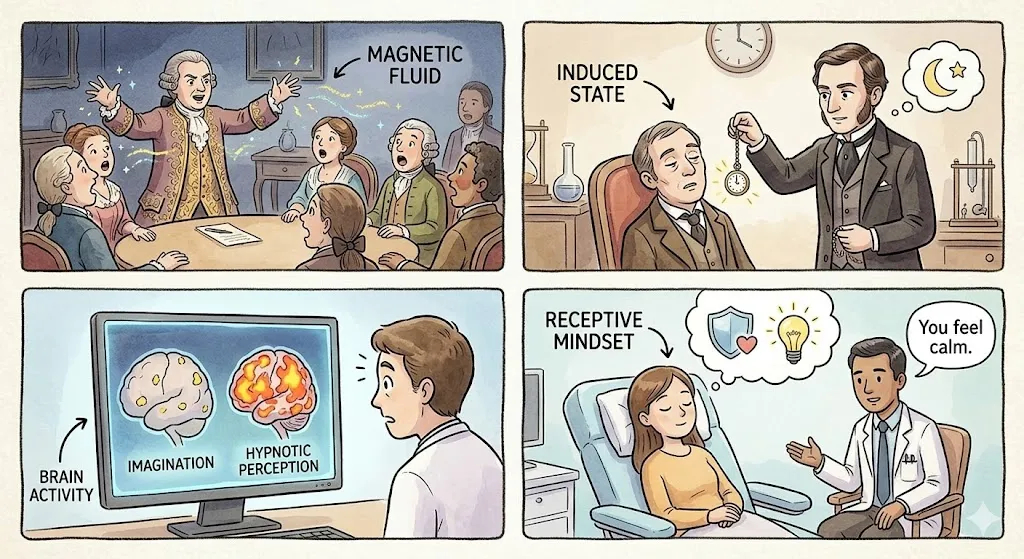
Hypnosis is a practice that has fascinated and confused people for centuries. It began in the late 1700s with a German doctor named Anton Mesmer. He claimed he could cure illnesses using an invisible 'magnetic fluid.' While many people found his demonstrations enthralling, others were skeptical. In 1784, scientists conducted the first blind placebo trial and proved that Mesmer’s cures were actually the result of the patients' own imaginations responding to the doctor's suggestions. Later, a surgeon named James Braid removed the idea of magnetism from the practice. He believed the process induced a sleep-like state, so he called it 'hypnotism.' Today, we understand hypnosis not as a mysterious trance, but as a set of procedures used to help people focus. A typical medical session begins with a hypnotic induction, which helps the patient enter a more receptive mindset. The professional then uses specific techniques to alter the patient's perception of things like pain or anxiety. Research shows that everyone has a different level of 'hypnotizability.' Some people are highly responsive, while others are completely unresponsive. People who are easily hypnotized are often more prone to fantasy and likely to become deeply absorbed in their activities. When a hypnotic suggestion works, brain scans show that the person’s brain activity changes. It starts to look more like actual perception than just simple imagination. Hypnosis is now a helpful tool in medicine, especially for managing pain. In some studies, patients who received suggestions for pain relief during surgery required fewer drugs afterward. It has also helped people with brain injuries improve their working memory by overcoming cognitive deficits caused by their own beliefs about their abilities. For habits like quitting smoking, hypnosis can be just as effective as counseling or regular exercise. However, it is important to stay alert to the facts and not believe every myth. While hypnosis can help with anxiety and depression, there is little evidence that it can treat serious conditions like schizophrenia. When hypnosis does work, it isn't because of magic or magnetic fluids. Instead, it is because our minds have a powerful ability to respond to external guidance. By understanding how the brain processes these suggestions, scientists are uncovering new ways to help the body heal itself. In the end, the 'magic' of hypnosis is simply the mesmerizing power of our own thoughts.
Seo_intro
Learn about the fascinating history of Anton Mesmer and the modern medical applications of hypnotism in this B1 English reading worksheet.
Activities
Vocabulary
- Label: enthrallingAnswer: 1
- Label: skepticalAnswer: 2
- Label: placeboAnswer: 3
- Label: suggestionsAnswer: 4
- Label: inducedAnswer: 5
- Label: receptiveAnswer: 6
- Label: perceptionAnswer: 7
- Label: absorbedAnswer: 8
- Label: deficitsAnswer: 9
- Label: alertAnswer: 10
- Text: capturing and holding one's attention; fascinating
- Text: not easily convinced; having doubts
- Text: a substance or treatment with no active effect, used as a control in testing
- Text: ideas or plans put forward for consideration
- Text: brought about or caused a specific state
- Text: willing to consider or accept new suggestions and ideas
- Text: the way in which something is regarded, understood, or interpreted
- Text: deeply interested or involved in something
- Text: shortages or failings in a person's abilities
- Text: fully aware and attentive; wide awake
- Before: The magic show was absolutelyAfter: , and the children couldn't look away.Answer: enthralling
- Before: The teacher wasAfter: when the student claimed a dog ate his homework.Answer: skeptical
- Before: In the experiment, half the patients received aAfter: pill instead of medicine.Answer: placebo
- Before: The hypnotist gave the patientAfter: to help them feel more relaxed.Answer: suggestions
- Before: The calm musicAfter: a feeling of peace in the room.Answer: induced
- Before: You should wait until your boss is in aAfter: mood before asking for a raise.Answer: receptive
- Before: The artist used light and shadow to change the viewer'sAfter: of the painting.Answer: perception
- Before: He was soAfter: in his book that he didn't hear the doorbell ring.Answer: absorbed
- Before: After the accident, he struggled with minor memoryAfter: .Answer: deficits
- Before: Drivers must stayAfter: at all times to avoid accidents.Answer: alert
Comprehension
- Text: Anton Mesmer's magnetic fluid theory was proven to be scientifically accurate in 1784.Answer: false
- Text: James Braid was the first person to use the term 'hypnotism' based on a sleep-like state.Answer: true
- Text: Everyone is equally easy to hypnotize regardless of their personality traits.Answer: false
- Text: Hypnosis can actually change how a person's brain processes information during perception.Answer: true
- Text: Hypnosis has been shown to be a proven cure for serious conditions like schizophrenia.Answer: false
- Text: Hypnosis has fascinated people for many centuries.Answer: centuries / fascinated / many / has / people / for / Hypnosis
- Text: Mesmer claimed he could cure various illnesses.Answer: illnesses / claimed / Mesmer / could / various / he / cure
- Text: Scientists proved the cures were imaginary.Answer: imaginary / cures / proved / the / were / Scientists
- Text: Brain scans show changes in brain activity.Answer: changes / brain / scans / activity / show / in / Brain
- Text: Our minds have the power to heal.Answer: power / heal / have / minds / the / to / Our
Written Expression
- Text: Would you ever try hypnosis to help you with a problem like stress or a bad habit? Why or why not?
- Text: In your opinion, what is the most interesting thing about how the human brain works?
Example: I would be willing to try hypnosis because I think it is an interesting way to use the mind's power. I often get stressed before exams, so learning to relax through suggestions could be very helpful.
Critical Thinking
How might the 'placebo effect' apply to other areas of life, such as sports, education, or personal relationships?
If hypnosis can change our perception of reality, what does that tell us about the nature of what we see and feel every day?
References
Recommended for You

Are Organic Foods Really Healthier?
Explore the debate over organic food, comparing nutritional benefits, farming standards, and costs for intermediate Engl...
How Pigs and Ducks Stay Healthy on the Farm
Explore how pigs and ducks use unique body adaptations like mud, feathers, and webbed feet to survive and thrive in thei...

A Helping Hand at the Pond
Read a story about Pig and Duck working together to rescue a stuck toy truck by the pond. Includes vocabulary, reading c...