
The Secret Instincts of Your House Cat
Explore the evolutionary reasons behind common cat behaviors in this B1 English worksheet based on the TED-Ed video 'Why do cats act so weird?'.
Title
The Secret Instincts of Your House CatReading Text
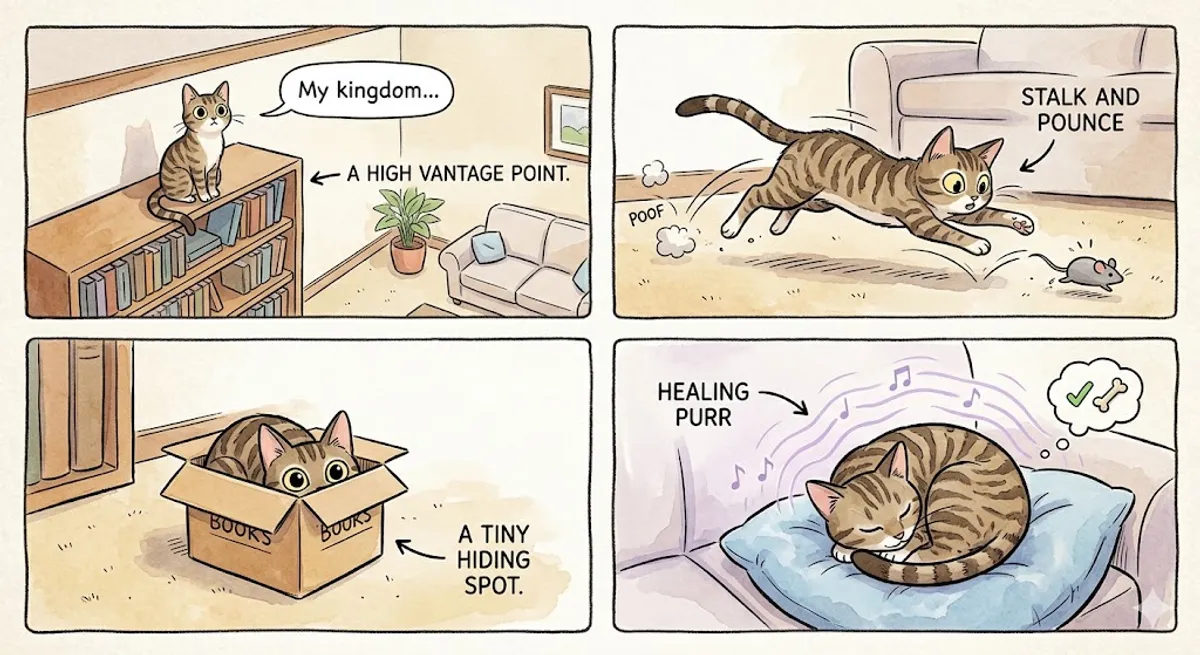
Domestic cats are some of the most popular and entertaining pets in the world. However, their strange behaviors can often be baffling to their owners. Why do they climb on top of bookcases or hide in tiny cardboard boxes? To understand this, we must look at their ancestors. For millions of years, cats were both solitary predators and prey for larger animals. Their survival depended on instinctual behaviors that we still see today. Even if your cat seems perplexing, she is actually acting like a 'super cat.' In the wild, cats are opportunistic hunters. Because their prey is usually small, they need to eat many times a day using a 'stalk, pounce, and kill' strategy. This explains why your cat has a propensity to chase small toys and prefers several small meals rather than one big one. Their physical habits are also tied to survival. Cats have a unique muscular structure that allows them to climb to high places. From there, they can survey their territory and spot potential danger. Furthermore, when a cat scratches your furniture, it isn't being mean. It is keeping its claws conditioned and ready for defense while stretching its muscles. To avoid being caught by larger animals, cats evolved to be experts at hiding. This is why they love squeezing into small, conventional and unconventional spots. It also explains why they prefer a clean litter box; a strong odor could give away their location to a predator. Finally, one of their most predominant behaviors is purring. While we often think it just means they are happy, research suggests that the frequency of a purr can actually help heal bones and tissues. In your cat's mind, your home is not just a house—it is a jungle where every instinct helps them thrive.
Seo_intro
Explore the evolutionary reasons behind common cat behaviors in this B1 English worksheet based on the TED-Ed video 'Why do cats act so weird?'.
Activities
Vocabulary
- Label: bafflingAnswer: 1
- Label: solitaryAnswer: 2
- Label: predatorsAnswer: 3
- Label: instinctualAnswer: 4
- Label: perplexingAnswer: 5
- Label: opportunisticAnswer: 6
- Label: propensityAnswer: 7
- Label: conditionedAnswer: 8
- Label: conventionalAnswer: 9
- Label: predominantAnswer: 10
- Text: very confusing or difficult to understand
- Text: done or existing alone; without others
- Text: animals that naturally prey on others
- Text: based on a natural, automatic behavior rather than thought
- Text: completely baffling; very puzzling
- Text: taking advantage of chances or opportunities when they happen
- Text: a natural tendency to behave in a particular way
- Text: brought into a good or desired state of health or fitness
- Text: following what is traditional or done by most people
- Text: most common, main, or strongest element
- Before: The detective found the clues to be veryAfter: .Answer: baffling
- Before: Tigers areAfter: hunters and usually live alone.Answer: solitary
- Before: Wolves are naturalAfter: that hunt in packs.Answer: predators
- Before: A bird's ability to build a nest isAfter: .Answer: instinctual
- Before: The math problem was soAfter: that no one could solve it.Answer: perplexing
- Before: The bird isAfter: , eating any seeds or insects it can find.Answer: opportunistic
- Before: She has aAfter: to buy books even when she hasn't read the old ones.Answer: propensity
- Before: The athlete stayedAfter: through daily exercise and a good diet.Answer: conditioned
- Before: They decided to have aAfter: wedding in a church.Answer: conventional
- Before: Blue is theAfter: color in the artist's new painting.Answer: predominant
Comprehension
- Text: Cats climb to high places primarily to hide from their human owners.Answer: false
- Text: In the wild, cats' ancestors were both hunters and animals that were hunted.Answer: true
- Text: Scratching furniture is a way for cats to keep their claws in good condition and stretch.Answer: true
- Text: Cats prefer small meals because they are naturally opportunistic hunters of small prey.Answer: true
- Text: Scientific research shows that purring is only used by cats to show happiness.Answer: false
- Text: Domestic cats are popular and entertaining pets.Answer: popular / entertaining / cats / are / and / pets / Domestic
- Text: Their ancestors needed instincts to survive.Answer: survive / ancestors / their / to / needed / instincts
- Text: Cats climb to high points to survey their territory.Answer: high / cats / survey / points / climb / to / territory / their
- Text: They love to hide into small spots.Answer: small / they / into / hide / spots / love / to
- Text: In a cat's mind the home is a jungle.Answer: jungle / a / cat's / home / is / the / in / a / mind
Written Expression
- Text: Describe your favorite pet and some of its most unusual habits.
- Text: Do you think it is better for cats to live indoors or outdoors? Explain your reasons.
Example: I think cats are happier indoors because they are safe from cars and predators. My cat likes to sleep on the sunlit carpet and chase reflections on the wall.
Critical Thinking
Discuss how humans have changed the natural environment of cats and how that might affect their stress levels.
The video suggests cats might view us as 'big, dumb cats.' If this is true, how does that change the way you think about your relationship with your pet?
References
Recommended for You
The Science and History of Hypnosis
Learn about the fascinating history of Anton Mesmer and the modern medical applications of hypnotism in this B1 English ...
Amazing Animals: The Red-eyed Tree Frog
Learn about the colorful and clever red-eyed tree frog in this A2 English reading activity about its unique life in the ...
Amazing Animals: The Bottlenose Dolphin
Explore the wonderful world of bottlenose dolphins with this A2 English reading activity focused on their intelligence a...