The Hidden Cost of AI: Is Life Too Easy?
Explore how artificial intelligence simplifies our lives while potentially weakening our critical thinking and decision-making skills in this B1 text.
The Hidden Cost of AI: Is Life Too Easy?
Explore how artificial intelligence simplifies our lives while potentially weakening our critical thinking and decision-making skills in this B1 text.
Title
The Hidden Cost of AI: Is Life Too Easy?Seo_intro
Explore how artificial intelligence simplifies our lives while potentially weakening our critical thinking and decision-making skills in this B1 text.
Parts
- Part_number: 1Text:
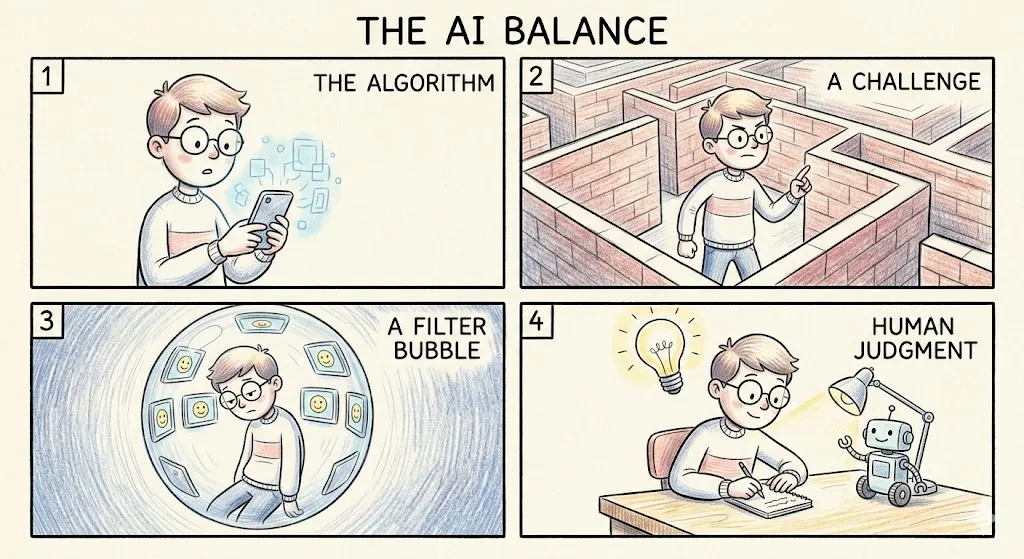
Artificial Intelligence (AI) is designed to make our lives easier by handling difficult tasks. Today, AI helps us write emails, choose movies, and even drive cars. While these tools save time, some experts worry about the long-term effects on the human mind. When we stop doing things for ourselves, we might lose important skills. This process is called 'cognitive offloading.' It means we rely on technology to do the thinking for us. If we always follow an algorithm's advice, we might forget how to make our own choices or solve problems without help.
Vocabulary_explanations
Handling: Dealing with or managing a specific task or situation.Long-term: Occurring over a long period of time in the future.Cognitive offloading: Using external tools, like technology, to reduce the mental effort needed for a task.Rely on: To depend on someone or something for support or help.Algorithm: A set of rules or instructions followed by a computer to solve a problem.Advice: An opinion or suggestion about what someone should do.Choices: Decisions made between two or more possibilities.Questions:- Question: AI is primarily designed to make human tasks more difficult.Options:
- True
- False
Answer: False - Question: What does 'cognitive offloading' involve?Options:
- A) Learning new languages
- B) Using technology to do mental work
- C) Exercising the brain daily
Answer: B) Using technology to do mental work - Question: According to the text, what might happen if we always follow algorithms?Options:
- A) We become faster at math
- B) We might forget how to make our own decisions
- C) We will have more free time for hobbies
Answer: B) We might forget how to make our own decisions
- Part_number: 2Text:
The main concern is that AI takes away the 'friction' in our lives. Friction refers to the small challenges that force us to think and learn. For example, finding your way without GPS requires effort and builds navigation skills. When AI removes these challenges, life becomes smoother, but our brains become less active. Philosophers argue that we need these struggles to grow as individuals. Without the need to struggle or choose, we might become passive. This could lead to a future where humans find it hard to think deeply or act independently.
Vocabulary_explanations
Concern: A feeling of worry about a particular situation.Friction: In this context, the challenges or difficulties that require mental effort.Challenges: Tasks or situations that test someone's abilities.Requires: Needs something or makes it necessary.Navigation: The process of finding the way to a place.Philosophers: People who study the fundamental nature of knowledge and existence.Struggles: Difficult tasks that require a lot of effort to complete.Passive: Accepting what happens without active response or resistance.Deeply: In a way that shows great thought or serious feeling.Independently: Doing something without being helped or influenced by others.Questions:- Question: In this text, 'friction' represents helpful challenges.Options:
- True
- False
Answer: True - Question: What is an example of a skill that might weaken due to AI?Options:
- A) Navigation
- B) Running
- C) Sleeping
Answer: A) Navigation - Question: Why do philosophers think 'struggle' is important?Options:
- A) It makes people angry
- B) it helps individuals grow
- C) It saves electricity
Answer: B) it helps individuals grow
- Part_number: 3Text:
Furthermore, AI often predicts what we want based on our past behavior. This creates a 'filter bubble' where we only see things we already like. This limits our exposure to new ideas and different perspectives. To stay sharp, we must balance our use of AI. We should use technology as a tool, not a replacement for our own judgment. By choosing to do some things the 'hard way,' we can maintain our critical thinking. Ultimately, the goal is to enjoy the convenience of AI without losing the qualities that make us human.
Vocabulary_explanations
Predicts: Says that something will happen in the future.Filter bubble: A situation where an internet user only sees information that reinforces their own beliefs.Exposure: The state of being introduced to or experiencing something.Perspectives: Particular attitudes or ways of considering a matter; points of view.Sharp: Quick to notice or understand things; mentally alert.Balance: A situation in which different things exist in equal or correct amounts.Replacement: Something that takes the place of another thing.Judgment: The ability to make considered decisions or come to sensible conclusions.Maintain: To keep something at the same level or standard.Convenience: The quality of being useful, easy, or suitable for someone.Questions:- Question: A 'filter bubble' helps you see many different points of view.Options:
- True
- False
Answer: False - Question: How should we use AI according to the text?Options:
- A) As a total replacement for our brain
- B) As a tool, but not a replacement for judgment
- C) Not at all
Answer: B) As a tool, but not a replacement for judgment - Question: What is the 'hard way' mentioned in the text?Options:
- A) Breaking the computer
- B) Doing tasks manually to keep the mind active
- C) Paying more money for AI
Answer: B) Doing tasks manually to keep the mind active
References
Recommended for You
Smart Study Secrets: Easy Ways to Ace Your Tests
Discover easy, science-backed study tips for middle schoolers to improve memory, prepare for exams, and study with confi...
Study Smarter, Not Harder: Science-Backed Exam Strategies
Discover science-backed study tips for middle schoolers to prepare for exams, improve memory, beat stress, and achieve t...

Interviews on AI: Thai Graduates at a Career Crossroads
Explore three personal interview perspectives on how AI will shape job opportunities for university graduates in Thailan...