The Great Silence: Exploring the Fermi Paradox
Explore the Fermi Paradox and the 'Great Filter' theory with Brian Cox, examining why we haven't found alien life yet.
The Great Silence: Exploring the Fermi Paradox
Explore the Fermi Paradox and the 'Great Filter' theory with Brian Cox, examining why we haven't found alien life yet.
Title
The Great Silence: Exploring the Fermi ParadoxSeo_intro
Discover the Fermi Paradox and the Great Filter theory. Explore scientific reasons why we haven't found alien life yet.
Parts
- Part_number: 1Text:
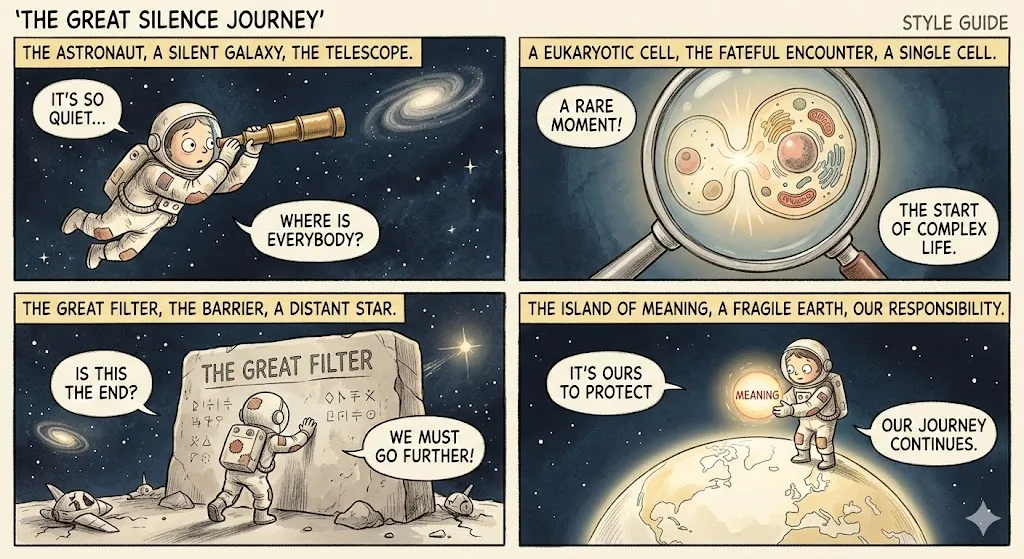
The Fermi Paradox remains one of the most chilling mysteries in modern science. In the mid-20th century, physicist Enrico Fermi famously pondered, 'Where is everybody?' Considering the billions of stars in our galaxy and the trillions of planets orbiting them, the mathematical probability of alien civilizations seems high. Yet, we observe a 'Great Silence.' This discrepancy between high probability and lack of evidence defines the paradox. If the universe is teeming with life, why haven't we heard a single broadcast or seen a single mega-structure? This silence forces us to question our assumptions about the prevalence of intelligent life.
Vocabulary_explanations
Chilling: frightening or causing a feeling of dread.Pondered: thought about something carefully for a long time.Orbiting: moving in a curved path around a star or planet.Discrepancy: a lack of agreement or a difference between two facts.Teeming: being full of or swarming with something.Broadcast: a signal or program sent out by radio or television.Mega-structure: an extremely large man-made (or alien-made) object.Assumptions: things that are accepted as true without proof.Prevalence: the fact of being common or happening often.Paradox: a situation that seems impossible because it has opposite features.Questions:- Question: The Fermi Paradox was named after a physicist who asked why aliens haven't contacted us.Answer: True
- Question: What is the 'Great Silence' mentioned in the text?Options:
- A) A library in space
- B) The lack of evidence for alien civilizations
- C) A specific planet without sound
- D) The end of the universe
Answer: B) The lack of evidence for alien civilizations - Question: Based on the text, why is the probability of alien life considered high?Options:
- A) Because we have seen UFOs
- B) Because of the vast number of stars and planets
- C) Because aliens have sent broadcasts
- D) Because the universe is very old
Answer: B) Because of the vast number of stars and planets
- Part_number: 2Text:
One potential answer to this mystery is the Rare Earth hypothesis. This theory suggests that the environmental conditions required for complex life are exceedingly specific and perhaps unique to Earth. Our planet has maintained an unbroken chain of life for nearly four billion years. This stability is remarkable given the violent nature of the cosmos, which is filled with supernova explosions and drifting asteroids. Factors such as Earth's stable orbit, its protective atmosphere, and the presence of a single, reliable sun may be prerequisites that are rarely met elsewhere. Without this long-term consistency, biological evolution might be cut short before reaching intelligence.
Vocabulary_explanations
Hypothesis: a suggested explanation for something that has not been proven.Exceedingly: to a very great degree; extremely.Maintained: kept something in good condition or continued a process.Unbroken: continuous; not interrupted or damaged.Cosmos: the universe seen as a well-ordered whole.Supernova: a star that suddenly increases greatly in brightness because of a catastrophic explosion.Drifting: moving slowly with no fixed direction.Prerequisites: things that must exist or happen before something else can happen.Consistency: the quality of always behaving or performing in a similar way.Cut short: stopped or ended earlier than expected.Questions:- Question: The Rare Earth hypothesis claims that life is likely to be found on most planets.Answer: False
- Question: How long has life continuously existed on Earth?Options:
- A) 1 million years
- B) 4 billion years
- C) 400 billion years
- D) 100 years
Answer: B) 4 billion years - Question: According to the text, what makes our planet's stability 'remarkable'?Options:
- A) The lack of water
- B) The violent nature of the universe
- C) The large size of the sun
- D) The speed of evolution
Answer: B) The violent nature of the universe
- Part_number: 3Text:
Technological limitations offer another perspective on why we are alone. It is possible that advanced civilizations exist but remain undetectable to our current instruments. Some scientists propose that aliens might utilize nano-technology so miniaturized that we simply overlook it. Additionally, the sheer scale of interstellar space causes signals to become diluted and weak as they traverse light-years. We also have to consider the concept of von Neumann machines—autonomous, self-replicating probes. If a civilization had perfected such technology, they could theoretically map the entire galaxy within a few million years. Their absence suggests that no one has achieved this level of technological exponentiation yet.
Vocabulary_explanations
Limitations: restrictions or weak points in ability or technology.Perspective: a particular way of considering something; a viewpoint.Instruments: tools or devices used for scientific work.Miniaturized: made in a very small size using modern technology.Overlook: to fail to notice or consider something.Sheer: used to emphasize the large size or weight of something.Diluted: made weaker or less effective.Traverse: to move across or through an area.Autonomous: acting independently or having the freedom to do so.Exponentiation: the process of increasing at a very rapid, accelerating rate.Questions:- Question: Von Neumann machines are hypothetical robots that can make copies of themselves.Answer: True
- Question: Why might we fail to detect alien signals according to this part?Options:
- A) They use ancient technology
- B) Signals become weak over long distances
- C) Aliens do not use electricity
- D) We are looking in the wrong galaxy
Answer: B) Signals become weak over long distances - Question: What does the absence of self-replicating probes suggest?Options:
- A) Technology is impossible to improve
- B) No civilization has reached that high level of technology
- C) Aliens are hiding their robots
- D) The galaxy is too small for probes
Answer: B) No civilization has reached that high level of technology
- Part_number: 4Text:
The most daunting explanation is the 'Great Filter.' This theory posits that there is a developmental barrier that prevents most civilizations from becoming interstellar. This filter might lie in our future rather than our past. As a species develops nuclear energy, genetic engineering, or artificial intelligence, its technical prowess often outpaces its social and political wisdom. A civilization might inadvertently trigger its own destruction through war or ecological collapse before it ever leaves its home planet. If the filter is ahead of us, it serves as a grim warning about the inherent risks of rapid technological advancement and self-destruction.
Vocabulary_explanations
Daunting: making you feel slightly frightened or worried about your ability to achieve something.Posits: suggests or accepts something as a fact or base for argument.Developmental: relating to the process of growing or changing into a more advanced state.Interstellar: occurring or situated between stars.Prowess: great skill or ability in a particular field.Outpaces: moves or develops faster than something else.Inadvertently: without intention; accidentally.Ecological: relating to the relation of living things to their environment.Grim: worrying, without hope, or very serious.Inherent: existing as a natural or basic part of something.Questions:- Question:
The 'Great Filter' theory suggests that civilizations might destroy themselves before they can travel to other stars.
Answer: True - Question: Where might the 'Great Filter' be located for humanity?Options:
- A) Only in our ancient history
- B) Potentially in our future
- C) On the moon
- D) In the deep ocean
Answer: B) Potentially in our future - Question: What is mentioned as a risk that could 'outpace' our wisdom?Options:
- A) Farming techniques
- B) Technical prowess (like AI or nuclear energy)
- C) Ancient philosophy
- D) Art and music
Answer: B) Technical prowess (like AI or nuclear energy)
- Part_number: 5Text:
Alternatively, the filter may be biological. The transition from simple, single-celled organisms to complex, multicellular life is a massive evolutionary leap. On Earth, this 'fateful encounter' involving the evolution of the eukaryotic cell took billions of years. If this specific event was a freak accident of nature, then sentient life might be incredibly rare. Professor Brian Cox recently emphasized that Earth could be the only 'island of meaning' in a vast, empty sea of stars. This realization places a tremendous responsibility on humanity to safeguard our world. We are the universe's only chance to understand itself, making our survival paramount.
Vocabulary_explanations
Transition: a change from one system or state to another.Multicellular: consisting of many cells.Leap: a big change, increase, or improvement.Fateful: having an important and usually negative effect on the future.Encounter: a meeting, especially one that is sudden or unexpected.Sentient: able to experience feelings and be aware of things.Emphasized: showed that something is very important or worth giving attention to.Island: a place that is separate from others (used metaphorically here).Safeguard: to protect something from harm or destruction.Paramount: more important than anything else.Questions:- Question:
The evolution of the eukaryotic cell is described as a 'fateful encounter' that happened very quickly.
Answer: False - Question: According to Brian Cox, what is Earth's role in the universe?Options:
- A) It is a massive planet
- B) It is an 'island of meaning'
- C) It is the center of the galaxy
- D) It is an accidental rock
Answer: B) It is an 'island of meaning' - Question: Why is human survival considered 'paramount' at the end of the text?Options:
- A) Because we are the universe's only chance to understand itself
- B) Because we need more technology
- C) Because we want to find aliens
- D) Because the earth is too small
Answer: A) Because we are the universe's only chance to understand itself
References
Critical Thinking
Which of the three modern 'obstacles' (climate change, AI, or weapons) do you believe is the most difficult part of the Great Filter for humanity to overcome?
Do you think a global government or better international cooperation is a necessary prerequisite to passing the Great Filter?
Recommended for You

Smart Study Secrets: Easy Ways to Ace Your Tests
Discover easy, science-backed study tips for middle schoolers to improve memory, prepare for exams, and study with confi...

Study Smarter, Not Harder: Science-Backed Exam Strategies
Discover science-backed study tips for middle schoolers to prepare for exams, improve memory, beat stress, and achieve t...

Interviews on AI: Thai Graduates at a Career Crossroads
Explore three personal interview perspectives on how AI will shape job opportunities for university graduates in Thailan...