
Heroes or Villains? Pirates, Privateers, and Buccaneers
Learn about the differences between pirates, privateers, and buccaneers in this B1 English reading and vocabulary worksheet.
Title
Heroes or Villains? Pirates, Privateers, and BuccaneersSeo_intro
Learn about the differences between pirates, privateers, and buccaneers in this B1 English reading and vocabulary worksheet.
Reading Text
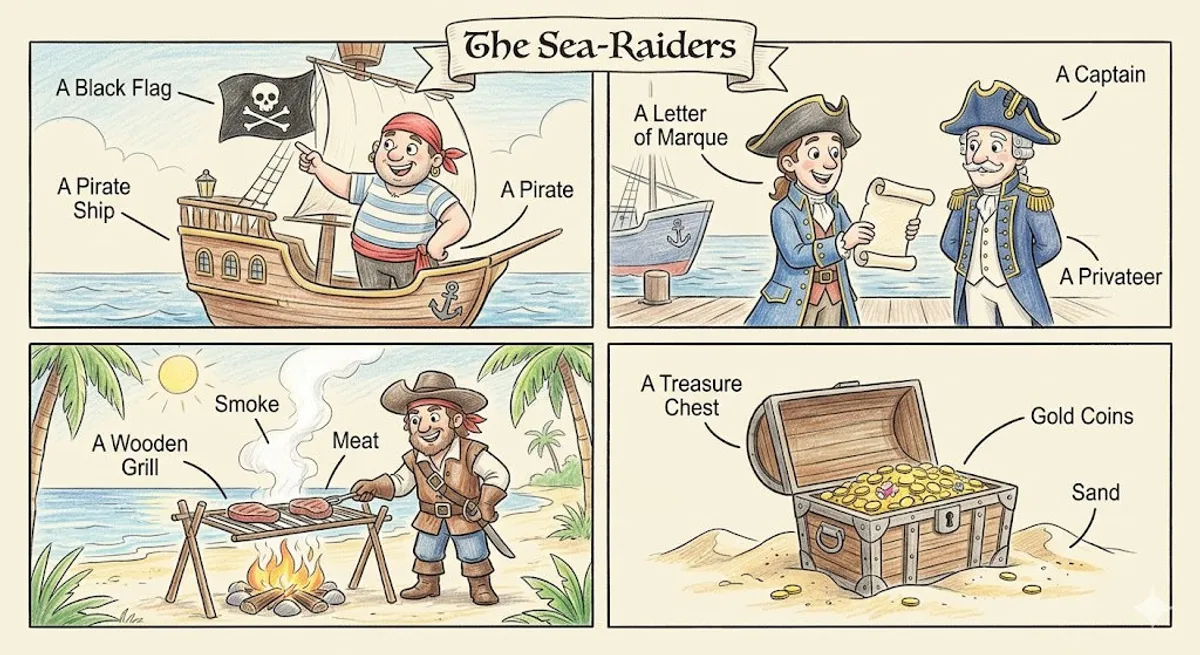
When we think of history on the high seas, we often imagine eye patches, parrots, and wooden legs. In movies, everyone is called a "pirate." However, in the 17th and 18th centuries, the ocean was much more complicated. There were three main types of sea-raiders: pirates, privateers, and buccaneers. The Pirate: The Lawbreaker A pirate was a criminal who operated outside the law. They did not work for any country or king. Instead, they attacked any ship they could find to steal gold, food, and supplies. Because they attacked everyone, they were considered "enemies of all mankind." If a pirate was caught, they were usually executed because they had no legal protection. The Privateer: The Legal Sailor A privateer was very different because they had a special legal document called a Letter of Marque. During times of war, a government (like England or France) would hire private ship owners to attack enemy ships. In a way, they were like a "private navy." Privateers were allowed to keep most of the treasure they found, but they had to give a small part to their government. If a privateer was captured by the enemy, they were treated as prisoners of war, not as criminals. The Buccaneer: The Caribbean Hunter The word "buccaneer" describes a specific group of people living in the Caribbean. Originally, they were not sailors; they were hunters who smoked meat on wooden grills called boucans. After the Spanish government tried to kick them off their land, the buccaneers began to attack Spanish ships for revenge. Most buccaneers lived on the islands of Tortuga or Hispaniola. While they were technically pirates, they often worked as privateers for England and France to fight against Spain. The End of an Era By the early 1700s, European countries became more powerful and no longer needed privateers. They started to arrest anyone who attacked ships. Many buccaneers and privateers had to choose: find a new job, or become a full-time pirate. This transition led to the famous "Golden Age of Piracy" that we see in movies today. Life for all these sea-raiders was incredibly dangerous, facing terrible storms, disease, and the constant threat of battle before their era finally faded into history.
Activities
Vocabulary
- Label: suppliesAnswer: v1
- Label: executedAnswer: v2
- Label: capturedAnswer: v3
- Label: revengeAnswer: v4
- Label: arrestAnswer: v5
- Label: transitionAnswer: v6
- Text: Food, equipment, and other essential things needed for a journey or purpose.
- Text: Killed as a legal punishment for a crime.
- Text: Caught and held as a prisoner by an enemy.
- Text: The act of hurting someone because they have hurt you first.
- Text: To use legal authority to catch and hold someone who broke the law.
- Text: A change from one state, condition, or role to another.
- Before: The ship had to return to port because they ran out of fresh water and other importantAfter: .Answer: supplies
- Before: The famous sea captain was finallyAfter: by the royal navy after a long chase.Answer: captured
- Before: He attacked the enemy ship to getAfter: for his fallen crew members.Answer: revenge
- Before: The town guards willAfter: anyone who tries to steal from the market.Answer: arrest
- Before: TheAfter: from a legal privateer to an illegal pirate was a difficult choice for many sailors.Answer: transition
Comprehension
- Text: A pirate worked legally for a specific king or country.Answer: false
- Text: Privateers carried a legal document called a Letter of Marque.Answer: true
- Text: Buccaneers originally lived in the Caribbean as farmers.Answer: false
- Text: Privateers were treated as criminals if they were caught by the enemy.Answer: false
- Text: The Golden Age of Piracy began when countries stopped needing privateers.Answer: true
- Text: law / criminal / operated / pirate / A / the / was / outside / a / whoAnswer: A pirate was a criminal who operated outside the law.
- Text: keep / treasure / to / most / Privateers / allowed / the / of / wereAnswer: Privateers were allowed to keep most of the treasure.
- Text: find / ship / attacked / could / any / They / theyAnswer: They attacked any ship they could find.
- Text: lived / Tortuga / Most / islands / buccaneers / of / the / onAnswer: Most buccaneers lived on the islands of Tortuga.
- Text: days / ocean / complicated / much / The / more / those / in / wasAnswer: The ocean was much more complicated in those days.
Written Expression
- Text: If you lived in the 17th century, would you rather be a privateer or a buccaneer? Explain why.
- Text:
Why do you think pirates are often shown as heroes or fun characters in modern movies, even though they were criminals?
I would rather be a privateer because they had legal protection from their government. This means it would be much safer than being a buccaneer or a regular pirate.
Critical Thinking
- Compare and contrast the legal status of pirates and privateers based on the text.
Discuss the economic reasons why a government in the 1700s might hire privateers instead of building a larger navy.
Recommended for You
François l'Olonnais: The Feared French Buccaneer
Learn about the life of François l'Olonnais, a famous French buccaneer who sailed the Caribbean Sea in the 17th century.
Friendship in the Digital Age
Explore how the internet has changed friendships, the loneliness paradox, and the importance of setting boundaries in re...

Surviving the Storms
Learn about handling conflict in friendships and why having a smaller group of friends is completely normal as you grow ...