
Friendship in the Digital Age
Explore how the internet has changed friendships, the loneliness paradox, and the importance of setting boundaries in relationships.
Title
Friendship in the Digital AgeSeo_intro
Explore how the internet has changed friendships, the loneliness paradox, and the importance of setting boundaries in relationships.
Reading Text
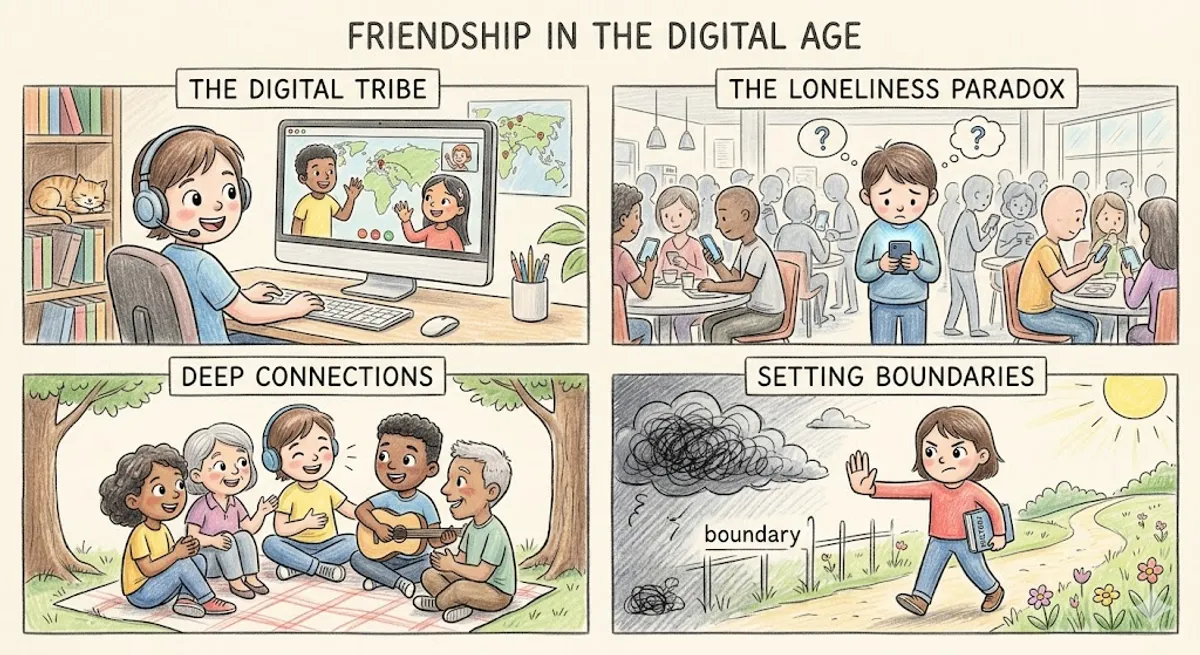
The rules of friendship have completely changed in recent years. In the past, you could only be friends with people who lived in your local neighborhood or went to your school. Today, the internet and digital spaces allow us to find our "tribe" anywhere in the world. For many teens and young adults, online friends feel just as real and supportive as people they see in real life. These digital friendships are often built on shared niche interests, like a specific movie fandom, computer coding, or playing multiplayer video games. You can connect deeply with someone across the globe just because you both love the exact same things. However, the modern age also brings a unique and frustrating challenge known as the "loneliness paradox." Have you ever felt completely alone, even right after scrolling through your busy social media feed or standing in a crowded school cafeteria? This strange feeling happens because the human brain has a cognitive limit to how many deep relationships we can handle at one time. Scientists believe we can only maintain about five very close, meaningful relationships. Collecting hundreds of online "followers" or casual acquaintances does not actually cure loneliness. To truly feel connected, we need deep, vulnerable relationships where we can share our honest thoughts and emotions. Finally, it is incredibly important to talk about setting boundaries in our relationships. Sometimes, we hold onto a friendship simply because we have known the person since kindergarten. But people change as they grow up. If a friendship becomes toxic, emotionally draining, or completely one-sided, it is okay to walk away. Just because you have a long history with someone does not mean you owe them your future time and energy. Knowing when to end a bad friendship is just as important as knowing how to keep a good one. Learning to protect your mental health is a crucial part of navigating the digital age.
Activities
Vocabulary
- Label: localAnswer: v1
- Label: nicheAnswer: v2
- Label: fandomAnswer: v3
- Label: paradoxAnswer: v4
- Label: cognitiveAnswer: v5
- Label: acquaintancesAnswer: v6
- Label: vulnerableAnswer: v7
- Label: boundariesAnswer: v8
- Label: toxicAnswer: v9
- Label: drainingAnswer: v10
- Text: relating to a particular area, city, or neighborhood
- Text: a very specific and specialized area of interest
- Text: a community of fans who love a specific book, movie, or game
- Text: a situation that seems impossible because it contains two opposite facts
- Text: related to thinking, understanding, and the brain
- Text: people you know slightly, but who are not close friends
- Text: open to sharing true feelings, even if it feels emotionally risky
- Text: limits you set to protect your personal time, energy, and mental health
- Text: very harmful, damaging, or unpleasant in a relationship
- Text: causing you to lose all your physical or emotional energy
- Before: We buy all our vegetables from theAfter: farmers market down the street.Answer: local
- Before: Collecting antique fountain pens is a veryAfter: hobby.Answer: niche
- Before: The sci-fi convention was packed with members of theAfter: .Answer: fandom
- Before: It is aAfter: that the more we try to control things, the less control we have.Answer: paradox
- Before: Solving complex puzzles is good for yourAfter: development.Answer: cognitive
- Before: I have manyAfter: at work, but only two close friends.Answer: acquaintances
- Before: It is hard to beAfter: and admit when you are scared or hurting.Answer: vulnerable
- Before: You need to set healthyAfter: so people don't take advantage of your kindness.Answer: boundaries
- Before: A friendship isAfter: if it constantly makes you feel bad about yourself.Answer: toxic
- Before: Arguing with him every single day is completely emotionallyAfter: .Answer: draining
Comprehension
- Text: Before the internet, people usually only made friends with people who lived near them.Answer: true
- Text: The "loneliness paradox" means that social media always cures loneliness.Answer: false
- Text: The human brain can handle hundreds of deep, meaningful relationships at the same time.Answer: false
- Text: You should always stay friends with someone if you have known them since kindergarten.Answer: false
- Text: Ending a toxic friendship is an important part of protecting your mental health.Answer: true
- Text: rules / completely / The / changed / friendship / have / ofAnswer: The rules of friendship have completely changed.
- Text: online / support / give / friends / can / realAnswer: Online friends can give real support.
- Text: limit / brain / a / The / cognitive / hasAnswer: The brain has a cognitive limit.
- Text: cure / online / does / loneliness / Collecting / followers / notAnswer: Collecting online followers does not cure loneliness.
- Text: to / okay / away / walk / is / It / absolutelyAnswer: It is absolutely okay to walk away.
Written Expression
- Text: Do you have any online friends? What niche interests do you share with them?
- Text: Have you ever experienced the 'loneliness paradox'? Describe what it felt like.
Yes, I have online friends I play chess with. We share a niche interest in learning new chess strategies.
I have experienced the loneliness paradox when I was at a big concert. Even though there were thousands of people, I felt alone because I didn't know anyone there.
Critical Thinking
- How do you balance the time you spend maintaining online friendships versus in-person friendships?
- Why is it sometimes difficult to set boundaries with a friend you have known for a very long time?
References
Recommended for You
Surviving the Storms
Learn about handling conflict in friendships and why having a smaller group of friends is completely normal as you grow ...
The Science of Making Friends
Learn about the science of proximity and Aristotle's three types of friendships in this B1 English reading passage.
Kevin-10: New Best Friends
An A2 English reading worksheet about Kevin the Koala meeting a funny kangaroo named Joey and learning how to use conjun...