
Uncovering the Past: The Work of Archaeologists
Discover how archaeologists excavate ancient sites, analyze artifacts in laboratories, and reveal the secrets of early human history.
Uncovering the Past: The Work of Archaeologists
Discover how archaeologists excavate ancient sites, analyze artifacts in laboratories, and reveal the secrets of early human history.
Title
Uncovering the Past: The Work of ArchaeologistsSeo_intro
Discover how archaeologists excavate ancient sites, analyze artifacts in laboratories, and reveal the secrets of early human history.
Reading Text
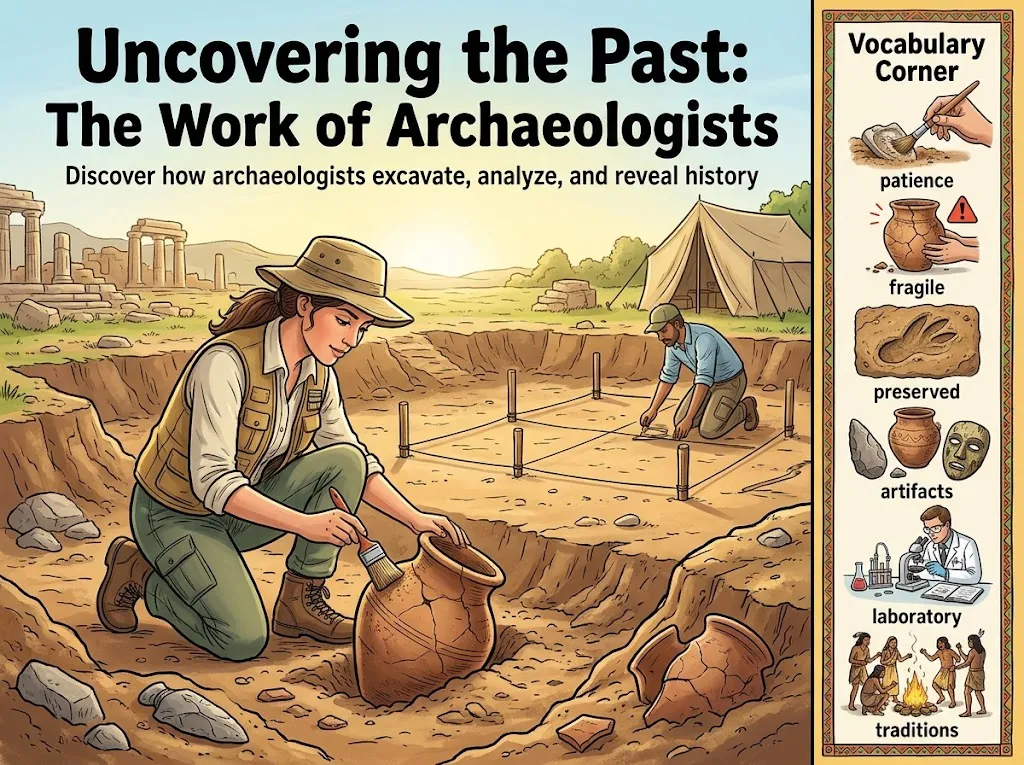
Archaeologists are historians who study people from the past. Their tasks require great patience and careful planning. They do not search for gold or ghosts; they look for real facts about human life. Teams work on exciting field projects around the world. On excavation sites, workers dig slowly so they do not break fragile objects. They uncover clay pots, stone tools, and ancient burial masks. They also make plaster casts of footprints preserved in old soil. Every find gives new facts about how people lived thousands of years ago. Workers place wooden posts into the ground to divide each area. They write detailed lists of every item they discover. Later, researchers take the artifacts to a quiet laboratory. They sit at large desks and run chemical tests on the materials. These tests show the exact age of each item. Studying ancient artifacts takes months of work, but the results are wonderful. Museums display these rare objects behind glass. Visitors look at gold masks and read about old traditions, helping us understand where our modern world began.
Activities
Vocabulary
- Label: patienceAnswer: def_1
- Label: fragileAnswer: def_2
- Label: preservedAnswer: def_3
- Label: artifactsAnswer: def_4
- Label: laboratoryAnswer: def_5
- Label: traditionsAnswer: def_6
- Text: the ability to stay calm and wait without becoming annoyed or upset
- Text: easily broken or damaged
- Text: kept in good condition over a very long period of time
- Text: objects made by humans in the past, especially ones of historical interest
- Text: a room or building equipped for scientific experiments and tests
- Text: customs or beliefs passed down from generation to generation
- Before: The old clay pot is veryAfter: , so please hold it with both hands.Answer: fragile
- Before: Working with small pieces of stone requires a lot ofAfter: and care.Answer: patience
- Before: Scientists discovered animal footprintsAfter: in the hardened mud.Answer: preserved
- Before: The researchers examined the ancientAfter: under bright lights.Answer: artifacts
- Before: Technicians test the soil samples in a modernAfter: before sharing the results.Answer: laboratory
Comprehension
- Text: Archaeologists spend most of their time looking for gold and ghosts.Answer: false
- Text: Workers dig slowly on excavation sites to protect delicate objects.Answer: true
- Text: Footprints found in ancient soil are recorded using plaster casts.Answer: true
- Text: Researchers test artifacts outdoors immediately after finding them.Answer: false
- Text: Chemical tests help researchers determine the exact age of items.Answer: true
- Answer: Archaeologists study human life from the past.
- Answer: Workers dig slowly to protect fragile objects.
- Answer: They make plaster casts of ancient footprints.
- Answer: Researchers test the artifacts in a laboratory.
- Answer: Museums display rare objects for visitors to see.
Written Expression
- Text:
Imagine you are an archaeologist on a dig site. Describe one object you discovered and explain what it tells you about the people who made it.
- Text: Why is it important to protect and study historical artifacts in museums instead of selling them?
Example 1: Yesterday, our team uncovered a small clay bowl near the river. It has decorative lines painted along the rim, which suggests that ancient families valued art in everyday items.
Example 2: Displaying artifacts in museums allows everyone in the community to learn about our shared history and respect past cultures.
Critical Thinking
If archaeologists from the future excavated your hometown 1,000 years from now, what three everyday objects would they find, and what wrong conclusions might they make about our lives?
Some ancient sites are located in areas where people need to build new roads or homes. How should communities balance preserving the past with building modern infrastructure?
Recommended for You
History: Finding the Rosetta Stone
Learn about the discovery of the Rosetta Stone in Egypt and how it helped unlock ancient hieroglyphs in this A2 English ...
The Desert Fennec Fox
Learn about the fennec fox and how this small desert animal survives hot days and cold nights in the sand dunes.
Science (Biology): How Bats Protect Farm Crops
An A2-level English reading worksheet exploring how nocturnal bats help farmers by eating crop-damaging insect pests.