The Desert Fennec Fox
Learn about the fennec fox and how this small desert animal survives hot days and cold nights in the sand dunes.
The Desert Fennec Fox
Learn about the fennec fox and how this small desert animal survives hot days and cold nights in the sand dunes.
Title
The Desert Fennec FoxSeo_intro
Learn about the fennec fox and how this small desert animal survives hot days and cold nights in the sand dunes.
Reading Text
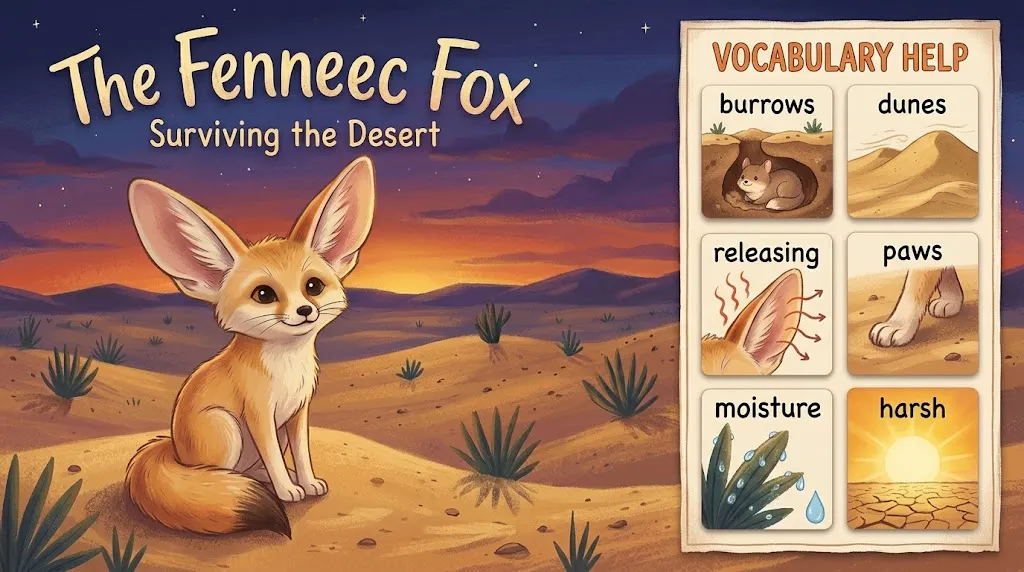
The fennec fox is a small animal that lives in very hot and dry deserts. During the daytime, the hot sun makes the desert dangerous. To stay cool and save energy, the fox sleeps in cool underground burrows. When the sun goes down and twilight begins, the fox comes out to hunt across the sandy dunes. The fox has very large ears. These big ears help it stay cool by releasing extra heat from its body. Its ears can also hear tiny sounds made by small animals under the sand. The fox has soft, thick fur on its paws. This fur protects its feet from the hot sand and helps it walk quietly. The fennec fox hunts at night for insects, lizards, and small birds. It does not need to drink open pools of water often because it gets moisture directly from its food. These special features help the small fennec fox live happily in the harsh desert.
Activities
Vocabulary
- Label: burrowsAnswer: def_1
- Label: dunesAnswer: def_2
- Label: releasingAnswer: def_3
- Label: pawsAnswer: def_4
- Label: moistureAnswer: def_5
- Label: harshAnswer: def_6
- Text: holes or tunnels in the ground where animals sleep or hide
- Text: hills of sand made by the wind in a desert or beach
- Text: letting heat, air, or something go out into the open
- Text: the feet of an animal that has claws or pads
- Text: small amounts of water or wetness inside something
- Text: very difficult, uncomfortable, or severe to live in
- Before: Rabbits and foxes dig undergroundAfter: to hide from enemies and sleep safely.Answer: burrows
- Before: The camel walked slowly over the tall sandAfter: in the Sahara Desert.Answer: dunes
- Before: The dog burned its softAfter: when it ran on the hot summer sidewalk.Answer: paws
- Before: Desert plants storeAfter: in their leaves so they can live without rain.Answer: moisture
- Before: Winter in the arctic is very cold andAfter: for wild animals.Answer: harsh
Comprehension
- Text: The fennec fox hunts during the hottest part of the midday sun.Answer: false
- Text: The fox sleeps inside underground burrows to stay cool.Answer: true
- Text: The large ears of the fennec fox help release extra body heat.Answer: true
- Text: Thick fur on its paws protects the fox's feet from hot sand.Answer: true
- Text: The fennec fox must drink water from large rivers every single day.Answer: false
- Answer: The fennec fox lives in dry deserts.
- Answer: Large ears keep the small fox cool.
- Answer: It hunts small insects across the sand.
- Answer: Thick fur on its paws protects its feet.
- Answer: The fox gets water from its daily food.
Written Expression
- Text: Describe the fennec fox and explain one way its body helps it survive in the desert.
- Text: Imagine you are exploring a desert at twilight. Write about what you see and hear.
Example 1: The fennec fox has very big ears. These ears help it stay cool in the hot sand and hear small insects underground.
Example 2: At twilight, the sky turns orange and purple over the quiet dunes. I feel the cool wind and hear a small fox walking softly on the sand.
Critical Thinking
Why is it safer and easier for a small desert predator to hunt at night instead of during the daytime?
If a fennec fox were moved to a cold, snowy forest, what physical traits would be helpful, and what traits would cause problems?
Recommended for You

History: Finding the Rosetta Stone
Learn about the discovery of the Rosetta Stone in Egypt and how it helped unlock ancient hieroglyphs in this A2 English ...
Science (Biology): How Bats Protect Farm Crops
An A2-level English reading worksheet exploring how nocturnal bats help farmers by eating crop-damaging insect pests.
Scrapping Plastic Plates
An A2 reading lesson exploring how eco-friendly materials like banana leaves and sugarcane fiber replace single-use plas...