The 'How Are You?' Mystery
Learn why the American greeting 'How are you?' is often a social ritual rather than a literal question about health or well-being. (B1 Level)
The 'How Are You?' Mystery
Learn why the American greeting 'How are you?' is often a social ritual rather than a literal question about health or well-being. (B1 Level)
Title
The 'How Are You?' MysterySeo_intro
Explore why the American greeting 'How are you?' is a social ritual rather than a literal question about your well-being.
Parts
- Part_number: 1Text:
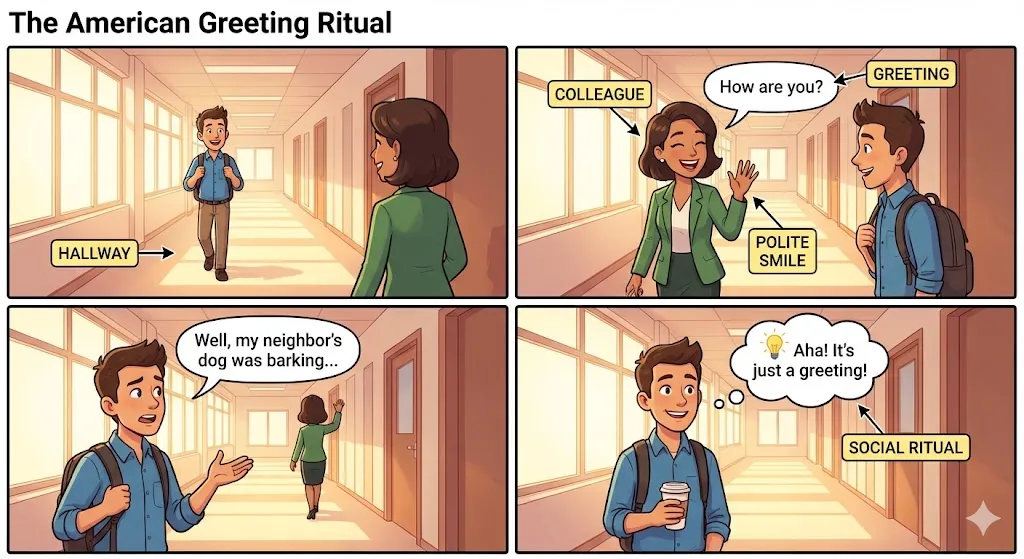
If you have spent even five minutes in the United States, you have likely encountered a confusing situation. You walk into a shop or pass a colleague in the hallway, and they say, 'Hey, how are you?' You might start to explain that you are a bit tired because your neighbor’s dog was barking all night. However, before you can even finish your second sentence, the person has already smiled and walked away. This can feel very rude or confusing if you are not used to it, but there is a specific reason for this behavior in American culture.
Vocabulary_explanations
Encountered: to meet or come across something unexpectedlyConfusing: difficult to understand or making you feel uncertainColleague: a person that you work withHallway: a long narrow passage in a building with doors that lead to roomsBarking: the sharp explosive cry of a dogRude: not polite; offensive or embarrassingBehavior: the way that someone actsCulture: the habits, traditions, and beliefs of a country or groupSpecific: particular; relating to one thing and not othersLikely: probably; almost certain to happenQuestions:- Question: Where might you encounter this 'confusing' situation?Options:
- In a hospital
- In a shop or hallway
- In a quiet library
- On an airplane
Answer: In a shop or hallway - Question: The text suggests that people walk away because they are intentionally trying to be mean.Options:
- True
- False
Answer: False - Question: In the example provided, why is the speaker feeling tired?Options:
- They worked late
- Their neighbor's dog was barking
- They were traveling
- They were sick
Answer: Their neighbor's dog was barking
- Part_number: 2Text:
In many parts of the world, 'How are you?' is a sincere question about your health or your feelings. In the United States, however, it is primarily used as a standard greeting, much like saying 'Hello.' When an American asks this in a passing or casual setting, they are simply acknowledging your presence and trying to be friendly. They are not usually looking for a deep emotional update or a medical report. It is a social ritual used to establish a polite and positive atmosphere before moving on to the next task.
Vocabulary_explanations
Sincere: honest and saying what you really feel or believePrimarily: mainly; mostlyGreeting: something friendly that you say or do when you meet someoneCasual: relaxed and not formalAcknowledging: showing that you have noticed someone or somethingPresence: the fact of being in a particular placeEmotional: relating to strong feelingsUpdate: new information about a situationRitual: a set of fixed actions performed regularlyEstablish: to create or start something that will lastQuestions:- Question: In the U.S., 'How are you?' is often just another way of saying 'Hello.'Options:
- True
- False
Answer: True - Question: What is the primary purpose of this greeting in a casual setting?Options:
- To get a medical report
- To discuss deep feelings
- To acknowledge someone's presence
- To start a long debate
Answer: To acknowledge someone's presence - Question: Americans use this greeting to create a negative atmosphere.Options:
- True
- False
Answer: False
- Part_number: 3Text:
Because this is a greeting rather than a real question, the best response is usually short and positive. Even if you are having a difficult day, most people say something like, 'Good, thanks! You?' or 'Pretty good, how about you?' If you are sitting down for a long lunch or a private meeting, the person might ask again with more detail. In that case, they actually want to hear about your life. But in the hallway or at the grocery store, keep it brief. You can even respond to 'How are you?' by simply saying 'Hey, how’s it going?' and continue walking. It might feel strange at first, but in the U.S., this is considered perfectly polite.
Vocabulary_explanations
Response: an answer or reaction to somethingPositive: hopeful, confident, or goodDifficult: not easy; needing effort or skillPrivate: only for one person or group and not for everyoneDetail: a small part of something; more informationGrocery store: a shop that sells food and other things for the homeBrief: lasting only a short time; using few wordsPerfectly: completely or 100%Polite: behaving in a way that is socially correct and shows respectStrange: unusual or surprising; difficult to understandQuestions:- Question: What is considered a 'good' response in a passing situation?Options:
- A 10-minute story
- A list of health problems
- 'Good, thanks! You?'
- Silence
Answer: 'Good, thanks! You?' - Question: When is it appropriate to give a more detailed answer?Options:
- While walking past someone in a hallway
- At the grocery store checkout
- During a private meeting or long lunch
- When you are in a hurry
Answer: During a private meeting or long lunch - Question: You can respond to 'How are you?' with another greeting like 'How's it going?'Options:
- True
- False
Answer: True
Critical Thinking
Title: Social Rituals and CultureInstructions:Compare the American 'How are you?' to how people greet each other in your home country. Is it more sincere or more ritualized?
- Why do you think cultures develop 'brief' greetings for public spaces instead of long conversations?
Recommended for You

Smart Study Secrets: Easy Ways to Ace Your Tests
Discover easy, science-backed study tips for middle schoolers to improve memory, prepare for exams, and study with confi...

Study Smarter, Not Harder: Science-Backed Exam Strategies
Discover science-backed study tips for middle schoolers to prepare for exams, improve memory, beat stress, and achieve t...

Interviews on AI: Thai Graduates at a Career Crossroads
Explore three personal interview perspectives on how AI will shape job opportunities for university graduates in Thailan...