Avoiding Repetition - Standalone Auxiliaries
Master natural English by replacing repetitive verb phrases with standalone auxiliaries. Practice choosing, typing, and arranging the correct auxiliary forms across thirty interactive challenges.
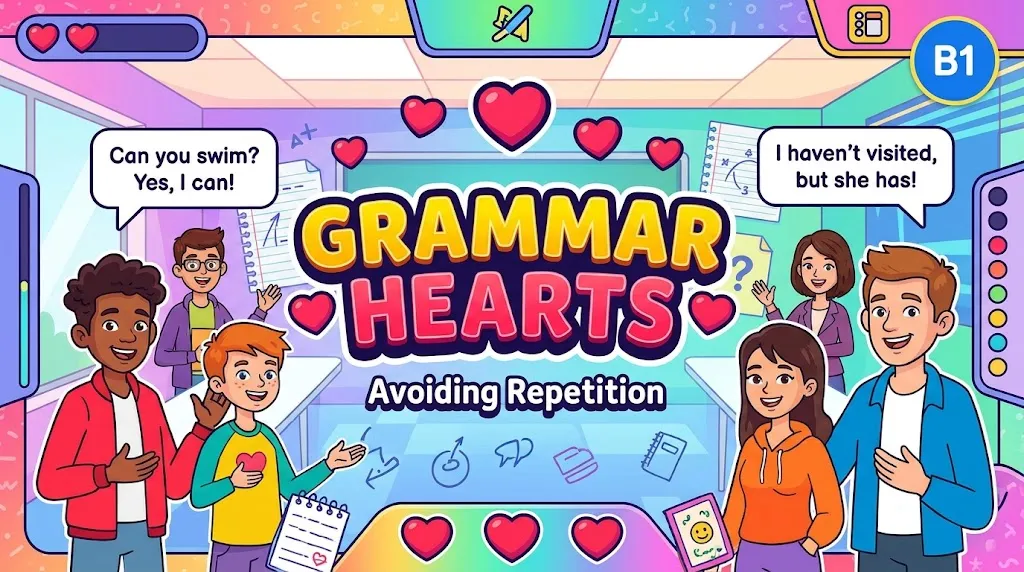
Avoiding Repetition - Standalone Auxiliaries
Master natural English by replacing repetitive verb phrases with standalone auxiliaries. Practice choosing, typing, and arranging the correct auxiliary forms across thirty interactive challenges.
- Title: Avoiding Repetition with Standalone Auxiliaries
Hint
Summary: Standalone Auxiliaries & EllipsisContent:To make speech and writing natural, avoid repeating the full verb phrase by using a **standalone auxiliary**. * **Reusing Auxiliaries & Modals**: Keep the original auxiliary (*be*, *have*) or modal (*can*, *will*, *should*). * *"I haven't visited Chiang Mai, but she **has**."* * *"Can you swim?" — "Yes, I **can**."* * **Do-Support for Main Verbs**: In the Present Simple and Past Simple, replace lexical verbs with *do*, *does*, or *did*. * *"Somsak likes spicy food, but his sister **doesn't**."* * *"We arrived late, and they **did** too."* * **Contraction Prohibition**: Standalone affirmative auxiliaries at the end of a clause carry full stress and **must never be contracted** (*"Yes, I am"* — not *"Yes, I'm"*; *"They are"* — not *"They're"*).
Questions:- Question: Lisa wants to study abroad, but her brother ___.Options:
- doesn't
- isn't
- don't
Explanation: Use **do-support** (*doesn't*) for third-person singular present simple main verbs. - Question: "Have you finished your homework yet?" — "Yes, I ___."Options:
- have
- 've
- did
Explanation:Positive standalone auxiliaries at the end of a sentence **cannot be contracted** (*have*, never *'ve*).
- Question: We enjoyed the concert last night, and Peter ___ too.Options:
- did
- enjoyed
- was
Explanation: Use the past auxiliary **did** to replace the past simple verb *enjoyed*. - Question: Tom can't play the guitar, but his sister ___.Options:
- can
- can play
- is
Explanation: Repeat the modal verb **can** and drop the repeated verb phrase *play the guitar*. - Question: "Are your classmates ready for the presentation?" — "Yes, they ___."Options:
- are
- they're
- do
Explanation:Use the full form **are**. Positive standalone auxiliaries cannot be contracted at the end of an utterance.
- Question: I haven't visited Chiang Mai yet, but my parents ___.Options:
- have
- visited
- did
Explanation: Match the present perfect aspect using the plural auxiliary **have**. - Question: Sam works at a hospital, but I ___.Options:
- don't
- am not
- doesn't
Explanation: Use **don't** for the first-person subject *I* with a present simple main verb. - Question: "Who locked the front gate this afternoon?" — "Ken ___."Options:
- did
- locked
- has
Explanation: Use **did** to substitute for the completed past simple action *locked*. - Question: You should submit your project today, and Sarah ___ too.Options:
- should
- should submit
- does
Explanation: Retain the modal **should** and omit the repeated verb phrase. - Question: We were surprised by the news, but Anna ___.Options:
- wasn't
- didn't
- weren't
Explanation: Match the past copula *be* with the singular subject *Anna* using **wasn't**. - Instruction: Fill in the blank with the correct standalone auxiliary:Question: My brother gets up early every morning, but I ___.Answer:
- don't
Explanation: Use **don't** to contrast with the present simple verb *gets up* for the subject *I*. - Instruction: Fill in the blank with the correct standalone auxiliary:Question: "Who ate the last mango?" — "Dan ___."Answer:
- did
Explanation: Use the past auxiliary **did** to replace the past simple verb *ate*. - Instruction: Fill in the blank with the correct standalone auxiliary:Question: Jane hasn't submitted her assignment, but they ___.Answer:
- have
Explanation: Use the plural present perfect auxiliary **have** to match the subject *they*. - Instruction: Fill in the blank with the correct standalone auxiliary:Question: "Can you help me fix this lock?" — "Yes, I ___."Answer:
- can
Explanation: Echo the modal verb **can** without repeating the verb phrase. - Instruction: Fill in the blank with the correct standalone auxiliary:Question: Paul forgot his rain jacket, but Maria ___.Answer:
- didn't
Explanation: Use **didn't** for negative contrast with a past simple main verb. - Instruction: Fill in the blank with the correct standalone auxiliary:Question: We were nervous before the test, but Ken ___.Answer:
- wasn't
Explanation: Use **wasn't** to match the singular subject *Ken* in the past tense of *be*. - Instruction: Fill in the blank with the correct standalone auxiliary:Question: "Are you coming to the party tonight?" — "Yes, I ___."Answer:
- am
Explanation: Never contract positive standalone auxiliaries at the end of a clause (**am**, not *'m*). - Instruction: Fill in the blank with the correct standalone auxiliary:Question: Pim hasn't visited Japan, but I ___.Answer:
- have
Explanation: Preserve the present perfect aspect with the affirmative auxiliary **have**. - Instruction: Fill in the blank with the correct standalone auxiliary:Question: "Will you join us for dinner?" — "Mark ___."Answer:
- will
Explanation: Echo the future modal **will** to omit the repeated predicate. - Instruction: Fill in the blank with the correct standalone auxiliary:Question: Lisa wanted to join the road trip, but her friends ___.Answer:
- didn't
Explanation: Use **didn't** for negative past simple do-support. - Sentence: I haven't visited Chiang Mai, but she has.Explanation: Omit the repeated verb phrase after the auxiliary **has**.
- Sentence: They are ready, and we are too.Explanation: Use **are** to echo the copula *be* without repeating the adjective.
- Sentence: He has left the office, but she hasn't.Explanation: Use the negative auxiliary **hasn't** to contrast present perfect actions.
- Sentence: Somsak likes spicy food, but his sister doesn't.Explanation: Use **doesn't** for third-person singular do-support in the present simple.
- Sentence: We arrived late yesterday, and they did too.Explanation: Use **did** to replace the past simple lexical verb *arrived*.
- Sentence: I don't eat seafood, but my brother does.Explanation: Use **does** to contrast habits in the present simple.
- Sentence: She couldn't find her keys, but he could.Explanation: Contrast modal ability in the past using **could**.
- Sentence: You should enter the contest, and your brother should too.Explanation: Repeat the modal **should** to omit the repeated verb phrase.
- Sentence: Pim didn't pass the driving test, but Maria did.Explanation: Use **did** to create an affirmative past contrast.
- Sentence: They haven't seen the movie yet, but we have.Explanation: Retain the uncontracted auxiliary **have** at the end of the clause.
Recommended for You
So do I & Neither can I
Practice agreeing with positive and negative statements using "So" and "Neither" with inverted auxiliary verbs across th...
Cause and Effect: Because, As, and So
Master connecting causes and results in English using because, as, and so! Complete thirty exciting grammar challenges, ...
Question Tags - Level 2
Practice making natural conversation in English by adding mini-questions to the end of your sentences.