
Physics: Sound Waves and Music
An A2-level ESL reading comprehension worksheet exploring the physics of sound waves, vibrations, pitch, and volume through musical instruments.
Physics: Sound Waves and Music
An A2-level ESL reading comprehension worksheet exploring the physics of sound waves, vibrations, pitch, and volume through musical instruments.
Title
Physics: Sound Waves and MusicSeo_intro
An A2-level ESL reading comprehension worksheet exploring the physics of sound waves, vibrations, pitch, and volume through musical instruments.
Reading Text
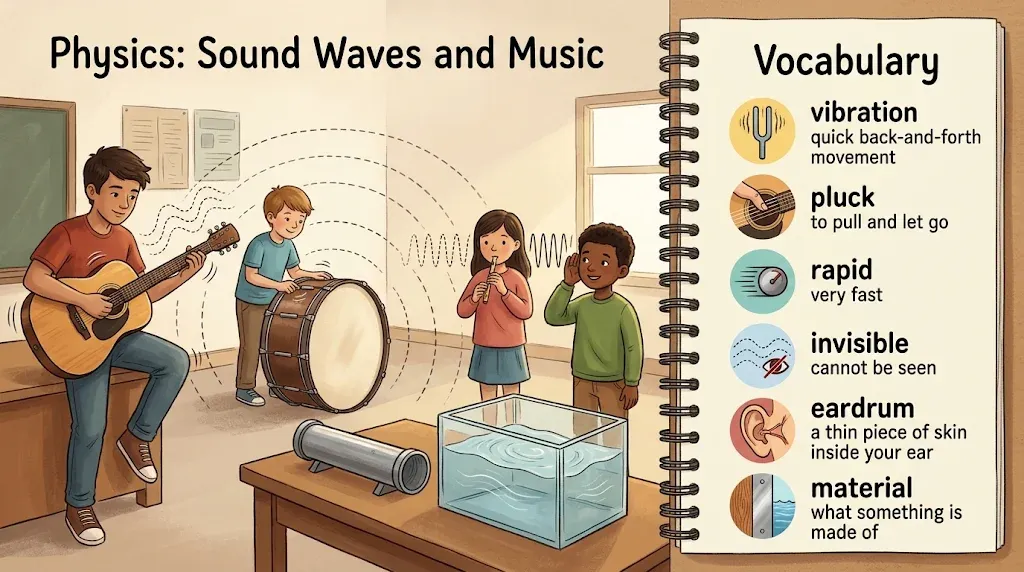
Every musical note starts with a tiny movement called a vibration. When you pluck a guitar string, it moves back and forth very fast. This rapid motion pushes the air around the string and creates invisible waves. These sound waves travel through the air until they reach your ears. Inside your ear, a thin piece of skin called the eardrum starts to shake. Your brain reads these shakes as voices, music, or street noise. Sound travels at different speeds depending on the material. It moves faster through solid metal and water than through gas like air. Scientists measure sound in two main ways. Pitch tells us how high or low a note sounds. Fast vibrations make high sounds, like a small whistle. Slow vibrations make low sounds, like a heavy bass drum. Volume measures how loud or soft a sound is. Strong waves carry more energy and produce louder noises across a room.
Activities
Vocabulary
- Label: vibrationAnswer: def_1
- Label: pluckAnswer: def_2
- Label: rapidAnswer: def_3
- Label: invisibleAnswer: def_4
- Label: eardrumAnswer: def_5
- Label: materialAnswer: def_6
- Text: A very small, fast shaking movement back and forth.
- Text: To pull a musical string quickly with your finger to make a sound.
- Text: Happening very fast or in a short time.
- Text: Impossible to see with your eyes.
- Text: A thin piece of skin inside the ear that moves when sound hits it.
- Text: A substance that things are made of, such as metal, water, or wood.
- Before: When youAfter: a guitar string, it starts to move and make music.Answer: pluck
- Before: Sound waves areAfter: , so we cannot see them moving through the room.Answer: invisible
- Before: A tinyAfter: in the air is the beginning of every musical sound.Answer: vibration
- Before: Sound moves at different speeds depending on theAfter: it travels through.Answer: material
- Before: When sound enters your ear, it makes yourAfter: shake.Answer: eardrum
Comprehension
- Text: Sound waves move through the air and can be seen easily.Answer: false
- Text: Your brain understands the shaking of your eardrum as music, voices, or noise.Answer: true
- Text: Sound travels faster through air than through solid metal.Answer: false
- Text: Slow vibrations create low sounds like a bass drum.Answer: true
- Text: Strong sound waves carry more energy and make louder sounds.Answer: true
- Answer: Every musical note starts with a tiny vibration.
- Answer: Sound waves travel through the air to your ears.
- Answer: Sound moves faster through water than through air.
- Answer: Fast vibrations make high sounds like a small whistle.
- Answer: Strong waves carry more energy across a room.
Written Expression
- Text:
What is your favorite musical instrument, and does it usually make high-pitched or low-pitched sounds?
- Text: Describe a loud sound and a soft sound that you hear every day.
Example 1: My favorite instrument is the bass guitar. It has thick strings that vibrate slowly, so it makes deep, low-pitched sounds.
Example 2: Every morning, I hear a loud alarm clock next to my bed. At night, I hear the soft sound of the wind outside my window.
Critical Thinking
In outer space, there is no air, water, or solid material between planets. Based on the reading, why is space completely silent?
Imagine you put your ear against a long metal fence while a friend taps the other end. Will you hear the tap through the metal first or through the air first? Explain why.
Recommended for You
Physics: Friction and Moving Vehicles
Learn about how friction affects cars and trucks on dry and icy roads in this A2 English reading and vocabulary workshee...

The Secret to Happiness: Living Gratefully
A B1-level reading comprehension worksheet exploring Brother David Steindl-Rast's teachings on how gratefulness cultivat...

The Psychology of Shopping: Why We Spend More
Explore how supermarkets and online stores use psychological nudges, anchoring, and loss aversion to influence consumer ...