Generations and Register: Finding Common Ground in Communication
Explore how employers, educators, and students navigate generational differences in formal and informal language register in work and school.
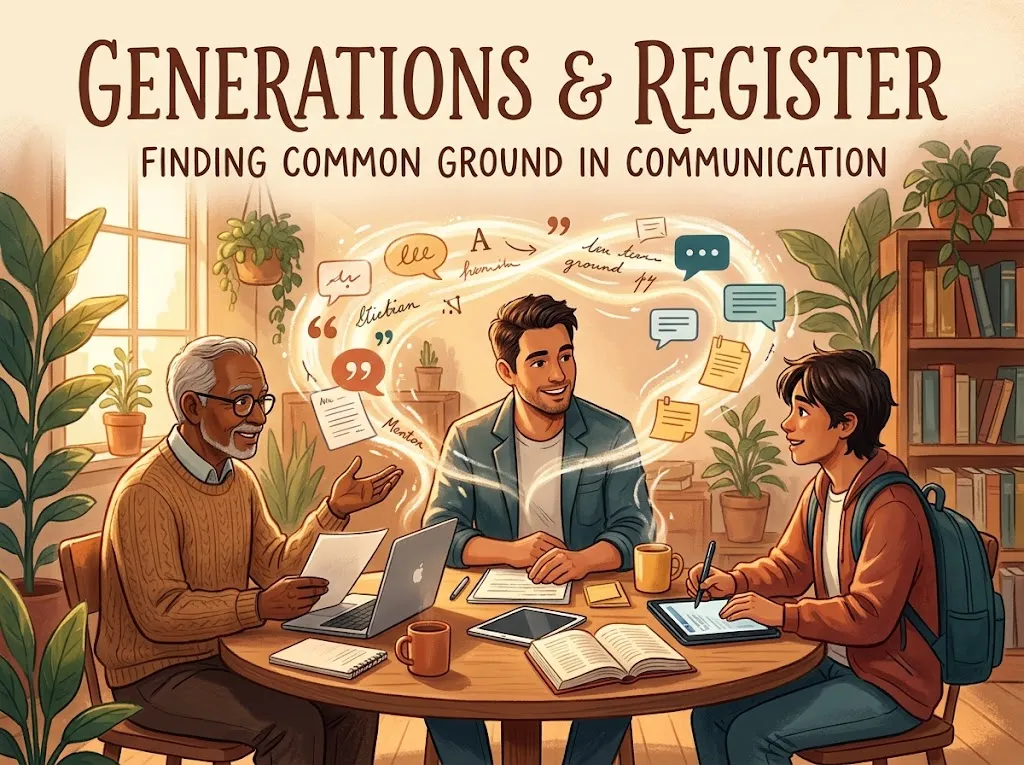
Generations and Register: Finding Common Ground in Communication
Explore how employers, educators, and students navigate generational differences in formal and informal language register in work and school.
Title
Generations and Register: Finding Common Ground in CommunicationSeo_intro
Explore how employers, educators, and students navigate generational differences in formal and informal language register in work and school.
Parts
- Part_number: 1Text:
In linguistics, register refers to the style of language a person chooses for a specific situation. People naturally change their tone, grammar, and vocabulary depending on who they are speaking with. Today, different generations have contrasting expectations about communication. Older generations often prefer formal language, especially in letters, emails, and face-to-face meetings. Younger generations, raised in a fast-paced digital world, frequently use informal expressions, short text messages, and quick responses. Because of these differences, misunderstandings can happen easily in daily life. Finding a common ground is essential for smooth communication across age groups.
Vocabulary_explanations
Register: The style and formality of language used in a specific social situation.Linguistics: The scientific study of language and how people communicate.Contrasting: Very different from each other in a noticeable way.Expectations: Beliefs or assumptions about how people should act or speak.Formal language: Polite, serious, and grammatical language used in professional or academic contexts.Face-to-face: Directly meeting or speaking in person rather than online or by phone.Fast-paced: Moving, changing, or developing very quickly.Informal expressions: Casual, relaxed words and phrases used among close friends or family.Misunderstandings: Occasions when people fail to understand each other correctly.Common ground: Shared opinions, interests, or agreements between different people.Questions:- Question: Register refers to changing language style depending on the situation.Options:
- True
- False
Answer: True - Question: Which group prefers fast digital messaging and quick responses?Options:
- A) Older generations
- B) Younger generations
- C) Neither group
Answer: B) Younger generations - Question: What often happens when generations have contrasting communication styles?Options:
- A) Immediate perfect agreement
- B) Complete silence
- C) Misunderstandings in daily life
Answer: C) Misunderstandings in daily life
- Part_number: 2Text:
From an employer's point of view, professional register is a vital workplace skill. When hiring new employees, managers expect clear etiquette in emails and interviews. Many business leaders notice that recent graduates send messages starting with casual greetings like 'Hey' instead of polite salutations. Furthermore, some young staff members write emails without subject lines or use internet abbreviations like 'u' and 'idk'. Employers worry that this overly relaxed tone harms the company's professional reputation with clients. While managers appreciate efficiency and modern tech skills, they believe proper workplace decorum builds trust and shows respect to colleagues and customers.
Vocabulary_explanations
Point of view: A particular attitude, opinion, or way of considering a matter.Etiquette: The set of conventional rules for polite behavior in a workplace or society.Recent graduates: People who have finished high school or university very recently.Salutations: Greetings used at the beginning of a letter or formal email, such as 'Dear Mr. Davis'.Subject lines: Short titles at the top of an email that summarize its purpose.Abbreviations: Shortened forms of words or phrases, such as letters standing for full words.Overly relaxed: Too casual or informal for a serious professional environment.Reputation: The general opinion that the public holds about a business or person.Efficiency: The ability to produce good results without wasting time or energy.Decorum: Polite, dignified, and socially correct behavior in a formal setting.Questions:- Question: Employers believe an overly casual tone can hurt a company's reputation.Options:
- True
- False
Answer: True - Question: What casual greeting do some managers notice recent graduates using?Options:
- A) 'Dear Sir'
- B) 'Greetings'
- C) 'Hey'
Answer: C) 'Hey' - Question: According to employers, what does workplace decorum build?Options:
- A) Trust and respect
- B) Slower typing speeds
- C) Unnecessary conflicts
Answer: A) Trust and respect
- Part_number: 3Text:
Educators observe these linguistic challenges daily inside modern classrooms. Teachers explain that traditional grammar instruction focused heavily on rigid textbook rules. However, digital communication has blurred the boundary between casual speech and academic writing. Students now submit essays containing emojis, slang, and incomplete sentences because they communicate that way on social media platforms. Teachers do not want to discourage student creativity or punish natural voice. Instead, instructors want to teach code-switching. This valuable skill teaches students to identify the right context and deliberately select between informal banter and formal academic prose, preparing them for future success in both college and careers.
Vocabulary_explanations
Rigid: Strict, fixed, and unwilling to change or adapt.Blurred: Made unclear, less distinct, or difficult to separate.Boundary: An imaginary or real line that divides two different concepts or areas.Submit: To present or hand in work for evaluation, such as an assignment.Slang: Very informal words and phrases common in spoken language among specific groups.Platforms: Digital applications or online services that enable communication and media sharing.Discourage: To cause someone to lose confidence, hope, or motivation.Code-switching: The practice of changing one's language style or dialect depending on the social setting.Banter: Playful, friendly, and teasing conversation among friends.Academic prose: Formal, structured writing used in research papers, books, and essays.Questions:- Question: Teachers want to discourage all student creativity and punish their natural voice.Options:
- True
- False
Answer: False - Question: Why do some students use emojis and slang in school assignments?Options:
- A) Because they are taught to do so in grammar books
- B) Because they communicate that way on social media platforms
- C) Because teachers award bonus points for emojis
Answer: B) Because they communicate that way on social media platforms - Question: What is the primary goal of teaching code-switching?Options:
- A) Helping students choose the right style for different situations
- B) Forcing students to stop using smartphones completely
- C) Teaching computer programming code in English class
Answer: A) Helping students choose the right style for different situations
- Part_number: 4Text:
Many young students feel that older generations judge their communication habits unfairly. To younger people, direct and approachable language represents honesty and teamwork. They believe that elaborate greetings, ceremonial signatures, and rigid corporate phrasing feel stiff and insincere. Furthermore, students often find formal business English intimidating because schools rarely teach the unspoken rules of professional correspondence. Rather than being deliberately rude, young learners often struggle to express politeness without sounding robotic or fake. Students argue that communication is a two-way street. They want to learn professional norms, but they hope mentors provide constructive guidance instead of harsh criticism.
Vocabulary_explanations
Unfairly: In a manner that is not just, balanced, or reasonable.Approachable: Friendly and easy to talk to or understand.Elaborate: Detailed, complicated, or using many decorative words.Ceremonial: Very formal, traditional, or following strict ritual rules.Stiff: Excessively formal, unnatural, or not relaxed.Insincere: Not expressing genuine thoughts or authentic feelings.Intimidating: Making someone feel nervous, fearful, or unconfident.Unspoken rules: Expectations that everyone understands without being officially written down.Two-way street: A mutual situation where both sides must make an effort to understand each other.Constructive guidance: Helpful and positive advice intended to help someone improve.Questions:- Question: Students view direct, approachable communication as a sign of honesty and teamwork.Options:
- True
- False
Answer: True - Question: Why do many students find formal business English intimidating?Options:
- A) Schools rarely teach the unspoken rules of professional correspondence
- B) They are forbidden from reading business articles
- C) They prefer to communicate only using hand signals
Answer: A) Schools rarely teach the unspoken rules of professional correspondence - Question: What kind of support do young learners hope mentors will provide?Options:
- A) Harsh criticism and punishments
- B) Complete silence during projects
- C) Constructive guidance instead of harsh criticism
Answer: C) Constructive guidance instead of harsh criticism
Critical Thinking
Title: Critical Thinking & DiscussionInstructions:Should older professionals adapt to modern, approachable communication styles, or should younger workers strictly follow traditional corporate etiquette? Explain your perspective.
Describe a situation in your own life where you had to adjust your language register between family, friends, teachers, or employers. What made that transition easy or challenging?
Recommended for You

The Joy of Hobbies: Why Having Fun Is Never a Waste of Time
Learn why hobbies should be fun, relaxing, and free from social media pressure in this easy A2 English reading lesson.

Finding the Perfect Path: Three Perspectives on Modern Work
Explore diverse career perspectives on work-life balance, self-employment, and workplace priorities in this English read...
Smart Study Secrets: Easy Ways to Ace Your Tests
Discover easy, science-backed study tips for middle schoolers to improve memory, prepare for exams, and study with confi...