
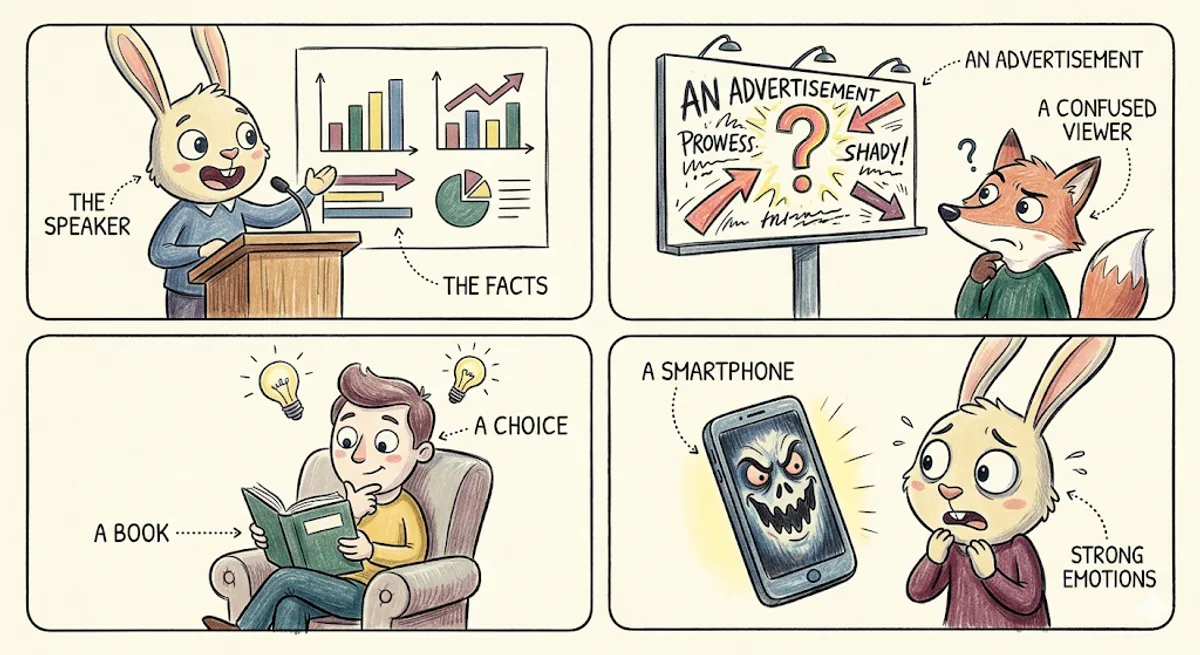
Persuasion vs. Propaganda
Learn the difference between persuasion and propaganda in this A2 English reading comprehension worksheet.
Title
Persuasion vs. PropagandaReading Text
Persuasion and propaganda both have the same main goal: they want to change how we think, feel, or act. To do this, both methods often use our emotions. For example, a speaker or writer might try to make us feel hope, fear, or anger to get our attention. Because they use the same tools, like speeches, advertisements, and social media, it can be very easy to confuse them. However, there is a big difference in how they treat the truth and the audience. Persuasion usually gives you facts and logical reasons. It invites you to think about the information and make your own choice. Propaganda is very different. It often hides the truth, changes the facts, or uses lies to control people. The goal of propaganda is to make you agree without asking any questions or thinking critically about the topic. In short, persuasion tries to win an argument honestly, while propaganda tries to manipulate you. Persuasion respects your freedom to choose, but propaganda just wants you to obey. The next time you see a strong message online or on television, ask yourself: is this person inviting me to think, or are they trying to control me?
Seo_intro
Learn the difference between persuasion and propaganda in this A2 English reading comprehension worksheet.
Activities
Vocabulary
- Label: propagandaAnswer: def1
- Label: emotionsAnswer: def2
- Label: confuseAnswer: def3
- Label: audienceAnswer: def4
- Label: manipulateAnswer: def5
- Text: Information, often false or one-sided, used to control people's thoughts.
- Text: Strong feelings like hope, fear, sadness, or anger.
- Text: To make it difficult for someone to understand the difference between things.
- Text: The group of people who are reading, watching, or listening to a message.
- Text: To control someone or something in a clever or dishonest way.
- Before: Politicians sometimes useAfter: to get people to agree with them without thinking.Answer: propaganda
- Before: A good movie can make you feel many differentAfter: .Answer: emotions
- Before: Because the two words are so similar, it is easy toAfter: them.Answer: confuse
- Before: The speaker asked theAfter: to think carefully about the facts.Answer: audience
- Before: A bad advertisement might try toAfter: you into buying something you do not need.Answer: manipulate
Comprehension
- Text: Persuasion and propaganda have completely different main goals.Answer: false
- Text: Both methods use human emotions to get attention.Answer: true
- Text: Persuasion usually tries to hide the truth from the audience.Answer: false
- Text: Propaganda wants people to think critically about the topic.Answer: false
- Text: Persuasion respects your freedom to make your own choice.Answer: true
- Text: same / the / have / goal / both / mainAnswer: Both have the same main goal.
- Text: feelings / use / they / our / oftenAnswer: They often use our feelings.
- Text: is / to / it / confuse / easy / themAnswer: It is easy to confuse them.
- Text: truth / often / the / it / hidesAnswer: It often hides the truth.
- Text: to / wants / you / just / obey / propagandaAnswer: Propaganda just wants you to obey.
Written Expression
- Text:
Can you think of a time when you saw a strong message online or on TV? Describe it. Did it try to persuade you or manipulate you?
- Text: Why is it important to ask questions and think critically when you read the news?
Example: I once saw an advertisement for a phone that made me feel afraid I was missing out. I think it was trying to manipulate me into buying it.
Critical Thinking
- Discuss with a partner: How can you protect yourself from being manipulated by false information?
- Do you think persuasion is always good and propaganda is always bad? Why or why not?
Recommended for You

Learning English: A Path to New Opportunities
An A2 English reading passage explaining the benefits of learning English from a Thai perspective, focusing on tourism, ...
The Fermi Paradox
Explore the Fermi Paradox in this B1 English reading comprehension worksheet about space, aliens, and the universe.
Amazing Animals: The Cheetah
Learn about the world's fastest land mammal in this A2 English reading activity about the incredible African cheetah.