The Invisible Bubble of Personal Space
Master the unwritten rules of American social etiquette by learning about the 'invisible bubble' and personal space norms. (B1 Level)
The Invisible Bubble of Personal Space
Master the unwritten rules of American social etiquette by learning about the 'invisible bubble' and personal space norms. (B1 Level)
Title
The Invisible Bubble of Personal SpaceSeo_intro
Master the unwritten rules of American social etiquette by learning about the 'invisible bubble' and personal space norms.
Parts
- Part_number: 1Text:
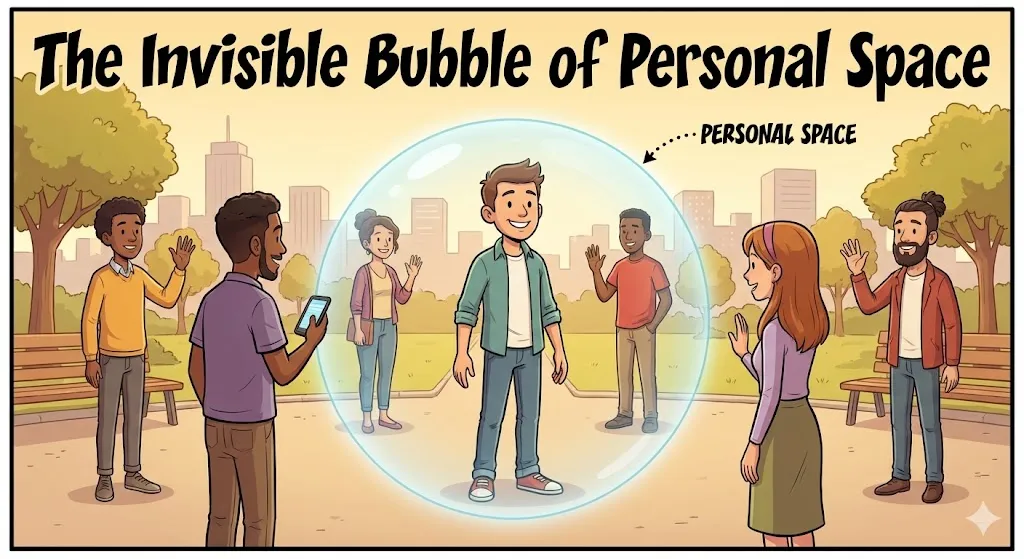
One of the most important unwritten rules in the United States involves 'personal space.' Many Americans feel very uncomfortable if someone stands too close to them during a conversation. They often imagine an invisible bubble surrounding their body, and they generally expect others to stay outside of that circle. If you accidentally step inside this bubble, you might notice the American person slowly backing away or leaning their body back to create more distance. This is not because they dislike you, but because they feel their private territory is being invaded.
Vocabulary_explanations
Personal space: the physical distance two people stay apart during an interactionUncomfortable: feeling slight worry, embarrassment, or lack of comfortInvisible: something that cannot be seenBubble: a protected area or circle around someoneSurrounding: being all around something or someoneGenerally: usually; in most casesAccidentally: by chance; not on purposeBacking away: moving backwards to get further from someoneTerritory: an area of space that a person feels belongs to themInvaded: entered without permission or by forceQuestions:- Question: Americans feel better when people stand very close to them.Options:
- True
- False
Answer: False - Question: What do Americans imagine is surrounding their body?Options:
- A wall of glass
- An invisible bubble
- A heavy shield
- A bright light
Answer: An invisible bubble - Question: If an American backs away, it is usually because they dislike you.Options:
- True
- False
Answer: False
- Part_number: 2Text:
In a typical social or business conversation, Americans usually prefer to stand about an arm’s length away from each other. This distance is about two or three feet, or roughly one meter. This physical gap allows people to feel safe and relaxed while they talk. In many other cultures, standing close is a sign of warmth and friendship, but in the U.S., it can be misinterpreted as being aggressive or overly personal. Even in crowded places like elevators or buses, Americans will often try to look at their phones or the ceiling to give others a sense of 'mental' space since they cannot have physical space.
Vocabulary_explanations
Typical: normal or expected for a certain group or situationArm’s length: the distance equal to the length of a human armRoughly: approximately; aboutPhysical gap: a literal distance or space between two objects or peopleSafe: protected from danger or social discomfortRelaxed: feeling calm and not worriedWarmth: a feeling of friendliness or kindnessMisinterpreted: understood incorrectly by othersAggressive: behaving in a forceful or angry wayMental: relating to the mind or thinkingQuestions:- Question: What is the standard distance Americans prefer in a conversation?Options:
- One centimeter
- About one meter
- Five meters
- There is no standard
Answer: About one meter - Question: Standing close is always seen as aggressive in every culture.Options:
- True
- False
Answer: False - Question: Why do Americans look at their phones in crowded elevators?Options:
- They are very busy
- To create a sense of 'mental' space
- They are searching for a map
- They are taking photos
Answer: To create a sense of 'mental' space
- Part_number: 3Text:
This rule also applies to touching. While some cultures use frequent touch during conversation, Americans usually limit physical contact to a firm handshake when meeting someone for the first time. Hugs are typically reserved for close friends and family members. If you are unsure about how much space to give, a good tip is to watch the other person’s feet. If they move back when you move forward, you have likely entered their invisible bubble. By maintaining a bit of distance, you show that you respect their comfort and understand this common American social boundary.
Vocabulary_explanations
Applies: is relevant or is used in a specific situationTouching: the act of putting a part of your body against something elseFrequent: happening oftenLimit: to keep something within a certain amount or boundaryHandshake: a greeting where two people hold and move their joined handsReserved: kept for a particular person or groupUnsure: not certain or confident about somethingMove forward: to walk or lean toward the frontMaintaining: keeping something at the same level or stateBoundary: a line or limit that marks the edge of a personal areaQuestions:- Question: How do Americans usually greet someone for the first time?Options:
- With a big hug
- With a firm handshake
- By touching their shoulder
- By standing very close
Answer: With a firm handshake - Question: What is a good way to tell if you are too close to someone?Options:
- Ask them for their ID
- Watch the other person's feet
- Count to ten
- Check your watch
Answer: Watch the other person's feet - Question: Hugs are common for first-time business meetings in the U.S.Options:
- True
- False
Answer: False
Critical Thinking
Title: Cultural BoundariesInstructions:In your culture, is it common to stand close to people you don't know well? How might an American feel in your home country?
Why do you think physical 'space' is equated with 'respect' in some cultures but 'friendliness' in others?
Recommended for You

Smart Study Secrets: Easy Ways to Ace Your Tests
Discover easy, science-backed study tips for middle schoolers to improve memory, prepare for exams, and study with confi...

Study Smarter, Not Harder: Science-Backed Exam Strategies
Discover science-backed study tips for middle schoolers to prepare for exams, improve memory, beat stress, and achieve t...
Interviews on AI: Thai Graduates at a Career Crossroads
Explore three personal interview perspectives on how AI will shape job opportunities for university graduates in Thailan...