Interviews on AI: Thai Graduates at a Career Crossroads
Explore three personal interview perspectives on how AI will shape job opportunities for university graduates in Thailand today.
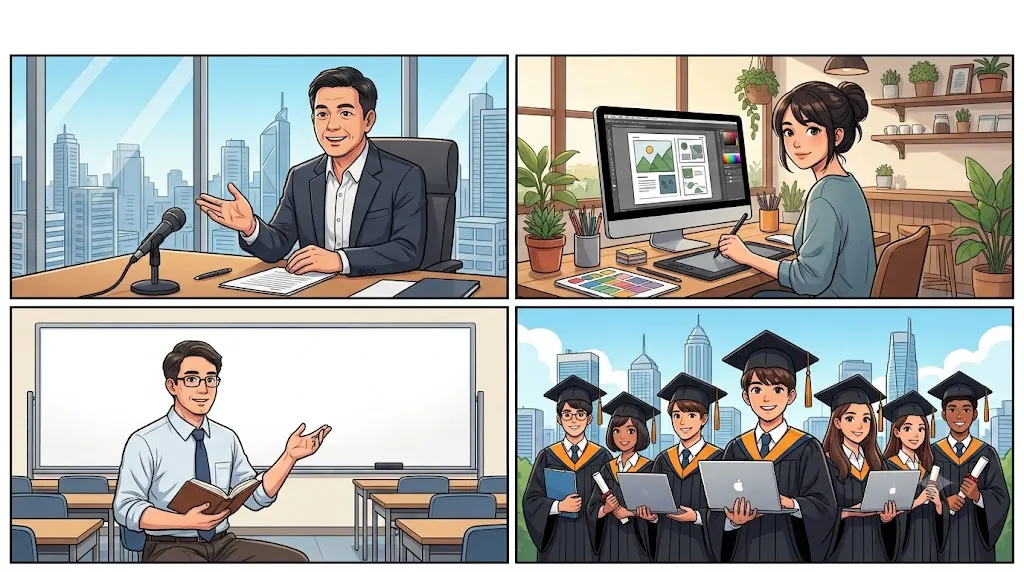
Interviews on AI: Thai Graduates at a Career Crossroads
Explore three personal interview perspectives on how AI will shape job opportunities for university graduates in Thailand today.
Title
Interviews on AI: Thai Graduates at a Career CrossroadsSeo_intro
Explore three personal interview perspectives on how AI will shape job opportunities for university graduates in Thailand today.
Parts
- Part_number: 1Text:
Interviewer: Welcome to our podcast, Somchai. As an HR director in Bangkok, how do you think AI will affect new graduates? Somchai: Thank you. Many people worry that software will replace basic office work. It is true that algorithms will process documents faster than any human. However, I doubt that companies will stop hiring people altogether. Instead, businesses will look for graduates who know how to work alongside smart technology. I worry that students who ignore these tools might struggle in the market. But if you learn how to guide these applications, you will find plenty of exciting job opportunities in Thailand.
Vocabulary_explanations
Worry: To feel anxious or concerned about something that might happen.Algorithms: Sets of rules or processes followed by a computer to solve problems.Process: To perform a series of mechanical or electronic operations on data.Doubt: To feel uncertain or disbelieve that something is true or will happen.Altogether: Completely; entirely; considering everything.Struggle: To experience difficulty and make great effort to succeed.Market: The supply and demand for jobs and employment opportunities.Guide: To direct, manage, or control the movement or development of something.Opportunities: Possibilities or chances for employment and advancement.Questions:- Question: What does Somchai say algorithms will do faster than humans?Options:
- A) Conduct in-person job interviews
- B) Process documents and data
- C) Manage full human resources departments
Answer: B) Process documents and data - Question: Somchai doubts that companies will stop hiring people completely.Options:
- True
- False
Answer: True - Question: What might happen to students who ignore modern technology tools?Options:
- A) They will automatically get higher salaries.
- B) They might struggle in the job market.
- C) They will move to other countries immediately.
Answer: B) They might struggle in the job market.
- Part_number: 2Text:
Interviewer: Kanya, as a recent design graduate in Chiang Mai, what are your main concerns? Kanya: To be honest, I worry a lot about my future. Image generators can create visual designs in seconds, so some local agencies might cut junior positions. Clients often demand cheaper rates because they assume software does all the heavy work. I doubt that basic illustration alone will guarantee a good salary anymore. However, I will adapt by focusing on user experience and brand strategy. Smart software might generate images, but it cannot understand human emotion or cultural context the way a designer can.
Vocabulary_explanations
Concerns: Matters that cause worry or interest to a person.Worry: To feel anxious about potential negative events or outcomes.Agencies: Businesses that provide specific services, such as design or advertising.Junior: A low-ranking or entry-level position in a company.Demand: To request something forcefully or insist on a condition.Doubt: To hold a feeling of disbelief or uncertainty about something.Guarantee: To promise or ensure that a specific outcome will happen.Adapt: To modify one's behavior or ideas to suit new conditions.Might: Used to express possibility or uncertainty about a future state.Cultural context: The social and cultural background that gives meaning to an idea or design.Questions:- Question: Why do some clients demand cheaper rates from design graduates?Options:
- A) They think software does all the work.
- B) Designers are taking too long to finish projects.
- C) The quality of design work has decreased.
Answer: A) They think software does all the work. - Question: Kanya believes basic illustration alone will easily guarantee a high salary.Options:
- True
- False
Answer: False - Question: How does Kanya plan to adapt her design career?Options:
- A) By quitting the creative industry completely
- B) By focusing on user experience and brand strategy
- C) By opening a traditional printing press
Answer: B) By focusing on user experience and brand strategy
- Part_number: 3Text:
Interviewer: Dr. Arin, as an economics professor in Chonburi, what do you predict for the university system? Dr. Arin: Technology will certainly transform our economy, but history shows that automation creates new roles while replacing old ones. I worry that traditional classrooms rely too much on simple memorization. If we do not update our teaching methods, our graduates might fall behind international standards. I doubt that passive learning will help students survive in this modern world. Universities will need to form stronger connections with industry leaders. We must teach students critical thinking and creative problem-solving so they will direct technology rather than fear it.
Vocabulary_explanations
Predict: To state that an event will happen in the future based on present knowledge.Transform: To make a thorough or dramatic change in form, appearance, or character.Automation: The use of automatic equipment or software in a system or operation.Worry: To feel anxious or uneasy about a prospective problem.Memorization: The process of learning something so that you can remember it exactly.Might: Used to indicate a conditional possibility in the future.Doubt: To feel uncertain about the truth or reliability of an idea.Passive: Accepting or allowing what happens without active response or resistance.Industry leaders: Top businesses or influential experts within a professional field.Critical thinking: The objective analysis and evaluation of an issue in order to form a judgment.Questions:- Question: What does Dr. Arin worry about regarding traditional classrooms?Options:
- A) They spend too much money on new software.
- B) They rely too much on simple memorization.
- C) They have too many students in every class.
Answer: B) They rely too much on simple memorization. - Question: Dr. Arin doubts that passive learning will help students survive in the modern job market.Options:
- True
- False
Answer: True - Question: What key skills should universities teach according to Dr. Arin?Options:
- A) Critical thinking and creative problem-solving
- B) Manual typing and shorthand writing
- C) Strict adherence to old business practices
Answer: A) Critical thinking and creative problem-solving
Critical Thinking
Title: Discussion & Critical Thinking QuestionsInstructions:Which perspective—Somchai's, Kanya's, or Dr. Arin's—best reflects your own worries or expectations about how technology will affect your future career?
How can students balance learning technical AI tools while also developing human strengths like empathy and critical thinking?
Recommended for You
Smart Study Secrets: Easy Ways to Ace Your Tests
Discover easy, science-backed study tips for middle schoolers to improve memory, prepare for exams, and study with confi...
Study Smarter, Not Harder: Science-Backed Exam Strategies
Discover science-backed study tips for middle schoolers to prepare for exams, improve memory, beat stress, and achieve t...
The Origin of 'Carbon Footprint'
Explore how the concept of the carbon footprint was created and why focusing on individual guilt affects working communi...