
What is Your Name?
Learn how to introduce yourself, spell your name using the English alphabet, and ask for repetition in this easy A1 English lesson.
Title
What is Your Name?Seo_intro
Learn how to introduce yourself, spell your name using the English alphabet, and ask for repetition in this easy A1 English lesson.
References
Parts
- Part_number: 1Text:
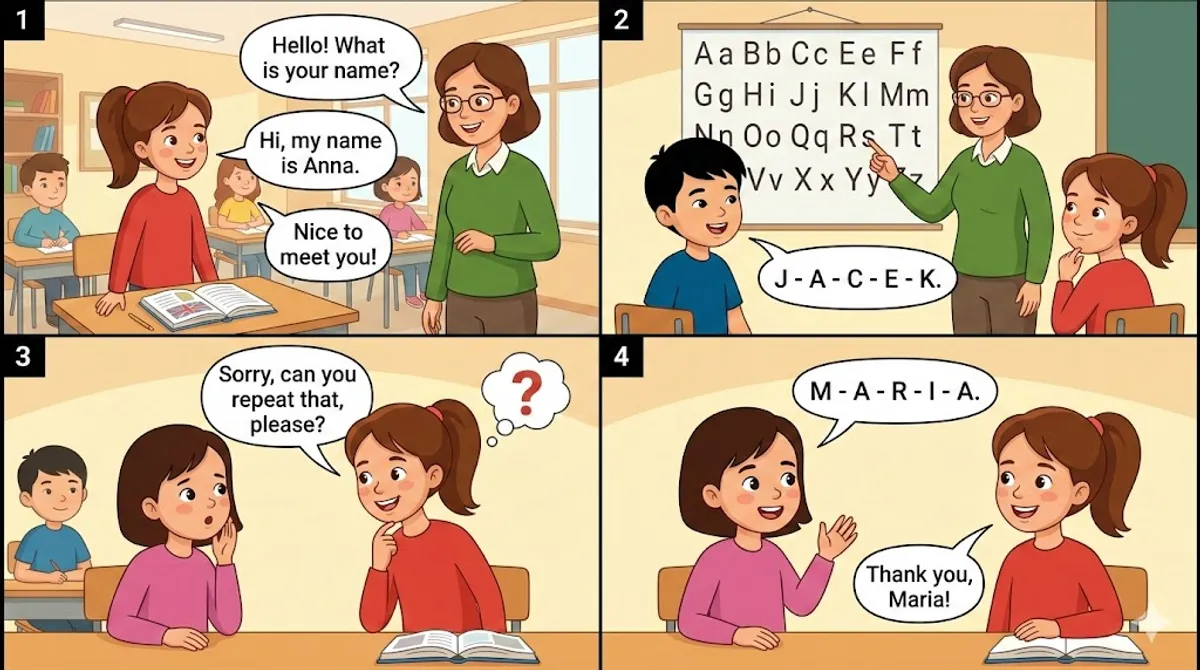
Hello! My name is Anna. I am a new student in the English class. Today, I meet my teacher and my classmates. The teacher says, "Hello, everyone. Welcome to the class. What is your name?" I stand up and say, "Hi, my name is Anna." The teacher smiles and says, "Nice to meet you, Anna." It is very easy to introduce yourself. You just say "Hello" and "My name is...". Meeting new people is fun. I want to learn all the names in my class.
Vocabulary_explanations
Student: A person who is learning at a school.Class: A group of students learning together.Teacher: A person who helps you learn.Classmates: The other students in your class.Everyone: All the people in a group.Welcome: A friendly greeting when someone arrives.Introduce: To tell someone your name for the first time.Yourself: You; the person speaking.Fun: Something you enjoy doing.Learn: To get new knowledge or skills.Questions:- Question: Anna is a new teacher in the English class.Options:
- True
- False
Answer: False - Question: What does Anna say to the class?Options:
- A) Goodbye, everyone.
- B) Hi, my name is Anna.
- C) Where is the teacher?
Answer: B) Hi, my name is Anna. - Question: Anna thinks meeting new people is fun.Options:
- True
- False
Answer: True
- Part_number: 2Text:
Sometimes, names are hard to hear. We need to spell them. We use the English alphabet to spell words. There are twenty-six letters in the alphabet, from A to Z. A boy in my class says, "Hello, my name is Jacek." The teacher asks, "How do you spell your name?" The boy says, "J - A - C - E - K." Spelling helps us write names correctly. I practice spelling my name: A - N - N - A. It is a short name, so it is easy to spell!
Vocabulary_explanations
Sometimes: Not all the time; on some occasions.Hard: Difficult; not easy.Hear: To take in sound through your ears.Spell: To say or write the letters of a word in order.Alphabet: All the letters used to write a language.Letters: The symbols we use to write, like A, B, and C.Correctly: In the right way; with no mistakes.Practice: To do something many times so you get better at it.Short: Not long.Easy: Not difficult; simple to do.Questions:- Question: How many letters are in the English alphabet?Options:
- A) 20
- B) 26
- C) 30
Answer: B) 26 - Question: Why does the teacher ask the boy to spell his name?Options:
- A) Because she wants to know how to write it correctly.
- B) Because she forgot her own name.
- C) Because the boy is leaving.
Answer: A) Because she wants to know how to write it correctly. - Question: Anna's name is very long and difficult to spell.Options:
- True
- False
Answer: False
- Part_number: 3Text:
What happens when you do not hear someone? You can ask them to say it again. You can say, "Can you repeat that, please?" or "Sorry, what is your name?" A girl says her name very quietly. I do not hear her. I look at her and say, "Sorry, can you repeat that, please?" She says louder, "My name is Maria." I say, "Thank you, Maria! How do you spell that?" She says, "M - A - R - I - A." Now I know her name. Asking questions is a good way to learn.
Vocabulary_explanations
Happens: Takes place or occurs.Someone: A person, but you do not say exactly who it is.Again: One more time.Repeat: To say something again.Please: A polite word you use when you ask for something.Quietly: Making very little noise.Sorry: A word you say to be polite when you make a mistake or did not hear.Louder: With more noise or volume.Know: To have information in your mind.Questions: Sentences you ask to get an answer.Questions:- Question: What can you say if you do not hear someone's name?Options:
- A) Can you repeat that, please?
- B) Goodbye!
- C) I know your name.
Answer: A) Can you repeat that, please? - Question: The girl says her name very loudly the first time.Options:
- True
- False
Answer: False - Question: Asking questions helps you learn.Options:
- True
- False
Answer: True
Recommended for You
Punch the Macaque: Navigating Primate Social Dynamics
Explore the advanced English B2+ reading comprehension lesson about Punch the macaque, his viral fame, and the complex p...
Punch the Monkey: The Baby Macaque Who Captured the World's Heart
Read the heartwarming true story of Punch, a viral baby monkey in Japan who found comfort in a stuffed toy.
Greeting & Goodbyes
Learn basic English greetings and goodbyes with this simple A1 story. Practice saying hello, good morning, and see you l...