Gratitude on the Bill: Understanding Tipping Culture
Navigate the complexities of American tipping etiquette, from standard restaurant percentages to the social reasons behind the custom.
Gratitude on the Bill: Understanding Tipping Culture
Navigate the complexities of American tipping etiquette, from standard restaurant percentages to the social reasons behind the custom.
Title
Gratitude on the Bill: Understanding Tipping CultureSeo_intro
Navigate the complexities of American tipping etiquette, from standard restaurant percentages to the social reasons behind the custom.
Parts
- Part_number: 1Text:
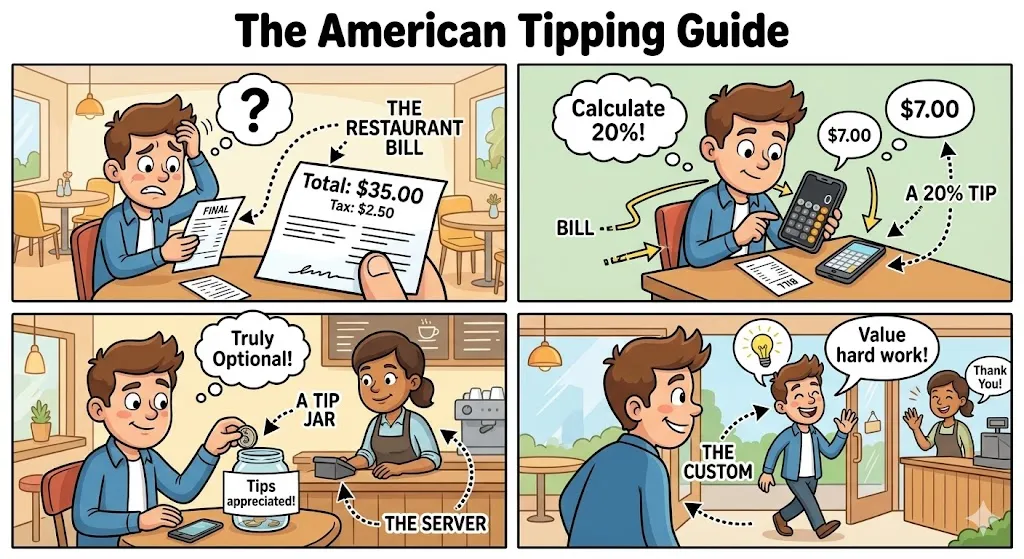
One of the most stressful experiences for newcomers in the United States is paying the bill at a restaurant. Unlike in many other countries where the price on the menu is the final price you pay, American culture relies heavily on 'tipping.' A tip is an extra amount of money you give to your server to thank them for their work. While it might seem optional, it is actually a social requirement in the U.S. because many restaurant workers earn a very low hourly wage and depend on these tips to pay their bills.
Vocabulary_explanations
Stressful: making you feel worried or anxiousNewcomers: people who have recently arrived in a new placeRelies: depends on something or someoneHeavily: to a great degree; a lotTipping: the act of giving a small amount of extra money to someone who provides a serviceExtra: more than what is usual or expectedServer: a person who brings food and drink to customers in a restaurantOptional: something you can choose to do or not do; not mandatoryRequirement: something that is needed or must be doneWage: the amount of money a person is paid per hour of workQuestions:- Question: How does the menu price in the U.S. differ from many other countries?Options:
- It is always much higher
- It is usually the final price
- It is not the final price you pay
- It includes the tip automatically
Answer: It is not the final price you pay - Question: A tip is an extra amount of money given to thank a server.Options:
- True
- False
Answer: True - Question: Why is tipping considered a social requirement in the U.S.?Options:
- Because food is very cheap
- Because workers depend on tips to pay their bills
- Because the law requires it
- Because servers are usually wealthy
Answer: Because workers depend on tips to pay their bills
- Part_number: 2Text:
In a standard sit-down restaurant, it is expected that you leave a tip of 15% to 20% of the total bill before tax. If the service was excellent, many people leave 22% or more. If the service was poor, it is still polite to leave at least 10% or 15% and perhaps speak to a manager about the problems. You do not need to tip at fast-food restaurants where you order at a counter, although you might see a 'tip jar' or a digital screen asking for a small donation. In those cases, tipping is truly optional and not required.
Vocabulary_explanations
Standard: usual or normalExpected: regarded as likely to happen or necessaryTotal: the whole amount of somethingExcellent: extremely good; outstandingPoor: not good; low qualityManager: the person in charge of a business or restaurantFast-food: food that is prepared and served very quicklyCounter: the long flat surface where you order foodDonation: a gift given to help a person or organizationTruly: really; honestlyQuestions:- Question: What is the standard tip range for a sit-down restaurant?Options:
- 5% to 10%
- 15% to 20%
- 50%
- No tip is expected
Answer: 15% to 20% - Question: You must always leave a tip at a fast-food counter.Options:
- True
- False
Answer: False - Question: What is suggested if the service was poor?Options:
- Leave no money at all
- Leave 10-15% and speak to a manager
- Leave a 25% tip
- Call the police
Answer: Leave 10-15% and speak to a manager
- Part_number: 3Text:
It is important to note that a small number of restaurants are moving away from this tipping system. These businesses might pay their workers a higher wage and include the cost in the menu price, or they might add a 'service fee' automatically to your bill. In these rare cases, the menu or your receipt will clearly state that a tip is not necessary or that 'hospitality is included.' However, unless you see a clear sign or note about this, you should always assume that a tip is expected. Understanding this custom shows that you value the hard work of the person serving you.
Vocabulary_explanations
Note: to notice or pay attention to somethingMoving away: changing or stopping a certain behavior or systemHigher: greater in amount or levelCost: the amount of money needed to buy or do somethingFee: an amount of money charged for a serviceAutomatically: without needing extra action or thoughtRare: not happening often; unusualReceipt: a piece of paper showing that money has been paidState: to say or write something clearlyCustom: a traditional way of behaving in a societyQuestions:- Question: What does 'hospitality is included' mean on a receipt?Options:
- You must pay double
- A tip is not necessary
- You get a free meal
- The service was bad
Answer: A tip is not necessary - Question: Unless there is a sign, you should assume a tip is expected.Options:
- True
- False
Answer: True - Question: Most restaurants in the U.S. have already stopped using tips.Options:
- True
- False
Answer: False
Critical Thinking
Title: Tipping and FairnessInstructions:Do you think it is fair for customers to pay part of a worker's wage through tips, or should the restaurant pay the full wage? Why?
How does the tipping system change the way a server interacts with a customer compared to a system where tips are not expected?
Recommended for You

Smart Study Secrets: Easy Ways to Ace Your Tests
Discover easy, science-backed study tips for middle schoolers to improve memory, prepare for exams, and study with confi...

Study Smarter, Not Harder: Science-Backed Exam Strategies
Discover science-backed study tips for middle schoolers to prepare for exams, improve memory, beat stress, and achieve t...
Interviews on AI: Thai Graduates at a Career Crossroads
Explore three personal interview perspectives on how AI will shape job opportunities for university graduates in Thailan...