
Numbers and Age
Learn how to say your age and use numbers 1–100 in English. This A1 lesson is perfect for beginners.
Title
Numbers and AgeSeo_intro
Learn how to say your age and use numbers 1–100 in English. This A1 lesson is perfect for beginners.References
Parts
- Part_number: 1Text:
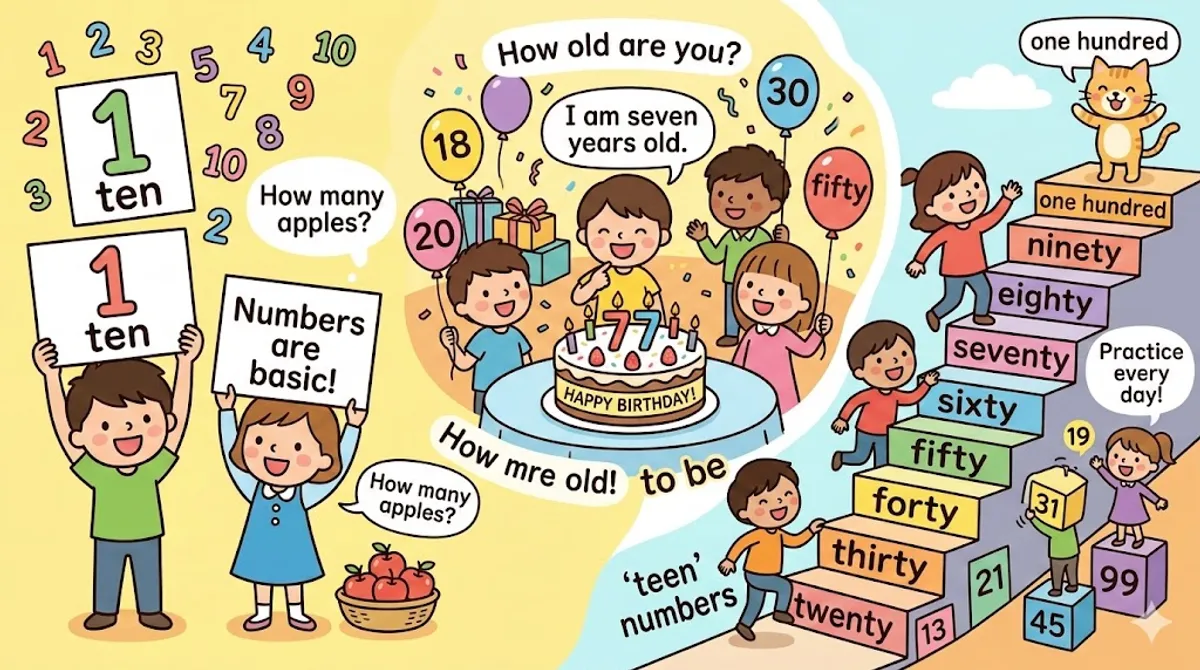
Numbers are very important. We use them every day. Can you count from one to ten? One, two, three, four, five, six, seven, eight, nine, ten. These are basic numbers. We use numbers to talk about many things. We use them for prices, phone numbers, and time. To ask a question about a number, we often say 'How many?'. For example, how many apples are on the table? There are four apples. It is easy to learn these small numbers first. Then, you can learn bigger numbers like twenty or fifty.
Vocabulary_explanations
Important: Something that has a big effect or value.Count: To say numbers in order, like 1, 2, 3.Basic: Simple and necessary; the first level.Prices: The amount of money you pay for something.Phone numbers: The set of numbers used to call a specific person.Time: Measured in minutes, hours, and days.Ask: To say something to get an answer.How many?: A question used to find the total number of things.Easy: Not difficult; simple to do.Small: Little in size or number.Questions:- Question: Which number comes after nine?Options:
- A) Seven
- B) Ten
- C) Five
Answer: B) Ten - Question: We use 'How many?' to ask about numbers.Options:
- True
- False
Answer: True - Question: Prices and time are related to numbers.Options:
- True
- False
Answer: True
- Part_number: 2Text:
How old are you? This is a common question. In English, we use the verb 'to be' for age. I am twenty years old. You are eighteen years old. He is seven years old. We do not use the verb 'to have' for age. If you are thirty, you say 'I am thirty'. You can also say 'I am thirty years old'. Both are correct. It is polite to ask 'How old are you?' to children. Sometimes adults do not like to talk about their age. Numbers for age go up to one hundred!
Vocabulary_explanations
Common: Happening often; many people use it.Question: A sentence that asks for information.Age: The number of years a person has lived.Verb: A word used to describe an action or state.To be: The verb used for age (am, is, are).To have: A verb people sometimes use incorrectly for age.Correct: Right; without mistakes.Polite: Having good manners; being kind.Adults: Grown-up people, not children.One hundred: The number 100.Questions:- Question: What verb do we use for age in English?Options:
- A) To have
- B) To be
- C) To do
Answer: B) To be - Question: You can say 'I am twenty' or 'I am twenty years old'.Options:
- True
- False
Answer: True - Question: Is it always polite to ask an adult their age?Options:
- A) Yes, always
- B) No, sometimes they do not like it
- C) Only on birthdays
Answer: B) No, sometimes they do not like it
- Part_number: 3Text:
Let's look at big numbers. After ten, we have eleven and twelve. Then come the 'teen' numbers. These are thirteen, fourteen, fifteen, sixteen, seventeen, eighteen, and nineteen. They all end in 'teen'. After nineteen, we count by tens. These are twenty, thirty, forty, fifty, sixty, seventy, eighty, and ninety. To make other numbers, just add the small number. For example, 21 is twenty-one. 45 is forty-five. 99 is ninety-nine. Finally, we reach one hundred. Practice these numbers every day. You will learn them fast! Now you can talk about your age and count things.
Vocabulary_explanations
Big: Large in size or amount.Teen: The ending for numbers 13 to 19.End: The final part of a word or thing.Tens: Numbers like 10, 20, 30, 40, etc.Add: To put things together to get a total.Reach: To arrive at a specific number or place.Finally: At the very end.Practice: To do something many times to get better.Fast: In a short time; quickly.Talk about: To speak or give information about a topic.Questions:- Question: What is the number 45 in English?Options:
- A) Fourteen-five
- B) Forty-five
- C) Fifty-four
Answer: B) Forty-five - Question: Numbers 13 to 19 all end in 'teen'.Options:
- True
- False
Answer: True - Question: What is the number after ninety-nine?Options:
- A) One hundred
- B) Eighty
- C) Twenty
Answer: A) One hundred
Recommended for You
Bicycles Take Over Paris: A New Cycling City
Learn how Paris is changing from a city of cars to a city of bicycles in this easy A2 English reading text.

Fun Free Time: What We Like to Do
Read about five different people and their favorite hobbies. Learn easy A1 English words about fun activities, sports, a...

The Science of Exercise: Why Our Bodies Love to Move
Discover the amazing science behind why human bodies are built for running, hiking, and movement, and how exercise impro...