Listening: Daily Routines
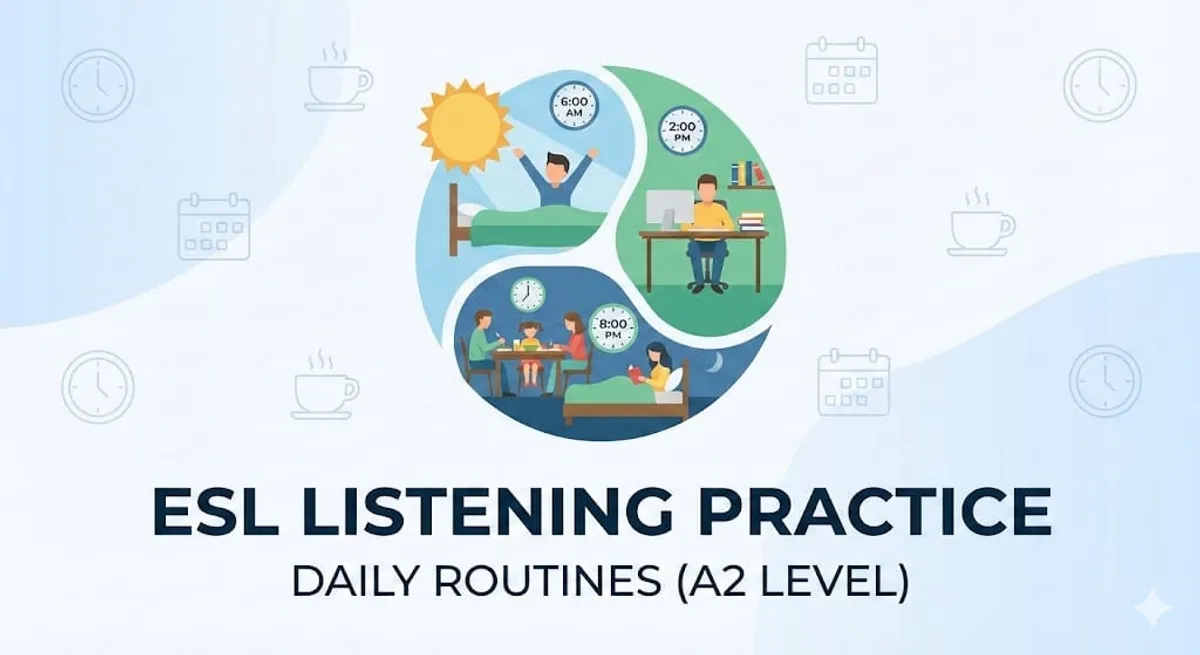
Boost A2 ESL students' listening comprehension with these three interactive daily routine activities. Perfect for practicing morning schedules, afternoon habits, and evening routines through engaging audio transcripts.
Title
A Busy Morning RoutineLang
en-USIntro
Listen to a woman talk about her morning schedule before work. Pay attention to the times she mentions.
Vocab
- Word: alarmDefinition: a clock that makes a loud sound to wake you upExample: My alarm rings at 6:00 AM every morning.
- Word: wake upDefinition: to stop sleepingExample: I usually wake up early on weekdays.
- Word: commuteDefinition: to travel between home and workExample: My commute to the office takes an hour.
- Word: stressDefinition: worry caused by a difficult situationExample: I feel stress when I have too much work.
- Word: relaxDefinition: to rest and become calmExample: I like to relax on the sofa after work.
Listening
Interviewer: Tell us about your morning, Sarah. Sarah: Well, my alarm goes off at 6:00 AM every day. I usually wake up and stay in bed for ten minutes. Then, I get up and take a quick shower. After that, I get dressed and go to the kitchen. I always eat a healthy breakfast. Usually, it is just toast and coffee. At 7:00 AM, I brush my teeth and pack my bag. Finally, I leave the house at 7:15 AM to commute to work. I take the bus, and it takes about forty-five minutes. I like to read a book on the bus. I arrive at the office at 8:00 AM, ready to start my day. Interviewer: Wow, that is a very early start! Sarah: Yes, but I like mornings. If I wake up late, I feel very stressed. The early start gives me time to relax before the busy day begins. I even have time to water my plants!
- Question: What time does Sarah's alarm go off?Options:
- 6:00 AM
- 7:00 AM
- 7:15 AM
- 8:00 AM
Correct: 6:00 AM - Question: What does Sarah usually have for breakfast?Options:
- Eggs and juice
- Cereal and milk
- Toast and coffee
- Fruit and tea
Correct: Toast and coffee - Question: How does Sarah commute to work?Options:
- She drives a car
- She walks
- She takes the train
- She takes the bus
Correct: She takes the bus - Question: What does she like to do during her commute?Options:
- Listen to music
- Read a book
- Sleep
- Talk on the phone
Correct: Read a book
Title
A Student's AfternoonLang
en-USIntro
Vocab
- Word: finishDefinition: to come to the end of somethingExample: I finish work at 5:00 PM.
- Word: libraryDefinition: a place where you can borrow or read booksExample: She studies quietly in the university library.
- Word: gymDefinition: a building or room for physical exerciseExample: We go to the gym twice a week.
- Word: comfortableDefinition: making you feel physically relaxedExample: I love wearing comfortable clothes at home.
- Word: simpleDefinition: easy to understand or doExample: The recipe for this soup is very simple.
Listening
Student: Hi everyone! Welcome to my audio vlog. Today I want to talk about my afternoon routine. I finish my university classes at 2:00 PM on most days. First, I go straight to the library for two hours. I like to do my homework there because it is very quiet. Around 4:00 PM, I leave the library and go to the gym. I exercise for about an hour to stay healthy. It helps me clear my mind after studying. After the gym, I walk back to my apartment. I take a shower and put on comfortable clothes. Then, it is time to relax. I usually watch a TV show or play video games with my roommate for a bit. Finally, at 7:00 PM, we cook dinner together. We usually make something simple, like pasta or chicken with rice. Cooking together is a fun way to end the afternoon before evening classes.
- Question: What time does the student finish his classes?Options:
- 12:00 PM
- 2:00 PM
- 4:00 PM
- 7:00 PM
Correct: 2:00 PM - Question: Why does he do his homework in the library?Options:
- Because it is quiet
- Because he works there
- Because his friends are there
- Because it is close to the gym
Correct: Because it is quiet - Question: How long does he exercise at the gym?Options:
- Two hours
- Half an hour
- About an hour
- Four hours
Correct: About an hour - Question: What do he and his roommate cook for dinner?Options:
- Steak and potatoes
- Pizza and salad
- Fish and vegetables
- Pasta or chicken
Correct: Pasta or chicken
Title
Evening Family ScheduleLang
en-USIntro
Vocab
- Word: strictDefinition: exactly following a ruleExample: My parents are very strict about bedtime.
- Word: prepareDefinition: to get ready for somethingExample: It takes me ten minutes to prepare for work.
- Word: pajamasDefinition: soft clothes you wear to sleepExample: The children put on their warm pajamas.
- Word: asleepDefinition: sleepingExample: The baby fell asleep in her bed.
- Word: quietDefinition: making very little noiseExample: The house is very quiet at night.
Listening
Host: Welcome to the show. Today, Mark is here to share his family's evening routine. Mark: Thanks for having me. Evenings in our house are very busy, but we follow a strict schedule. We usually eat dinner at 6:30 PM. After dinner, my wife and I wash the dishes, and the children clean the table. At 7:30 PM, it is time for the kids to prepare for bed. They take a bath and put on their pajamas. By 8:00 PM, we all sit in the living room and read a story together. We never watch TV before bed because it makes it hard to sleep. At 8:30 PM, the kids go to their bedrooms. I sing them a short song, and they fall asleep very quickly. After that, my wife and I finally have some quiet time. We drink tea and talk about our day before going to bed at 10:30 PM.
- Question: What is the family doing at 6:30 PM?Options:
- Washing dishes
- Eating dinner
- Reading a story
- Taking a bath
Correct: Eating dinner - Question: Who cleans the table after dinner?Options:
- The children
- The father
- The wife
- Nobody
Correct: The children - Question: Why does the family avoid watching TV before bed?Options:
- They don't have a TV
- It makes it hard to sleep
- They prefer listening to music
- The children don't like TV
Correct: It makes it hard to sleep - Question: What do the parents do after the children are asleep?Options:
- They watch TV
- They clean the house
- They drink tea and talk
- They go for a walk
Correct: They drink tea and talk
Recommended for You

Food Ordering Practice
Boost your ESL curriculum with these interactive A2 listening activities. Students practice ordering food in three real-world scenarios: a burger shop, a busy cafe, and an Italian restaurant.

Phone Calls - Hotel Receptionist
Boost ESL listening skills with this interactive, B1-B2 level comprehension activity. Students practice essential hospitality vocabulary through realistic hotel receptionist phone scenarios, featuring automated multiple-choice assessment.

Thai Universities
Enhance your B1 ESL curriculum with these interactive listening activities. Students will explore famous Thai universities, learning key vocabulary and improving comprehension through engaging, real-world campus dialogues.