
Gerund or Infinitive
The choice between the -ing form (gerund) and the infinitive (to + verb) often depends on the main verb that precedes it. While it can feel like a game of memorization, there are several patterns and "rules of thumb" that make the logic clearer.
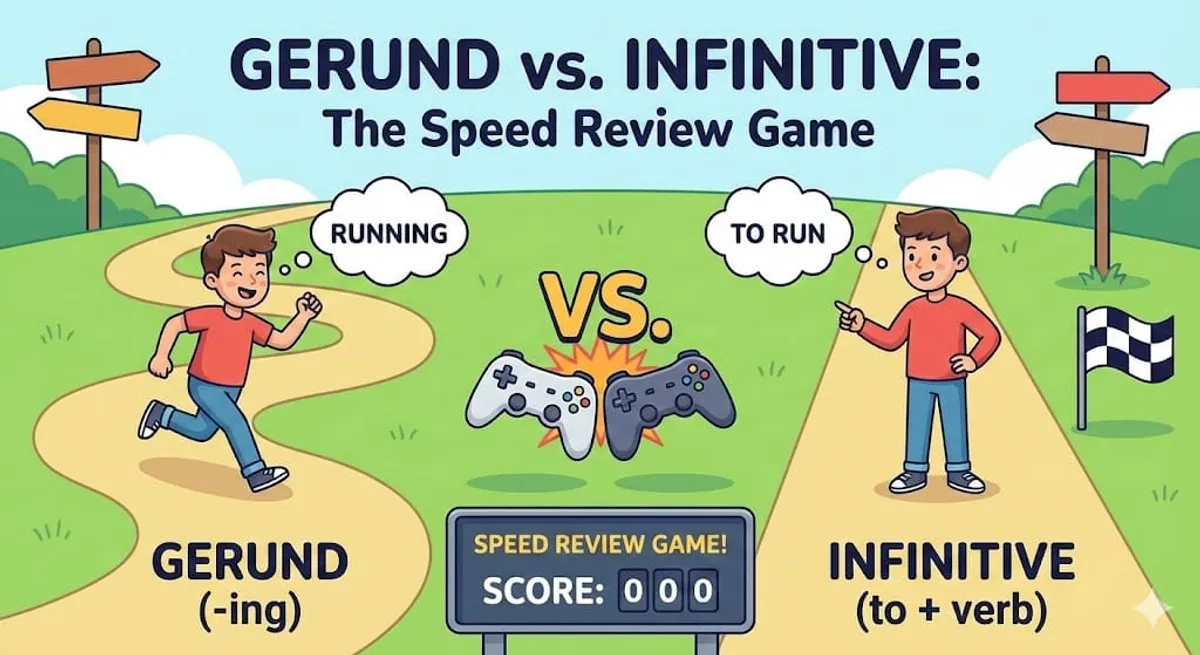
- Title: Gerund vs. Infinitive: The ChallengeQuestions:
- Category: Verb + GerundQuestion: I really enjoy ____ books on the weekend.Options:
- reading
- to read
- Either
Answer: readingExplanation: The verb **enjoy** is always followed by the gerund (-ing). - Category: Verb + InfinitiveQuestion: We decided ____ to Spain for our holiday.Options:
- going
- to go
- Either
Answer: to goExplanation: **Decide** points to a future intent, so it takes the infinitive (to + verb). - Category: Flexible VerbQuestion: It started ____, so we went inside.Options:
- raining
- to rain
- Either
Answer: EitherExplanation: **Start** is flexible. 'It started raining' and 'It started to rain' are both correct. - Category: Preposition + GerundQuestion: She is very good at ____ pictures.Options:
- painting
- to paint
- Either
Answer: paintingExplanation: After a preposition (like **at**), we always use the -ing form. - Category: Meaning ShifterQuestion: I stopped ____ junk food to get healthy.Options:
- eating
- to eat
- Either
Answer: eatingExplanation: **Stop + -ing** means you quit a habit completely. 'To eat' would mean you paused to eat. - Category: Flexible VerbQuestion: I love ____ to music while I work.Options:
- listening
- to listen
- Either
Answer: EitherExplanation: **Love** is a flexible verb. Both forms are acceptable with no major change in meaning. - Category: Verb + InfinitiveQuestion: They promised ____ me with my homework.Options:
- helping
- to help
- Either
Answer: to helpExplanation: **Promise** relates to a future action, so it is followed by the infinitive. - Category: Verb + GerundQuestion: Please avoid ____ loud noises in the library.Options:
- making
- to make
- Either
Answer: makingExplanation: **Avoid** is always followed by the gerund (-ing). - Category: Flexible VerbQuestion: They continued ____ despite the noise.Options:
- working
- to work
- Either
Answer: EitherExplanation: **Continue** is flexible. You can use either form. - Category: Meaning ShifterQuestion: We stopped ____ some coffee on our way home.Options:
- buying
- to buy
- Either
Answer: to buyExplanation: Here, **Stop + Infinitive** means you paused one action in order to do another. - Category: Verb + GerundQuestion: Have you finished ____ your room yet?Options:
- cleaning
- to clean
- Either
Answer: cleaningExplanation: **Finish** indicates completing an action, so it always takes the gerund. - Category: Adjective + InfinitiveQuestion: It is difficult ____ this math problem.Options:
- solving
- to solve
- Either
Answer: to solveExplanation: After adjectives (like **difficult**), we usually use the infinitive. - Category: Subject as GerundQuestion: ____ is a great way to stay fit.Options:
- Swimming
- To swim
- Either
Answer: SwimmingExplanation: When the verb is the subject of the sentence (the activity itself), we generally use the -ing form. - Category: Meaning ShifterQuestion: I remember ____ the lights before I left.Options:
- turning off
- to turn off
- Either
Answer: turning offExplanation: **Remember + -ing** refers to a memory of a past event. - Category: Meaning ShifterQuestion: Please remember ____ your homework.Options:
- doing
- to do
- Either
Answer: to doExplanation: **Remember + Infinitive** is a reminder to perform a future task. - Category: Verb + InfinitiveQuestion: I want ____ a new car next year.Options:
- buying
- to buy
- Either
Answer: to buyExplanation: **Want** expresses a desire for the future, so it takes the infinitive. - Category: Verb + GerundQuestion: Would you mind ____ the window?Options:
- opening
- to open
- Either
Answer: openingExplanation: **Mind** (in requests) requires the gerund form. - Category: Verb + InfinitiveQuestion: He plans ____ to college in the fall.Options:
- going
- to go
- Either
Answer: to goExplanation: **Plan** talks about the future, so it uses the infinitive. - Category: Verb + GerundQuestion: My brother keeps ____ my clothes!Options:
- taking
- to take
- Either
Answer: takingExplanation: **Keep** (meaning continue) is always followed by the -ing form. - Category: Meaning ShifterQuestion: I'll never forget ____ the ocean for the first time.Options:
- seeing
- to see
- Either
Answer: seeingExplanation: **Forget + -ing** is used for memories of the past. - Category: Meaning ShifterQuestion: Don't forget ____ your mother.Options:
- calling
- to call
- Either
Answer: to callExplanation: **Forget + Infinitive** is used for necessary tasks or duties you must not skip. - Category: Verb + InfinitiveQuestion: I hope ____ you again soon.Options:
- seeing
- to see
- Either
Answer: to seeExplanation: **Hope** is about the future, so it uses the infinitive. - Category: Preposition + GerundQuestion: He left the party without ____ goodbye.Options:
- saying
- to say
- Either
Answer: sayingExplanation: **Without** is a preposition, so the verb following it must be -ing. - Category: Flexible VerbQuestion: I prefer ____ tea over coffee.Options:
- drinking
- to drink
- Either
Answer: EitherExplanation: **Prefer** is flexible. You can prefer 'drinking' or prefer 'to drink'. - Category: Meaning ShifterQuestion: The soup has no flavor. Try ____ some salt.Options:
- adding
- to add
- Either
Answer: addingExplanation: **Try + -ing** means to experiment. 'To add' would mean making a difficult effort to put it in.
1. Verbs Followed by the Gerund (-ing)
We typically use the -ing form when the action is viewed as a general experience, a habit, or something that has already started/happened.
- Common verbs: Enjoy, dislike, finish, quit, mind, suggest, avoid, keep.
- The Pattern: Verb + -ing.
- I enjoy running. (The act of running in general)
- She finished writing the report. (The task was already in progress)
2. Verbs Followed by the Infinitive (to + verb)
The infinitive often points toward future events, intentions, or goals. It suggests an action that hasn't happened yet at the moment of the first verb.
- Common verbs: Plan, hope, want, decide, promise, agree, offer, refuse.
- The Pattern: Verb + to + base form.
- I plan to eat out tonight. (The eating hasn't happened yet)
- They decided to move. (A future intent)
3. The "Meaning Shifters"
Some verbs can take both forms, but the meaning changes significantly. This is where English gets a bit tricky.
| Verb | Followed by -ing (Past/Process) | Followed by Infinitive (Future/Intent) |
| Stop | I stopped smoking. (I quit the habit) | I stopped to smoke. (I paused my walk in order to smoke) |
| Remember | I remember locking the door. (I have a memory of doing it) | Remember to lock the door. (Don't forget to do it in the future) |
| Forget | I'll never forget meeting him. (A memory of a past event) | I forgot to meet him. (I didn't show up) |
| Try | Try adding salt. (Experiment to see if it works) | Try to reach the shelf. (Make an effort to do something difficult) |
4. Other Reliable Patterns
Beyond specific verbs, there are structural rules you can rely on:
- After Prepositions: Always use -ing.
- I’m good at cooking. / She left without saying goodbye.
- As the Subject: Use -ing when the verb is the "thing" you are talking about.
- Swimming is great exercise.
- After Adjectives: Usually use the infinitive.
- It is difficult to breathe. / I'm happy to help.
5. Verbs with No Change in Meaning
A few verbs are flexible and don't care which one you use. The meaning remains the same.
- Begin, start, continue, hate, love, prefer, like.
- "It started to rain" and "It started raining" are both perfectly correct.
Would you like me to create a short practice quiz or a list of the most common "tricky" verbs to help you internalize these?
Recommended for You
Verb 'To Be' (Present Simple)
A1 - Use the verb to be to describe people, things, and feelings.
Vocabulary Speed Run: History & Culture
Earn points for speed and accuracy.
The Narrative Tenses
Practice distinguishing between completed past actions, ongoing background activities, and events that happened before a specific time in the past.