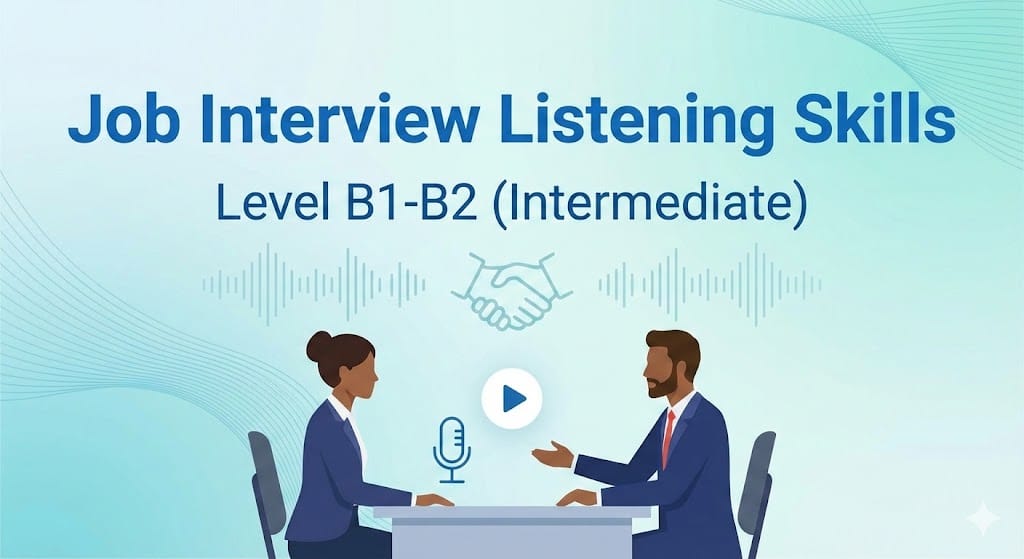
{
"title": "Standard Corporate Job Interview",
"lang": "en-US",
"intro": {
"text": "Listen to a candidate interviewing for a marketing position. Pay attention to how she discusses her past experience and achievements.",
"context": "You are sitting in an office observing a formal job interview."
},
"vocab": [
{
"word": "oversee",
"definition": "to supervise or manage a person, team, or task",
"example": "In my next role, I hope to oversee a larger team."
},
{
"word": "initiative",
"definition": "a new plan or process introduced to achieve a particular goal",
"example": "Our green initiative reduced office paper waste by half."
},
{
"word": "metrics",
"definition": "standards of measurement by which efficiency or performance is assessed",
"example": "We use detailed sales metrics to track our success."
},
{
"word": "collaborate",
"definition": "to work jointly with others on an activity or project",
"example": "I frequently collaborate with the design team on new campaigns."
},
{
"word": "transition",
"definition": "the process of changing from one state or condition to another",
"example": "The transition to a new software system was very smooth."
}
],
"listening": {
"transcript": "Interviewer: Good morning, Sarah. Thanks for coming in. Let's start with your current role. Can you tell me what you do?\nSarah: Good morning. Yes, currently I am a marketing coordinator. I oversee our email marketing campaigns and collaborate closely with the sales team to ensure our messaging aligns.\nInterviewer: Excellent. Can you describe a time you took the initiative on a project?\nSarah: Certainly. Last year, I noticed our open rates for emails were dropping. I proposed a new A/B testing initiative. We tested different subject lines and analyzed the metrics over three months.\nInterviewer: What were the results?\nSarah: We saw a twenty-five percent increase in engagement. It was a very successful transition to a more data-driven approach.\nInterviewer: That's impressive. How do you handle tight deadlines?\nSarah: I prioritize tasks based on their impact and communicate clearly with my team if we need to adjust expectations.",
"questions": [
{
"question": "What is Sarah's current job title?",
"options": [
"Marketing Manager",
"Marketing Coordinator",
"Sales Director",
"Data Analyst"
],
"correct": "Marketing Coordinator"
},
{
"question": "What specific task does Sarah oversee in her current role?",
"options": [
"Email marketing campaigns",
"Social media posts",
"Website redesign",
"Budget planning"
],
"correct": "Email marketing campaigns"
},
{
"question": "What initiative did Sarah propose to solve dropping open rates?",
"options": [
"Hiring more staff",
"Changing the software",
"A/B testing",
"Moving to print ads"
],
"correct": "A/B testing"
},
{
"question": "How much did engagement increase after her initiative?",
"options": [
"15%",
"20%",
"25%",
"30%"
],
"correct": "25%"
}
]
}
}
{
"title": "Creative Role Job Interview",
"lang": "en-US",
"intro": {
"text": "Listen to a conversation between a creative director and an applicant for a graphic design position. Notice how they discuss a portfolio and feedback.",
"context": "You are in a design studio listening to an interview for a creative role."
},
"vocab": [
{
"word": "portfolio",
"definition": "a collection of examples of a person's creative work",
"example": "Please bring a digital portfolio to the interview."
},
{
"word": "aesthetic",
"definition": "concerned with beauty or the appreciation of beauty; a specific style",
"example": "The brand has a very minimalist and modern aesthetic."
},
{
"word": "constructive",
"definition": "having a useful and beneficial purpose; intended to improve something",
"example": "I always welcome constructive feedback on my initial sketches."
},
{
"word": "turnaround",
"definition": "the amount of time taken to complete a process or fulfill a request",
"example": "We need a quick turnaround on this logo design."
},
{
"word": "versatile",
"definition": "able to adapt or be adapted to many different functions or activities",
"example": "He is a versatile designer who can do both web and print graphics."
}
],
"listening": {
"transcript": "Director: Hi David, it's great to meet you. I was looking through your portfolio and I really love your aesthetic.\nDavid: Thank you! I try to keep my designs clean and modern, but I'm quite versatile depending on the client's needs.\nDirector: We often have a very fast turnaround here. How do you manage your time when you have multiple tight deadlines?\nDavid: I use project management software to break down my tasks day by day. If things get overwhelming, I speak to the project manager immediately to see what can be shifted.\nDirector: That's a smart approach. In a creative team, you will receive a lot of critiques. How do you handle constructive feedback?\nDavid: I view feedback as a tool to make the final product better. I don't take it personally. Ultimately, the goal is to solve the client's problem, not to protect my ego.",
"questions": [
{
"question": "What did the director compliment David on?",
"options": [
"His resume format",
"His aesthetic",
"His interview suit",
"His punctuality"
],
"correct": "His aesthetic"
},
{
"question": "How does David primarily describe his design style?",
"options": [
"Complicated and busy",
"Traditional and classic",
"Clean and modern",
"Dark and moody"
],
"correct": "Clean and modern"
},
{
"question": "What does David use to manage his time and tasks?",
"options": [
"A handwritten journal",
"A daily alarm clock",
"Project management software",
"A physical calendar"
],
"correct": "Project management software"
},
{
"question": "How does David view constructive feedback?",
"options": [
"As a personal attack",
"As a tool to improve the product",
"As a waste of time",
"As something to ignore"
],
"correct": "As a tool to improve the product"
}
]
}
}
{
"title": "Technical Role Job Interview",
"lang": "en-US",
"intro": {
"text": "Listen to a technical interview for a software engineering position. Focus on the candidate's explanation of their problem-solving process.",
"context": "You are on a video call observing a technical interview for a tech company."
},
"vocab": [
{
"word": "debug",
"definition": "to identify and remove errors from computer hardware or software",
"example": "It took me three hours to debug the crashing application."
},
{
"word": "scalable",
"definition": "able to be changed in size or scale to handle growing amounts of work",
"example": "We need to build a scalable database for our growing user base."
},
{
"word": "bottleneck",
"definition": "a point of congestion or blockage in a system that slows down progress",
"example": "The old server was a major bottleneck for our website traffic."
},
{
"word": "agile",
"definition": "relating to a project management method that divides tasks into short phases",
"example": "Our development team prefers using an agile workflow."
},
{
"word": "deploy",
"definition": "to bring into effective action or make a program available for use",
"example": "We plan to deploy the new application on Friday night."
}
],
"listening": {
"transcript": "Interviewer: Hello Marcus. Let's dive right into your technical background. What is the most complex system you've helped build?\nMarcus: Hi there. At my last job, I was the lead engineer on building a scalable payment processing API. The old system was a major bottleneck during busy holiday seasons.\nInterviewer: How did you approach the problem?\nMarcus: First, we used an agile approach, breaking the project into two-week sprints. We spent the first sprint just trying to debug the existing architecture to see if we could salvage it. When we couldn't, we started fresh.\nInterviewer: What was the biggest challenge when you went to deploy the new system?\nMarcus: Migrating the legacy data without any downtime. We had to write a custom script to transfer the data in batches during off-peak hours.\nInterviewer: Excellent. And how do you stay updated with new programming languages?\nMarcus: I regularly attend local tech meetups and contribute to open-source projects on the weekends.",
"questions": [
{
"question": "What kind of system did Marcus help build at his last job?",
"options": [
"An inventory tracker",
"A scalable payment processing API",
"A social media platform",
"A mobile game application"
],
"correct": "A scalable payment processing API"
},
{
"question": "Why did the company need to replace the old system?",
"options": [
"It was too expensive to maintain",
"It was a bottleneck during holidays",
"It had been hacked repeatedly",
"It looked visually outdated"
],
"correct": "It was a bottleneck during holidays"
},
{
"question": "How long were the sprints in their agile approach?",
"options": [
"One week",
"Two weeks",
"One month",
"Six weeks"
],
"correct": "Two weeks"
},
{
"question": "What was the biggest challenge when deploying the new system?",
"options": [
"Training the staff",
"Migrating the legacy data",
"Finding a new server host",
"Writing the user documentation"
],
"correct": "Migrating the legacy data"
}
]
}
}